Political Leaders Engage in Heated Rhetoric Ahead of Parliamentary Elections, Focusing on 'New vs. Old' Narrative


The House of Representatives election scheduled for February 21 is fast approaching. All major political parties and candidates, both new and old, have intensified their campaigning to secure victory in this election, which is taking place under special circumstances.
In this election, while seeking votes from the public, leaders of the major political parties are largely focusing on creating a narrative of 'new versus old' rather than concentrating on the nation's core national issues, leading to a race to attract and divide voters.
When addressing the public, leaders from the Nepali Congress, CPN-UML, and the Communist Party are labeling the newly emerged Rastriya Swatantra Party (RSP) and its leaders as 'populist and gimmicky,' while RSP leaders are calling the old guard corrupt and incompetent, claiming, 'They ruined the country; only we can fix it.'
In election speeches across various parts of the country, this narrative creation by leaders has resulted in mutual taunts and jibes. In the last week, senior RSP leader and candidate for Jhapa-5, Balendra Shah (Balen), RSP Chairman Rabi Lamichhane, and Nepali Congress President Gagan Thapa have been prominently involved in these exchanges.
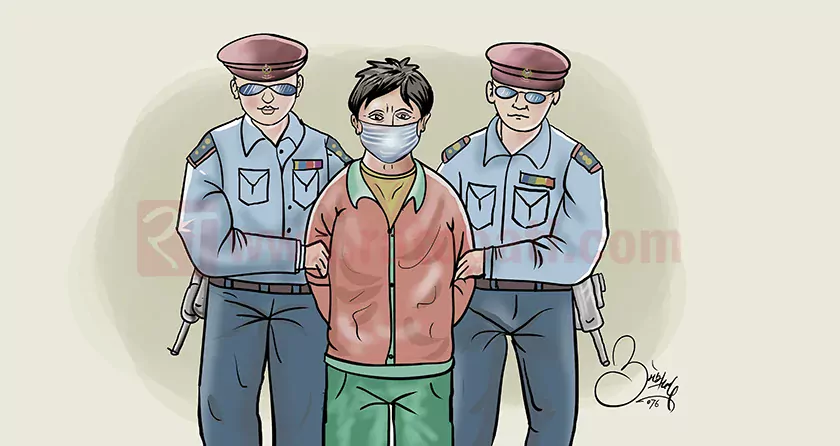
Addressing an RSP rally in Dhangadhi on February 7, senior leader Balendra Shah urged voters to support them for faster development, alleging that governments led by old parties cause delays in development projects. He expressed an intent that his leadership's government would ensure rapid development, even if it meant tying up or jailing those who fail to work.
While construction entrepreneurs have publicly objected to the statement made by Balen, who is being projected as the future Prime Minister by the RSP, Congress President Gagan Thapa has been continuously responding to Balen. Thapa reminded everyone that tying up or imprisoning people to speed up work is not the right path and stressed the necessity of amending laws.
Addressing a Congress election rally in Rupandehi just last Friday, President Thapa warned that falling for the slogans of the 'new' could lead to a repeat of the consequences seen in 2064 BS (2007 AD). Thapa commented that although the then-Maoists became the largest party in parliament based solely on the slogan of a 'New Nepal,' the country's five years were wasted, and he compared the current RSP to the Maoists of that time.
'It is happening again this time. There is a slogan of old versus new. The old ones ruined it, and we will fix it,' Thapa said, targeting Balen's statement. 'If the road is not built, they say they will finish it on time, whether by beating people with stones or tying them up.'
Thapa also asserted that work cannot be done just by beating people with stones without identifying the problem. 'If a plane doesn't land in Bhairahawa, beating people with stones won't help; the reason for the non-landing must be investigated, and the problem must be resolved,' Thapa stated. 'To accelerate the pace of physical infrastructure development, 41 laws need amendment. Someone says, 'I will get the work done on time, even if it means jailing the contractor.' Work is not being held up because of individuals. Development cannot gain momentum without systemic reform.'
Thapa had previously countered Balen's statement. Following Thapa's rebuttal, RSP Chairman Rabi Lamichhane defended Balen and took a swipe at Thapa.
Addressing RSP workers in Itahari, Sunsari, on February 12, Lamichhane claimed that an era of development and construction has begun in the country, sarcastically remarking that someone who has been a Member of Parliament for 20 years has only now realized the need to amend laws.
'After being an MP and minister for 20-20 years, you finally realize that 12-15 laws need to be changed to build roads? You finally gained knowledge? Keep your knowledge to yourself,' Lamichhane remarked.
Lamichhane downplayed the objections raised by construction entrepreneurs, saying, 'Construction entrepreneurs need not worry. The country is now moving forward on the path of development and construction. When we say tying up, we mean tying up by law, not with a rope. If work is done according to the law, no one will do anything.'
It is not just Rabi, Balen, and Gagan; the UML has also been less visible in such taunts and counter-allegations on the eve of the election. UML Chairman KP Sharma Oli has been stating that the February 21 election is a great struggle between those who want to burn the country and those who want to build it. Whether in rallies and conferences or during door-to-door campaigning, Oli frequently says, 'This time, it is an election between those who burn and those who build. It is an election between those who build and save the country versus those who burn it. You should not vote for those who burn, those who ruin.'
Listening to the statements of responsible leaders, it is clearly evident that the language of 'retaliation' and its reflection are dominating the Nepali political sphere more than agendas and development issues. It can be understood that this competition between the old parties that have dominated power politics for decades and the parties claiming to be new alternative forces is taking place merely for 'a fight for existence' rather than healthy political debate.
While such taunts and jibes can be taken lightly until the election, there is growing serious concern and interest as to whether the future of Nepal and Nepalis will be pushed further into darkness if this series of political retaliation does not stop even after the election.
This specific news has been automatically translated by AI. As a result, there may be some inaccuracies or language errors.