
Mithila Region Buzzes with Holi Songs Amidst Election Campaigning

Jaleshwor.
Long live, long live... Long live the party, ... Long live the symbol.
Long live, long live... Long live the party, ... Long live the symbol.
Not for caste, not for lineage, vote for the ... symbol,
... Long live brother, ... Long live brother,
Long live, long live... Long live the symbol.
'Jogira Sararar, Sararar, Sararar. Jogira Sararar.'
'Ram plays Holi in Mithila, in Mithila. In Mithila, oh, in Mithila. Ram plays Holi in Mithila.' 'Who suits the yellow silk garment, who suits the yellow silk garment, whose hands hold the colored powder pouch. Ram plays Holi in Mithila, in Mithila.'
'Jogira Sararar, Sararar, Sararar. Jogira Sararar.' 'Color showers, your scarf gets wet with color, oh color showers, your scarf gets wet with color.'
'Sita's hair is long, Ram will bring a golden pitcher. Oh, Sita's hair is long, Ram will bring a golden pitcher.'
Sita's hair is long, Sita oh, oh, oh. Sita's hair is long, oh, oh, oh Sita's hair is long. Ram will bring a golden pitcher.'
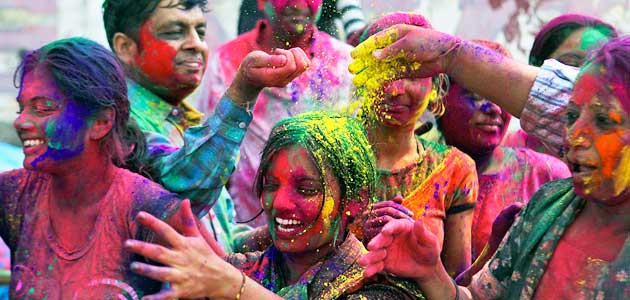
With the House of Representatives election 2082 approaching and only about a week left for the festival of colors and 'abir' (colored powder) Holi, every village and city in Mithila is echoing with election campaign songs, candidate promotions, symbol promotions on one side, and Holi songs (Jogira) on the other.
While there is election noise with leaders, cadres, horns, and microphones in every village and settlement, in the Mithila region, which spans across the Terai-Madhesh of Nepal and much of the Indian state of Bihar, as soon as evening falls, the sound of 'damphu', 'jhyali', 'dhol', and 'mridanga' begins to resonate in every village, and the tunes of Jogira are heard everywhere.
Individuals of various ages are engaged in the election campaign, touring villages. Among them, 65-year-old Bipendra Pandey, a resident of Bajrahi, Ward No. 8 of Jaleshwor Municipality, heads to the Milan Chowk (meeting square) at the village crossroads every evening after sunset, holding a 'damphu' from his home.
Similarly, 57-year-old Ramdev Mahara from the north side of the village arrives at the same square with a harmonium as soon as the sun sets. Upon hearing the news of the arrival of these two, 46-year-old Mohan Sah from the western part of the village arrives at Milan Chowk playing 'jhyali' with both hands, while 72-year-old Gauri Chaudhary from the eastern part of the village arrives playing the 'dhol'.
Apart from these individuals who arrive at Milan Chowk with various musical instruments, many others, including local folk singers Arun Pandey, Dhirendra Chaudhary, Ashanarayan Mandal, also gather at the village's meeting square as soon as the evening lamp is lit. The residents of Bajrahi village do not gather at the central square for any assembly, conference, meeting, debate, or discussion. Instead, they gather daily to foster brotherhood, love, harmony, share joys and sorrows, and for the preservation and promotion of Jogira.
In Bajrahi village, the captivating sound of Jogira can be heard as soon as it strikes seven in the evening. Hearing the 'Holaiyas' (those who sing Jogira) singing Jogira in unison and rhythm brings joy and happiness to everyone sitting in their courtyards in every lane of Bajrahi village.
The Jogira session, started by the Holaiyas carrying instruments like 'dhol', 'tasa', 'mridanga', 'damphu', 'jhyali', creating various tunes and music, continues until 11 or 12 at night. A crowd gathers to listen to and watch the Jogira, which is sung by setting various types of songs, jokes, witty remarks, and playful, bittersweet words to rhythm, and a large number of people participate in the singing and dancing during the Jogira, said Holaiya Arun Pandey.
The Jogira team from Bajrahi village, Ward No. 8 of Jaleshwor Municipality, is quite famous, and according to local Muslim leader Sakur Rain, the inclusion of both Hindu and Muslim communities in this Jogira team makes it even more wonderful.
The tradition of Muslims not participating in Hindu festivals and Hindus not showing interest in Muslim festivals is not seen in Bajrahi village, Ward No. 8 of Jaleshwor Municipality, the district headquarters of Mahottari. Local Nepali Congress youth leader Anil Pathak stated that leaders and intellectuals from both communities here have moved forward by breaking this social division. He mentioned that for years, Muslims here have been celebrating Hindu festivals together with Hindus, and vice versa.
While Jogira is creating a fervor in Bajrahi village, Ward No. 8 of Jaleshwor Municipality, Jogira also creates a buzz every year in Ankar village, Ward No. 7 of Jaleshwor Municipality. Local residents, including public representatives, participate enthusiastically in this.
Since the Ward Chairman of that ward, Ramchhabila Yadav, is himself a Holaiya, young people have returned from home and abroad to sing Jogira on the occasion of Holi in that ward, and the tune of Jogira has kept the villagers awake all night, said local youth leader Sushilkumar Sharma.
Inviting the festival of Holi, which brings happiness and excitement to the entire Mithila region and the whole country, separate teams of youth, adults, and the elderly have been singing Jogira for the past two or three days in Ward No. 7, making the entire ward musical. According to local Shivchandra Kaper, in this ward, women, men, children, and the elderly wait at home for evening to fall and for the Holaiyas to start singing Jogira, and as soon as Jogira begins, everyone comes out of their homes and goes to the square to listen to the Holi songs.
The beloved Jogira of all residents of Mithila is not limited to Jaleshwor Municipality. Local journalist Navin Priyadarshi reported that it is also sung with great fanfare in Banauli village, Ward No. 7 of Pipara Rural Municipality in the district.
In that village, which is also the birthplace of the poet Kokil Vidyapati, it has been reported by local Sunil Thakur that for the past few days, the evenings have resembled a fair due to the crowd of Holaiyas. Just like in Bajrahi of Jaleshwor Municipality, Ankar, and Banauli of Pipara, Bathnaha village of Manraishiswa Municipality-9 in Mahottari district is also colored by the tunes of Jogira.
Locals from various municipalities in Mahottari district have reported that in every village and lane of the 10 municipalities and five rural municipalities of Mahottari district, Jogira singing has started every night since Falgun 7 or 8, accompanied by musical instruments like 'dhol', 'tasa', 'mridanga', 'damphu', and 'jhyali'.
'Falgun has arrived, Holi has brought it'
'My colorful water gun, fill it up'
'Holi has come, fun has spread'
'My colorful water gun, fill it up'
'Jogira Sararar, Jogira Sararar....... '
'How many hands wore dhotis, how many hands wrapped them'
'How many rivers' water did they drink, how many fathers' sons are they'
'Jogira Sararar, Jogira Sararar....... '
Sudish Sah of Jaleshwor Municipality-2 stated that in anticipation of the great festival of Holi, which makes one forget sorrows and share happiness through hundreds of songs, jokes, witty remarks, and teasing like the ones mentioned above, Jogira has already started in all of Mithilanchal, including Mahottari, Dhanusha, Siraha, Saptari, Sarlahi, Rautahat, Bara, and the Indian districts of Madhubani and Darbhanga. He added that because Jogira fosters brotherhood, love, harmony, and sweet relationships among people, they gather in large numbers at village crossroads every night to sing Jogira.
Jogira singing, which usually starts about 15 days before Holi, has begun in every village of Mithilanchal for the last three or four days, and this Jogira singing continues until the night before Holi. Arun Singh, a 77-year-old Holaiya from Manraishiswa Municipality-4, expressed concern that recently, the tradition of Jogira is being disrupted by the loud noise of vulgar Bhojpuri songs, DJ music, and the commotion caused by those consuming alcohol.
Holaiya Vashishtha Mishra from Matihani Municipality-8 stated that local representatives and the administration need to pay special attention to the preservation, promotion, and safeguarding of Jogira. He opined that Jogira is a heritage and asset of the entire country, including Mithilanchal, and must be protected.
Similarly, cultural expert Dhruv Ray from Jaleshwor-5 stated that Holi songs are not merely a means of entertainment or songs but are our tradition and the heritage of our ancestors, and it is the shared responsibility of all of us to preserve, promote, and safeguard this tradition and heritage. He advised everyone to work towards its preservation, promotion, and safeguarding.
Meanwhile, ordinary Jogira lovers say that the election campaign has affected this year's Jogira singing. Arun Pandey of Jaleshwor-8 stated that because it is election time, and specifically during the campaigning period, candidates and their leaders/cadres interrupt the Jogira singing to ask for votes or take those sitting in the Jogira session away for campaigning, which is affecting this year's Jogira singing.
This specific news has been automatically translated by AI. As a result, there may be some inaccuracies or language errors.

.jpg_IDe7jFYWSC.jpg)