Gen Z Leader Warns Against Concealing Report on Recent Unrest, Citing History of Impunity


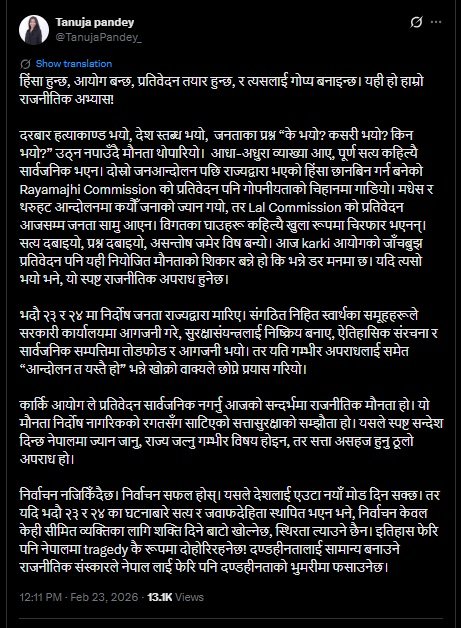
Kathmandu. Tanuja Pandey, a leader of the Gen Z movement, has stated that the decision not to publicize the report of the Karki Commission, formed to investigate the incidents of Bhadra 23 and 24, amounts to a deliberate political silence and a grave offense. In a post on her social media platform Facebook, she expressed outrage, alleging that the state is conspiring, as it has in past incidents, to bury the truth and promote impunity.
Pandey noted that in Nepal, it is a long-standing political practice for violence to occur, commissions to be formed, and reports to be kept confidential. She recalled that following the Royal Palace massacre, when the nation was stunned, silence was imposed before the public could raise questions, and the full truth was never revealed.
Similarly, she clarified that the reports of the Rayamajhi Commission following the second People's Movement and the Lal Commission investigating the Madhes and Tharuhat movements have also not been made public to this day. She claimed that because past wounds are not openly examined and questions are suppressed, dissatisfaction has accumulated in society and turned into poison.
She expressed fear that the report of the Karki Commission regarding the events of Bhadra 23 and 24 might also fall victim to the same deliberate silence as in the past. She mentioned that during those incidents, innocent citizens were killed by the state, organized vested interest groups set government offices on fire, security mechanisms were neutralized, and historical structures and public property were vandalized. She strongly objected to the attempt to cover up such serious crimes with the hollow phrase, 'Protests are like this.'
Pandey concluded that withholding the Karki Commission report is not just political silence in the current context, but an agreement for securing power, bought with the blood of innocent citizens. She wrote that this attitude of the state sends a dangerous message that the loss of human life and the burning of state property are not serious matters in Nepal, but only an inconvenient political situation is a major crime.
Although the upcoming elections could give the country a new direction, she warned that if truth and accountability are not established regarding the incidents of Bhadra 23 and 24, it will not bring stability to the country. She argued that elections without accountability will only open the path for a limited number of individuals to gain power.
She concluded that this political culture of normalizing impunity will cause history to repeat itself tragically in Nepal, and the country will once again fall into a vortex of lawlessness.
This specific news has been automatically translated by AI. As a result, there may be some inaccuracies or language errors.

_ffWTZYPQRm.jpg)
_UIDnxrYIZi.jpg)