Rastriya Swatantra Party Faces Setbacks in Madhesh as Election Day Nears Amidst Organizational Weakness


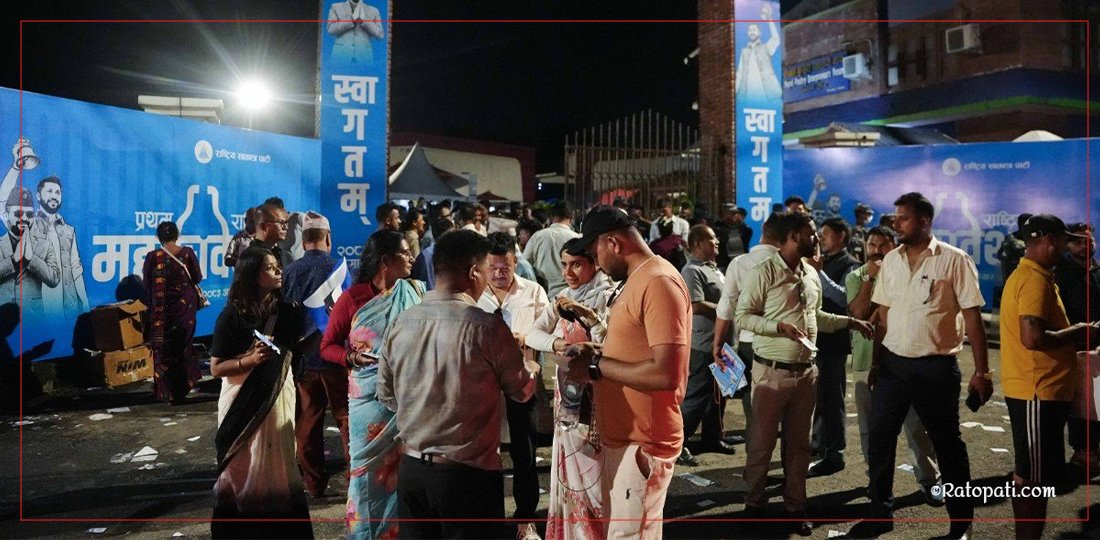
Kathmandu. The House of Representatives election is taking place on Falgun 21. This time, an unusual wave for the Rastriya Swatantra Party (RSP), which emerged during the 2079 elections, is being observed, particularly in the Madhesh Province.
However, as the election approaches, the party is suffering losses. That is, leaders in the establishment are leaving the party one after another. There is talk that the initial public fervor seen in the Terai-Madhesh region is beginning to wane.
The organizational structure of the RSP in the Terai-Madhesh is extremely weak compared to other regions. In many places, even the lower-level committees have not been formed.
According to lawyer Birendra Yadav of Birgunj, there is a growing realization of a lack of leaders and managers who can sustain the public's trust in the RSP until Falgun 21. He says, 'Although there is currently a public inclination in favor of the RSP, there is a lack of effective managerial leadership to maintain that until the voting day.'

In the Terai-Madhesh, parties like the Nepali Congress, UML, CPN, and Janata Samajbadi Party Nepal have strong organizations down to the ward level and possess experienced leaders capable of managing every aspect. However, the organizational base of the RSP is weak. Most of the leaders and cadres currently associated with the RSP have also come from other political parties.
Senior journalist Chandradev Kamati of Siraha states that the youth following the RSP candidates have come from some other party. Kamati says, 'The biggest challenge for the RSP is whether they will remain with the RSP tomorrow or not.'
In the Madhesh Province, the UML was previously the strongest party, followed by the Nepali Congress and the Maoist Centre. Currently, the UML's influence is decreasing, while the Congress's influence seems to be increasing to some extent. The status of the CPN and Madhesi parties is uncertain. Nevertheless, these parties possess strong organizational power and strategies to attract voters.
Congress's Activism and Growing Aversion Towards RSP
According to Kamati, the main reason for the initial decline in attraction towards the RSP is the activism of the Nepali Congress. 'The Congress has become very active in the Terai-Madhesh recently. There is a wave of people leaving various parties and joining the Congress, which has affected the public fervor for the RSP,' he says.
The UML and Maoist Centre are yet to become fully active. Kamati believes that the UML's activity will increase from Falgun 15, and thereafter, the RSP's public wave will decrease further. Lawyer Yadav also stated that the atmosphere initially surrounding the RSP is no longer visible. The trend of people leaving the RSP has also increased recently. He analyzes that the public fervor is declining because many people in Parsa and Bara have left the RSP for other parties.

According to Yadav, although there are many voters for the RSP, there is a shortage of manpower to organize them. If these voters cannot be retained until election day, the RSP appears to be in trouble. Although the RSP is a new party, most of its positions are occupied by old leaders and cadres.
Dissatisfaction in Ticket Distribution
A major reason for dissatisfaction in the Terai-Madhesh is the discontent over ticket distribution. Leaders and cadres who joined the RSP from the beginning did not receive tickets, but those who came from other parties received them easily. Due to this dissatisfaction, some have left the party. The question being raised in Madhesh is, 'The party is new, but the candidates are the same old ones; what is the difference between a new and an old party?'
However, Dr. Rajiv Jha, a former candidate for the Rastriya Mukti Party from Dhanusha-3 and now joined the RSP, claims that the RSP is expanding its organization at a rapid pace. He stated that ward committees, booth committees, and youth committees have been formed in all wards of Janakpur Sub-Metropolitan City. He said, 'There is a wave of people joining the RSP; we ourselves cannot keep up.' He mentioned that the goal is to formally integrate all cadres and leaders organizationally by Falgun 21.
The Madhesh Province has 32 constituencies. Most candidates who received tickets came from older parties, some having just left their previous parties. But those who have been with the RSP since its inception, being disgruntled over not getting tickets, have moved to the Congress or other parties, which has negatively impacted the RSP.

RSP leader Purushottam Yadav, however, claims that attraction towards the party is increasing not only in Madhesh but across the country. He stated that major leaders from the Congress, UML, Maoist Centre, and JSP Nepal are ready to join the RSP, but they have been unable to give them time due to busyness. He asserted that the departure of a few individuals would have no effect and claimed to win all 32 seats in Madhesh Province.
In the 2079 elections, the RSP received only 107,084 votes under the proportional representation system and 32,537 votes under the first-past-the-post system in Madhesh Province. There are a total of 3,386,628 voters in Madhesh Province. According to journalist Kamati, the RSP is more likely to receive votes under proportional representation than in direct elections because major parties dominate the direct contests. He understands that while the public wave is advantageous for proportional representation, organizational votes tend to stay within the organization.
The RSP's organization and votes so far are centered around urban areas, and it appears weakest in Madhesh. This is also analyzed as the strategic reason why RSP Chairman Rabi Lamichhane fielded Balen Shah.
Dissatisfied Voters
Recently, news of RSP cadres burning the UML flag has also had a negative impact. According to journalist Sneha Jha of Janakpur, voters are becoming annoyed because RSP leaders and cadres exhibit behavior suggesting they do not accept others and act as if they are the only ones who matter.
'Activities such as tearing flags somewhere, burning them, vandalizing party offices, or setting fires have discouraged voters rather than encouraged them,' she stated.
This specific news has been automatically translated by AI. As a result, there may be some inaccuracies or language errors.
_Yq85YOxh21.jpg)