Collapse of Alternative Political Alliance: Ideological Rift Dooms Unity Between Rastriya Swatantra Party, Balen Shah, and Kulman Ghising
For the past three decades, the Nepali political landscape has been dominated by established parties such as the Nepali Congress, CPN (UML), and the former Maoist Centre. These forces, which emerged from the 2047 People's Movement, the 2052 armed conflict, and the 2062/063 movement, have institutionalized a protectionist system, syndicate politics, and party-centric governance as integral parts of the state. However, as the elections in Phagun approach, a new turn is emerging in Nepali politics.
This time, alternative forces primarily represented by Rabi Lamichhane, Balen Shah, and Kulman Ghising have surfaced. The immense trust youth place in Balen Shah, Kulman Ghising's exceptional managerial capability, and Rabi's agenda for good governance could have converged to create a golden opportunity for alternative politics. The present article will focus on why the potential, necessity, and unity efforts of these rising forces ultimately failed.
Nepal's current alternative political scenario is not limited to a single ideology. Three distinct and different streams have become prominent within it.
Established just before the 2079 elections, the Rastriya Swatantra Party (RSP) has emerged as the most organized challenge to the traditional parties. The main basis for its birth is the public anger stemming from the misgovernance and chaos perpetuated by the old guard. RSP positions itself as a centrist party on a 'journey towards pluralism, contemporary socialism, and liberalism.' It prioritizes agendas for radical restructuring of the state, such as a directly elected Prime Minister, modification of the federal structure, and making parliamentary hearings effective by abolishing the Constitutional Council.
Meanwhile, Balen Shah's politics, which gained national stature from his tenure as Mayor of Kathmandu, is based on 'performance-based populism.' His term centered on his achievements, cutting through the sluggishness of the bureaucracy. His efforts to enforce 'urban discipline' and demolish illegal structures built on government land generated hope among the elite as 'courageous steps.' His strategic decision to join RSP and resign from the mayorship laid the groundwork for extending the Kathmandu model to the federal level, leading to him being viewed as RSP's future prime ministerial candidate.
On the other hand, Kulman Ghising's political capital is based on the glorious legacy of ending the 18-hour daily load shedding at the Nepal Electricity Authority. Ghising, considered a 'development hero,' is a technical personality who advanced his political journey through the Ujyalo Party. However, his party appears caught in a strategic trap due to the complexities of identity issues and values/beliefs.
Consequently, this party proved somewhat weak at the political negotiation table and missed significant opportunities due to a lack of timely and adequate ideological debate. Specifically, he considers voters from indigenous communities in the Kathmandu Valley and the hilly districts as his main base.
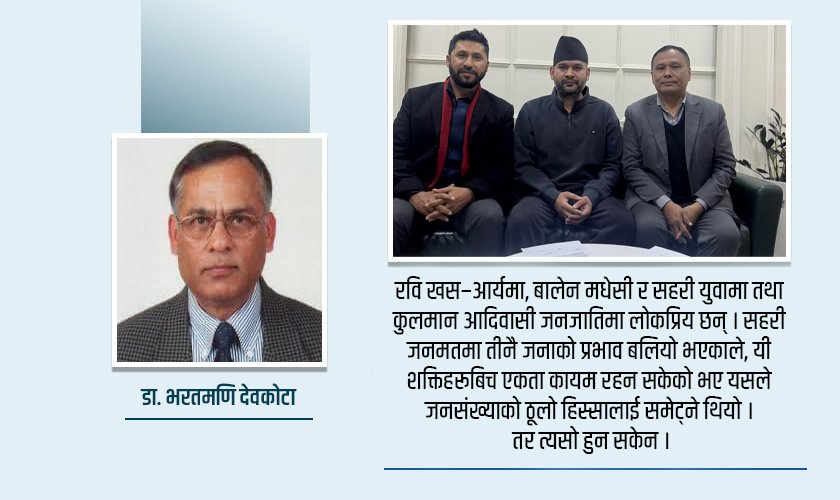
The demographic reach of these three leaders is interesting. Rabi is popular among Khas-Arya, Balen among Madhesis and urban youth, and Kulman among indigenous communities. Since all three have strong influence over the urban electorate, their unity could have encompassed a large segment of the population. But this did not happen.
Recently, intense diplomatic efforts were made to bring these three forces onto a single electoral front. The main objective behind this was to consolidate anti-establishment votes in one place.
Following long and intensive negotiations, a historic unity agreement was reached. This agreement put Rabi Lamichhane as the chairman, Balen Shah as the prime ministerial candidate, and Kulman Ghising as the senior vice-president and head of development policy. Initial projections estimated that this super-alliance would dominate urban centers and pose a tough challenge to Congress-UML even in rural areas.
But, ironically, this unity lasted only 12 days. This split was not solely due to leadership ego; deeper structural inconsistencies were responsible. Ghising upheld identity and community socialism, whereas RSP advocated for meritocracy to attract the urban middle class. An ideological alignment between these two streams could not be achieved.
Disputes arising over the size of the central committee, the general secretary post, and the seniority in the proportional representation list ultimately led the unity towards dissolution. Viewing this agreement more as a technical management exercise than an opportunity for national interest was a sign of political immaturity on both sides.
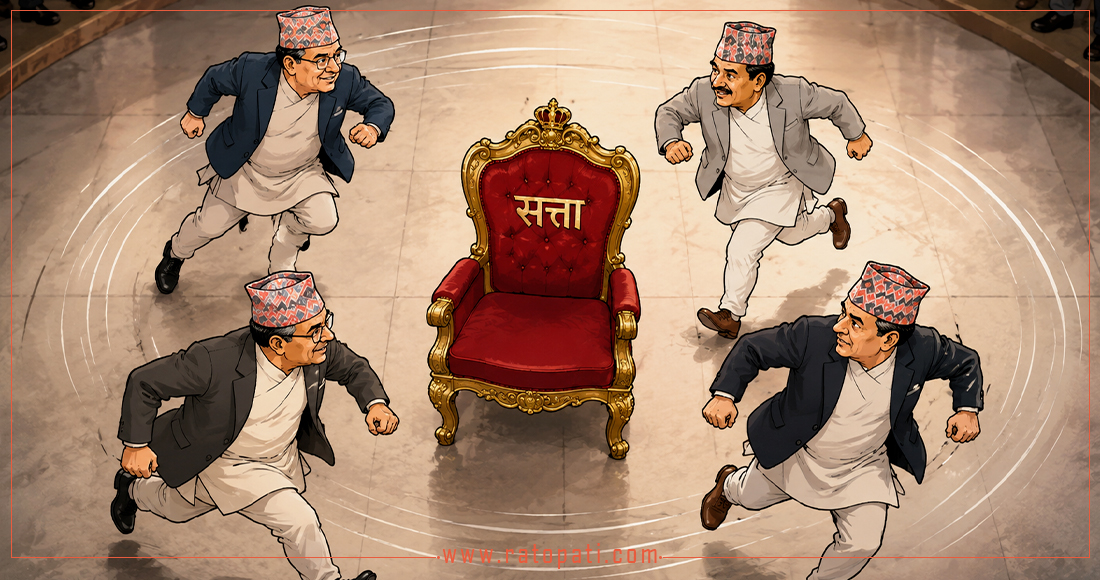
After the alliance dissolved, the election on Phagun 21 is no longer just old versus new; it has transformed into a multipolar confrontation. With alternative votes split between RSP and Ujyalo Party, the direct benefit is certain to go to Congress or UML. These two forces are now direct competitors in the main urban areas. Had the unity remained intact, it could have paved the way for constitutional amendment and laid the foundation for a new Nepal.
The general election in Phagun is a severe test for Nepal's federal democratic republic. The rise of RSP, Balen Shah, and Kulman Ghising has sent a clear message that voters are no longer satisfied merely with identity and dignity politics. They are seeking performance and concrete results.
However, the failure of these alternative forces to unite has exposed their political immaturity. This division has possibly saved the old parties from immediate total collapse for the time being. Balen's influence and Kulman's 'Ujyalo' (light) remain symbols of hope for millions of Nepalis, but without structural unity and mature political planning, it seems difficult to convert this into a mandate to govern.
Their mutual conflict has ultimately increased the danger of reviving the very syndicate politics they rose to overthrow. Thus, the dream of stability and majority created by the rise of the trio has once again shrunk into mere mathematical games. This could prove to be a sad chapter in Nepal's history.
This specific news has been automatically translated by AI. As a result, there may be some inaccuracies or language errors.