Intense Electoral Battle Heats Up in Doti as New Faces Challenge Established Parties


Dhangadhi. The fervor for the upcoming House of Representatives election on Falgun 21 in the hilly district of Sudurpashchim, Doti, has sharply increased. In this district, which has only one constituency for the House of Representatives, candidates from nine political parties are currently in the electoral arena.
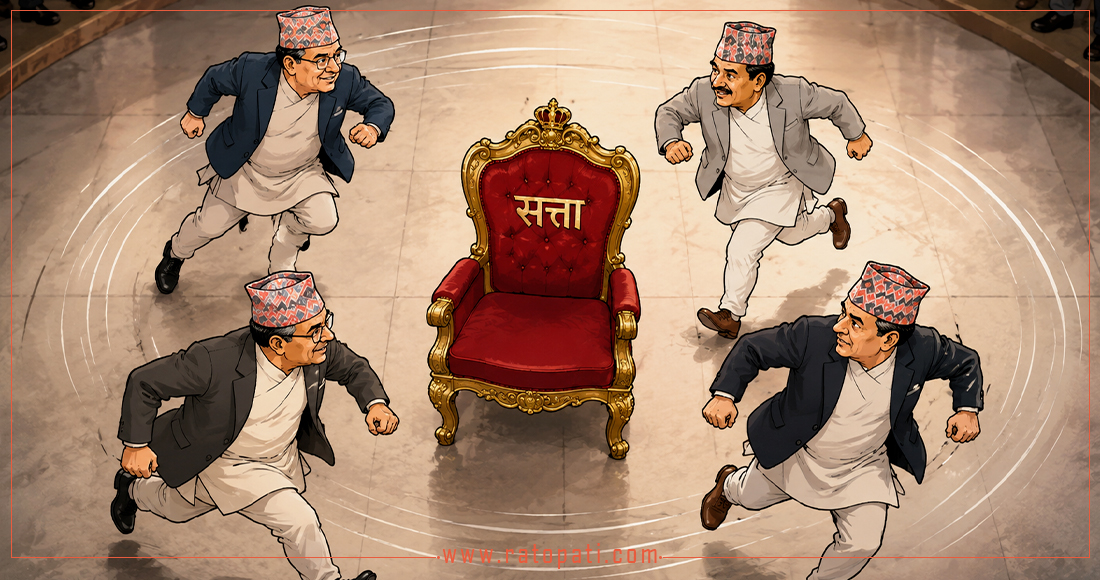
Doti, which usually garners attention due to the clash of well-known leaders, has become a subject of interest this time due to the departure of old faces and the arrival of new, young candidates.
With the major parties contesting independently and new parties presenting themselves aggressively, it is difficult to predict whose lap the result in Doti will fall into. Especially, the arithmetic of the past proportional representation votes and the changed political equation present an equal challenge to the candidates of all parties here.
In Doti, which is always caught in the tug-of-war of alliances, the Nepali Congress is contesting the election alone this time. The Congress has put forward Bharat Bahadur Khadka as its candidate. Having supported CPN (Unified Socialist)'s Prem Ale in the previous election when there was an alliance, Congress has adopted a strategy to win the election based on the strength of its own organization this time.
Khadka, who was elected as a proportional member of parliament in 2070 BS and a Provincial Assembly member (1) in 2074 BS, was recently elected as a central member in the special general convention of the Congress. Khadka, trusted by the party's new leadership and given the ticket, is currently busy with door-to-door campaigning. However, his solo journey without an alliance is not easy for him.
CPN (UML), on the other hand, has fielded a young leader in Doti for this election.
The electoral atmosphere in Doti has heated up after the party nominated Deepak Dhami, the central chairman of the ANASSU, the student wing close to UML, as the candidate. Dhami, who strongly advocated for the 32-year age limit debate, is being discussed in the district as the youngest and most energetic candidate compared to others.
Doti's upcoming result appears to be largely guided by the proportional representation vote count from 2079 BS. Analyzing the statistics from the last election, the vote difference between Congress and CPN (UML) here appears very narrow. In 2079, Congress received 22,516 votes in proportional representation, while UML followed closely with 22,456 votes. A difference of only 60 votes between these two major parties signals a tough competition this time.
Dhami, who received the parliamentary election ticket just two months after becoming the chairman of ANASSU, describes himself as a representative of the youth and a center of trust for the elders. Dhami stated that his priority is to end Doti's plight of unpaved roads, lack of quality education, and the necessity of being carried on stretchers for medical treatment.
“I will spend my age, time, and skills to change the lives of the people of Doti,” he said.
Dhami, who started his student politics from Shikhar Municipality in the district and established himself at the center, has returned to the district after two decades.
The entry of former Chief Minister of Sudurpashchim, Trilochana Bhatta, from the Communist Party of Nepal (CPN) into the electoral arena has made the competition more interesting. Bhatta, who won the Provincial Assembly seat in 2074 BS from the UML-Maoist alliance and served as Chief Minister for 5 years, is currently seeking votes from the electorate by recounting the achievements of his tenure.
However, he faces accusations in the district regarding the decision to name Godawari as the provincial capital while he was the Chief Minister.
Similarly, Narendra Bahadur Khadka of the Rastriya Swatantra Party (RSP) has also emerged as a strong competitor. Khadka, a former president of the Doti Chamber of Commerce and Industry, secured the third position in the 2079 election as an independent candidate, garnering 6,689 votes. Although Keshav Balayar, who contested with the 'Ghanti' (Bell) symbol last time, only received 774 votes, it is analyzed that the result could be overturned this time as Narendra's personal votes mix with the growing craze for RSP.
Prem Ale, who defeated UML's Gauri Oli by securing 27,210 votes in the previous election, is contesting from outside the district (Kailali-5) this time. Oli had received 23,004 votes then. Congress leader Bir Bahadur Balayar is also not in the race. In the space created by the absence of these leaders, the battle is whether Congress will retain its legacy or UML will reclaim its lost prestige.
Doti's upcoming result appears to be largely guided by the proportional representation vote count from 2079 BS. Analyzing the statistics from the last election, the vote difference between Congress and CPN (UML) here appears very narrow. In 2079, Congress received 22,516 votes in proportional representation, while UML followed closely with 22,456 votes. A difference of only 60 votes between these two major parties signals a tough competition this time.
In that election, CPN (Maoist Centre) received 6,924 votes and Unified Socialist received 2,373 votes in proportional representation. Now that Trilochana Bhatta, who came from a Maoist background, is the candidate (CPN), it is a matter of curiosity where those votes will lean. If Bhatta can attract those leftist votes, it could be a setback for both Congress and UML.
On the other hand, although the Rastriya Swatantra Party received only 1,248 votes in proportional representation, independent candidate Narendra Khadka secured over 6,000 votes. Now that the party and the candidate stand together, it is estimated that RSP's votes will increase significantly. RPP received 910 votes last time, and Rastriya Janamorcha received 569 votes.
Prem Ale, who defeated UML's Gauri Oli by securing 27,210 votes in the previous election, is contesting from outside the district (Kailali-5) this time. Oli had received 23,004 votes then. Congress leader Bir Bahadur Balayar is also not in the race. In the space created by the absence of these leaders, the battle is whether Congress will retain its legacy or UML will reclaim its lost prestige.
Along with the major parties, smaller parties are also struggling to assert their presence.
Manoj Bhatta, the General Secretary from Rastriya Janamorcha, businessman Khadak Agrawal from RPP, and Khagendra Bahadur Shahi from Nepal Workers' and Peasants' Party are in the electoral field. Prakash Kathayat from Netra Bikram Chand 'Biplav' led CPN Maoist and Saraswati Kumari Pal Malla from Miteri Party Nepal, the only female candidate, are also competing.
This specific news has been automatically translated by AI. As a result, there may be some inaccuracies or language errors.