Nepal's Upcoming Election: A Prelude to Deeper Instability Amidst Geopolitical and Societal Shifts


The renowned Italian Marxist philosopher Antonio Gramsci wrote in his 'Prison Notebooks' that "the old is dying, and the new cannot be born; in this interregnum, many morbid symptoms appear." The current political and social landscape of Nepal seems to revolve precisely around this statement. The election, slated for the upcoming Falgun 21, is viewed by many as a starting point for political stability.
On the surface, this appears to be a process of democratic exercise where the public votes and a government is formed. However, when analyzed through the lens of political sociology and international relations, this election is not a solution, but merely another chapter in the deep structural crisis Nepal is enduring. When considering the shifting balance of power in Nepal's geopolitics, the dissatisfaction of the emerging 'neo-middle class' internally, and the eroded credibility of traditional political parties, a grim conclusion emerges: 'The upcoming election will not bring stability. Instead, it will trap the country in a new vicious cycle of instability, from which Nepal will have to face another major constitutional or political struggle to escape.'
Through this article, I do not intend to project pessimism, but rather to dissect the potential geopolitical accidents and social disintegration Nepal might face, looking beyond the illusion of arithmetic.
The Trap of a Hung Parliament and the 'Unholy Alliance'
Various political pundits have already begun assessing the potential outcomes of the upcoming election. While making assessments this early might seem premature and against the code of conduct, the intention here is to highlight potential risks. Given the sharp division of public opinion and the nature of our electoral system, it appears mathematically almost impossible for any single party to secure a clear majority. According to the probable scenario, there is a strong possibility of a coalition government forming between the Nepali Congress, the newly emerging force Rastriya Swatantra Party (RSP), and Madhes-centric parties. Meanwhile, traditional communist forces like CPN-UML and CPN (Maoist Centre) are likely to be relegated to the opposition.
Such coalitions have occurred in Nepali politics before. The Jan Andolan (People's Movement) overthrew a similar coalition. The potential government coalition mentioned above is not considered a 'biologically natural alliance' in political science terminology. The British political scientist and philosopher Edmund Burke defined a party as, "a body of men united for promoting by their joint endeavors the national interest upon some particular principle in which they are agreed." However, in this potential Nepali equation, there will be no room for principles.
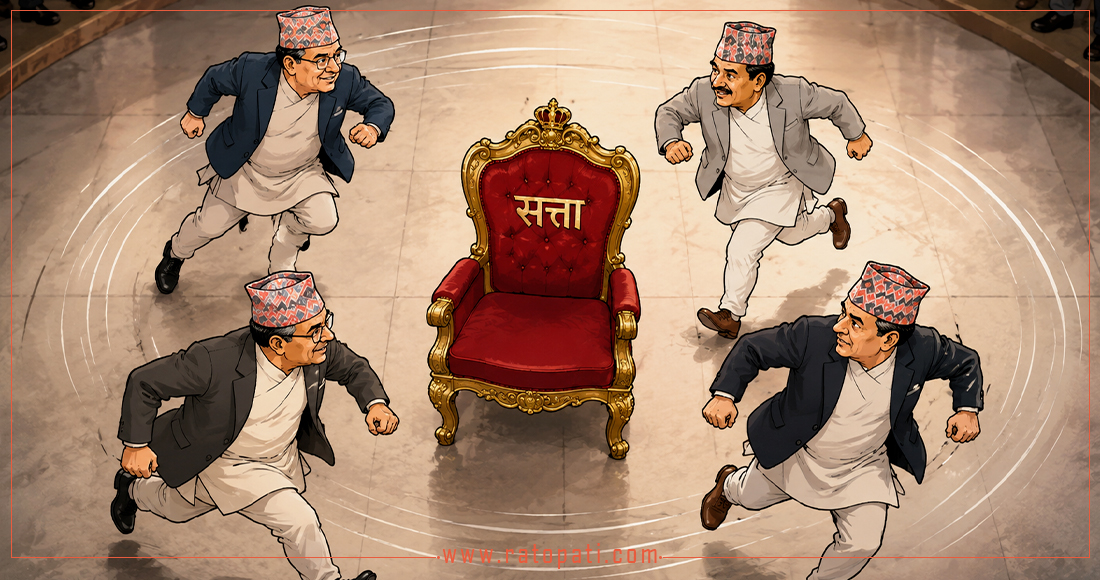
The Nepali Congress is an old force advocating for traditional (though signs of reform have appeared since Gagan Thapa became party president) and status-quo liberal democracy, while the RSP has emerged on the foundation of widespread disillusionment, carrying slogans of 'radical' reform and possessing a highly populist character. Madhesi parties have their own limited regional agendas (they do not hesitate to make decisions on issues outside their regional focus). The sole objective of these three parties, with vastly different 'schooling,' coming together will be the acquisition of power.
History bears witness that whenever governments were formed through such 'compromises' in the past, such as the hung parliament of 2051 BS and the Constituent Assembly period after 2064 BS, corruption flourished. Incidents ranging from the 'Prado-Pajero scandal' to the 'buying and selling of parliamentarians' were products of this unstable arithmetic. It can be argued that the formal beginning of 'crony capitalism' in Nepal dates back to this time. Sociologist Max Weber divided the legitimacy of leadership into three types: 'traditional,' 'charismatic,' and 'legal.'
The strength of new parties like the RSP rests on their 'charismatic authority,' which emanates from their 'rebel image.' However, when they join the government with an 'establishment' force like the Congress, the erosion of their 'rebel' image will begin. Within a few months of government formation, contradictions will arise regarding the distribution of ministries, political appointments, and the reopening of old corruption files. The conflict between the establishment faction of the Congress, which seeks to manage the old system with gradual reforms, and the RSP, which seeks an aggressive reform path to appease its 'core voters,' will hollow out the government from within.
The North's 'Red Line': Tibet and the New Security Narrative
When the game of geopolitics mixes with this weak foundation of internal politics, the situation becomes explosive. The 'liberal' coalition, which I see as the maximum possibility, will not be viewed 'naturally' by the northern neighbor, China. For Beijing, which has always considered Nepal's communist parties its 'ideological and strategic friends,' their absence from power and the transfer of government control to forces perceived as close to Western nations is a serious security challenge.
American geopolitical analyst Robert Kaplan wrote in his book 'The Revenge of Geography,' "Geography is destiny. Small nations must always fight for their existence caught between great powers." This statement applies 100% to the context of Nepal. For China, Tibet is its most vulnerable and sensitive security flank. Looking back at history, the Khampa rebellion, which operated with direct CIA support and investment in Nepal's Mustang district during the 1960s and 70s, was a serious assault on China's sovereignty.
Ultimately, following the astute move by King Birendra and the action by the Nepali Army, the Khampa insurgency was disarmed in 1974. However, that incident remains a deep wound in China's strategic memory. In the current scenario, if the new government, knowingly or unknowingly, attempts to play the 'Tibet card,' China will not take it lightly. The seed of doubt sown during US Deputy Secretary of State Uzra Zeya's visit to Nepal in 2022 (her inspection visit to the Tibetan refugee camp in Jawalakhel) will re-sprout. According to the theory of 'Offensive Realism' by international relations realist John Mearsheimer, "Great powers never tolerate the presence of another great power in their neighborhood."
If Nepal's new government, under pressure from the West, prioritizes giving identity to refugees, China might resort to 'Wolf Warrior Diplomacy.' This might not be limited to mere statements but could manifest simultaneously (like a wolf pack attack) through 'technical obstructions' at the Tatopani and Rasuwagadhi border crossings, non-cooperation in infrastructure projects, and strategic support to opposition communist parties to 'heat up the streets.'
The South's 'Soft Belly' and the Shadow of 'Indo-Pacific'
Nepal's potential political scenario will also deny peaceful sleep to its southern neighbor, India. Nepal has always been a crucial part of India's 'security umbrella' in its foreign policy. India considers Nepal part of its 'soft belly' (the Terai region south of Nepal extending to the Ganga basin), meaning the lower abdomen sensitive from a security perspective. It is true that India wants to see China's influence diminish in Nepal.
However, it does not want to see the sole influence of America or Western powers established in its place. India knows well that if the maneuvering of Western agencies increases in Kathmandu, it will directly affect the security of Uttar Pradesh and Bihar via India's open border (security of the soft belly). More seriously, if Nepal's new government, instigated by the West, raises the Tibet issue and China responds by increasing military activity on Nepal's northern border, India's 'Chicken Neck' (Siliguri Corridor) region will face increased pressure and risk.
India does not want to see Nepal become a 'playground' for great powers. Therefore, if this new government crosses the 'Lakshman Rekha' (line of control) and increases strategic partnership with the West (like any new version of the MCC), India itself will play a role in destabilizing this government. India's experience in 'micro-managing' the formation and collapse of governments in Kathmandu is very old and effective.
Sociology's 'Paradigm Shift' – The Rise and Revolt of the Neo-Middle Class
Beyond politics and geopolitics, another major 'tectonic shift' is occurring at the deeper level of Nepali society, without understanding which any political analysis remains incomplete. This is the massive expansion of the 'neo-middle class' in Nepal and their changing psychology. Senior Nepali sociologist Prof. Chaitanya Mishra has repeatedly stated in his analysis, "Nepal's economy now rests not on traditional agriculture, but on remittances and parasitic capitalism." This remittance economy has lifted the population below the poverty line in Nepal and transformed them into the middle class.
The current 'Gen-Z' represents that class whose members have closely witnessed the hard struggle of their parents to rise above poverty, the pain of the hot sun in the Gulf, or the cramped rented rooms in the city. French sociologist Pierre Bourdieu's concept of 'cultural capital' seems relevant here. This neo-middle class in Nepal has money (economic capital) and access to technology, but they lack respectable access to state power (cultural and political capital).
This class, fueled by the arrogance of its numbers, harbors the conceit of being a parallel government. To make this conceit a reality, it remains constantly active but unstable. This is its search for security assurance. Furthermore, this class is no longer content with the traditional slogans of 'food, shelter, and clothing.' Their questions have changed: "We pay taxes, but why doesn't the state provide us with quality education, health, and digital services?" They want all solutions to come from politics but harbor extreme hatred for the old parties' 'bag-carrying' and 'cadre-based' structures.
They seek not just 'development,' but 'system' and 'rule of law.' However, the government formed from the upcoming election is certain to remain a captive of the same old bureaucracy and political culture. This 'mismatch' between the state structure (hardware) and the expectations of the middle class (software) will be the strongest social fuel for the instability seen in the coming days. This class will continue to revolt from social media to the streets until a system favorable to them is established.
'Sharp Power' and Information Warfare – The New Game of Manipulation
The rising middle class and the younger generation are as ambitious as they are vulnerable and at risk of being 'manipulated.' While international relations scholar Joseph Nye discussed 'soft power' and 'hard power,' the current era belongs to 'sharp power.' Sharp power achieves its interests by spreading confusion, dividing society, and distorting information. Nepal has become a laboratory for this sharp power. Nepal's middle class is 'multiple hyper-connected.'
They form their opinions not by reading newspapers, but by watching TikTok, Twitter, and Facebook reels and short videos. As linguist and philosopher Noam Chomsky stated in his book 'Manufacturing Consent,' public consent or dissent is now 'manufactured' through media and algorithms. The MCC issue is a vivid example of this. The way Nepali society polarized overnight into pro- and anti-MCC factions was not organic.
The narrative that "If MCC comes, American troops will come" on one side, and the narrative that "If MCC doesn't come, the country will sink" on the other, were both 'narratives' created by geopolitical power centers. Great powers are now trying to directly control the minds of the people, not just the leaders of Nepal. If a government needs to be prevented from getting close to China, rumors of a 'debt trap' are spread, and the fear of 'becoming Ukraine' is shown regarding America. The middle class, which does not investigate the facts deeply, is unknowingly becoming a 'digital foot soldier' for foreign powers. This 'manipulation' paralyzes the government, preventing it from making any independent decisions.
The Horizon of 2084 BS: 'Critical Juncture' and the Search for a New Nepal Doctrine
Economists Daron Acemoglu and James Robinson introduced the concept of 'Critical Juncture' in their famous book 'Why Nations Fail.' This is a historical turning point where the old system completely fails, and an opportunity arises to choose a new path. The upcoming election in Falgun and the subsequent 2-3 years of instability will bring Nepal exactly to that 'Critical Juncture.' The coalition government formed from the next election will neither be able to manage the geopolitical balance nor fulfill the aspirations of the neo-middle class.
Pressure from the North, suspicion from the South, and internal revolt will weaken the government. Extreme disgust towards the system itself will arise among the public. It is from this point of crisis that the need for 'another decisive election' will be felt in Nepal. That might happen in or before the year 2084 BS. The 2084 BS election will not be a normal periodic election; it will be a 'Great War' that determines Nepal's future. By then, the Nepali people will understand that hung parliaments and unstable coalitions are a curse for the country.
The mandate of 2084 BS will demand two things: First, Governance Reform: A directly elected executive or an electoral system that provides a strong government, ending the bargaining power of small parties. Second, A Nepal Doctrine: Similar to what King Mahendra adopted during the Cold War, but in a democratic framework, with strict and clear 'strategic autonomy' in foreign policy. This should address the legitimate security concerns of India and China while guaranteeing that Nepal's territory is not used against anyone.
Time to Shift Shoulders
Although the upcoming election shows us the dream of stability, in reality, it is merely an entry into a new tunnel of instability. The geopolitical challenges we face are many times more complex and sensitive than in the past. Nepal is on the verge of transforming from a 'buffer state' of great powers to a 'battleground.' But history shows that 'great changes are always born from great crises.'
Just as a patient sometimes needs a fever to recover, perhaps a few years of instability and crisis are necessary for Nepali politics to get back on the right track. The 'Great War' of 2084 BS will be the point from which Nepal will re-interpret its geopolitical and social 'order' and enter a new era of stability. Until then, the leadership, the intellectual community, and the general public must fasten their 'seat belts' and prepare for the journey on this geopolitical 'roller coaster.' This is the time to shift shoulders, not to rest the burden.
(The author Dhamala has been writing on journalism and contemporary issues for a long time. Author Dhamala is associated with News Agency Nepal.)
Photo: AI
This specific news has been automatically translated by AI. As a result, there may be some inaccuracies or language errors.