Nepal Stock Exchange to Undergo Privatization in Two Phases Based on Restructuring Committee Report


Kathmandu. The state-owned Nepal Stock Exchange (NEPSE) is set to be privatized in two phases. The report from the study committee formed by the government on the restructuring of NEPSE has suggested divesting (withdrawing investment) NEPSE in two stages.
The report proposes bringing in a foreign strategic partner in the first phase. To improve the weaknesses in NEPSE's technical and managerial capacity, the report mentions bringing in an entity with at least 20 years of experience from the top 20 stock exchanges globally, offering them 15 to 25 percent share ownership.
This move is expected to introduce modern technology and international-standard operating procedures to NEPSE. In the second phase, the suggestion is to further reduce the stakes of the government and Nepal Rastra Bank and issue shares to private sector banks, financial institutions, insurance companies, and the general public.
The report recommends selling 15 percent of the shares to the general public through an Initial Public Offering (IPO). The government's shareholding structure, which currently holds the majority ownership, is recommended to be changed, reducing it to 25 percent in the first phase and to zero percent in the second phase.
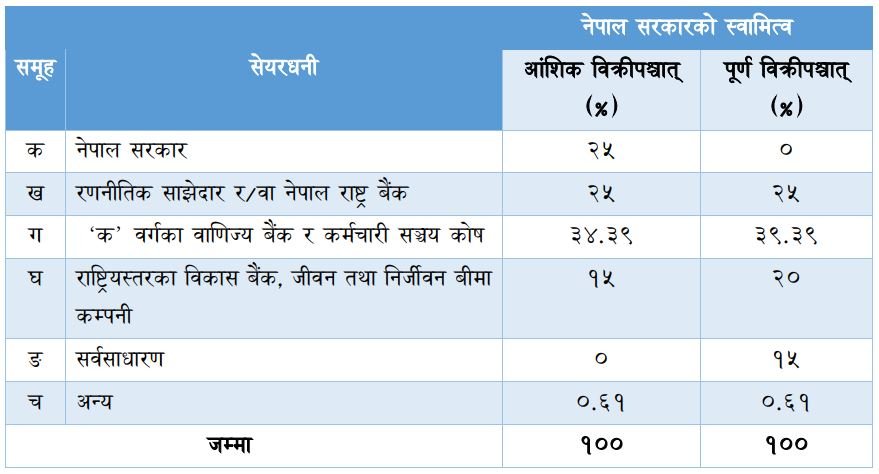
Regarding the capital structure, the committee has recommended increasing NEPSE's paid-up capital from the current one billion rupees to three billion rupees, considering the provisions of the Securities Market Operation Regulations and future expansion.
The suggestion prioritizes issuing bonus shares from NEPSE's retained earnings to achieve this capital increase. The report concludes that with the capital increase, NEPSE will need to invest heavily in its technology and infrastructure, which will aid in market stability.
The committee also pointed out the need for significant improvement in NEPSE's corporate governance. Citing that the current dominance of government employees on the NEPSE board leads to slow decision-making and conflicts of interest, the report recommends increasing the number of independent expert directors on the board.
The report prominently raises the issue that, according to international practice, the Chief Executive Officer (CEO) of NEPSE should not be on the board of directors, and a separate 'Nomination and Remuneration Committee' should be formed for the selection of directors.
The suggestion also includes launching new financial instruments beyond the currently available shares and debentures to develop and expand the market. It mentions bringing instruments such as intra-day trading, auction market, derivatives, index funds, and Exchange Traded Funds (ETFs) into operation.
The report highlights the necessity of establishing a separate 'SME Platform' for capital mobilization for small and medium-sized enterprises and making special arrangements for startups as well. A suggestion was also made to further strengthen NEPSE's trading system and integrate APIs with other entities for real-time data exchange.
Restructuring of NEPSE's subsidiary, CDS and Clearing Limited (CDSC), has also been recommended. The report includes the suggestion to limit NEPSE's current 100 percent shareholding in CDSC to 51 percent and transfer the remaining ownership to other suitable institutions.
The committee claims that if these suggestions are effectively implemented, Nepal's capital market will adopt an international standard structure, investor interests will be protected, and the contribution of the capital market to overall economic development will increase.
This specific news has been automatically translated by AI. As a result, there may be some inaccuracies or language errors.

_OpOYENSORc.jpg)