Post-Agitation Election: Citizens Hold Key to Addressing Demands Amidst Political Uncertainty


Following the widespread impact of the agitation on Bhadra 23 and 24, an interim government was formed amidst a few days of unrest and uncertainty after the previous government's resignation. The main mandate given to this government is to hold elections for the House of Representatives and hand over power to a government receiving a fresh mandate.
The guiding path for this government is to eradicate the extreme dissatisfaction and rampant corruption prevalent among the general public, including the 'Jengji' movement participants, guarantee good governance, maintain peace and order in the country, and move the nation towards economic prosperity.
The most serious question today is: is it possible for the representatives elected by conducting the elections in 082 using the old system and style, instead of the regular schedule in 084, to address the issues raised by the 'Jengji' movement? This remains the most pressing question.
There is still widespread apprehension that solving the problems of a country like Nepal, which is beset by multi-ethnic, multi-religious, multi-cultural diversity and complex geo-political challenges, will be difficult without a concrete plan for structural reform in state systems and amidst the self-interests and vague agendas of nearly six dozen parties participating in the election.
Therefore, the possibility of the upcoming election alone resolving all these problems appears slim. Nevertheless, in the absence of a credible leadership capable of effective coordination with the protesting factions, a fresh mandate was seen as the only alternative to save the country from becoming a 'failed state.'
The announcement of elections, dissolving parliament, was made as per the first condition of the interim government's Prime Minister. However, the way the old political parties have thrown themselves into the election is positive.
Initially, there were fears that the major parties that withdrew from the government might not participate in the election, calling this government unconstitutional. Despite the suppression of the 'Jengji' movement and the resulting loss of life and property, the investigation into these incidents, the imposition of restrictions on some leaders, the issue of voting rights for Nepalis living abroad, geographical and seasonal adversities, and the internal rift within a major political party, the election atmosphere in the country has heated up.
Amidst doubts and apprehensions, the registration of candidacies by 3,486 individuals, including 68 political parties and independents, in all 165 constituencies on Magh 6, according to the Election Commission's schedule, is a positive aspect.
The coordinating role played by the interim government and relevant bodies to ensure the participation of all parties, and the solidarity shown by the parties, deserves wholehearted praise.
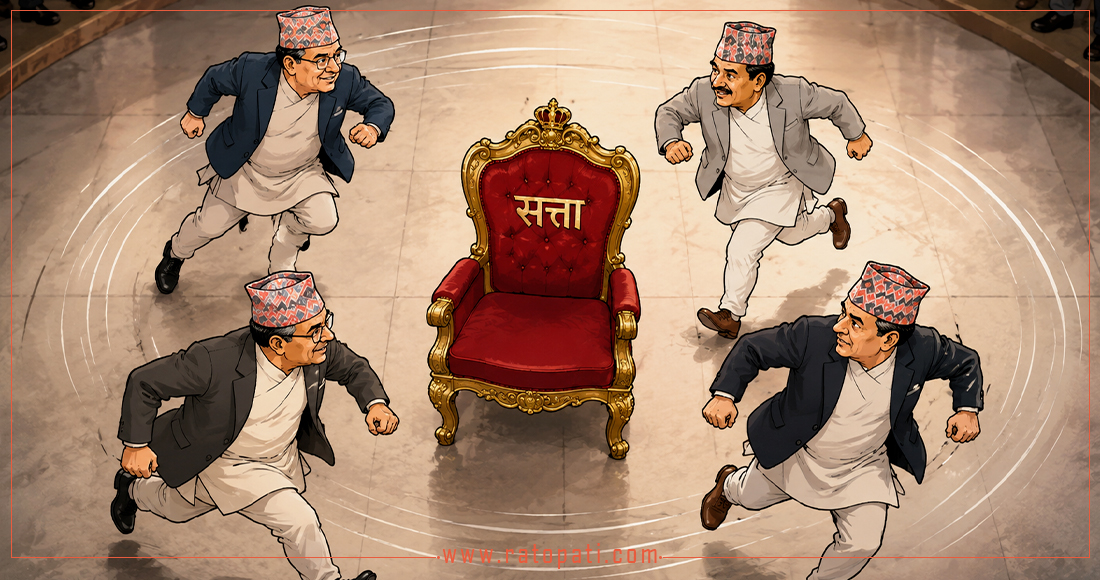
The election scheduled for the upcoming Falgun 21 is now almost certain. Through this election, the responsibility of addressing the demands of the 'Jengji' movement, realizing the dreams of more than six dozen citizens who sacrificed their lives and thousands of the injured, and charting a new course for the country has once again fallen on the shoulders of the citizens.
It is necessary for us to analyze the manifestos, policies, and agendas of the parties in detail to end the dilemma of which party to vote for with a judicious decision. If we once again fall for momentary gains, nepotism, or false promises, we will have no moral standing to criticize the future government when it engages in corruption or fails to deliver good governance.
This is the time to plant saplings; let us plant saplings whose fruits future generations can also enjoy. A country like Nepal with limited revenue cannot afford repeated expensive elections. If the vast expenditure incurred in elections were invested in infrastructure, it would contribute significantly to economic prosperity.
Major movements and loss of life and property every decade push the country deeper into a crisis pit. Therefore, staying away from emotional impulse and temptation, the main basis for voting should be the manifesto and policies that work for the benefit of the entire Nepal.
Change is possible only if a stable government with a majority and a strong opposition are chosen; otherwise, the parties that have sprouted like wild mushrooms will only bring instability.
Many ups and downs have occurred in the decade following the promulgation of the 2072 Constitution by the Constituent Assembly. The first amendment occurred five months after the promulgation of the Constitution, and the second within 5 years. Parties demanding a referendum on issues like the monarchy, secularism, provincial structure, and form of governance are also in this election, which is their constitutional right.
In the past, parties brought manifestos as long as 50 pages with attractive slogans, but their implementation remained zero. The main reasons why citizens do not trust manifestos are as follows:
Including attractive points based on arbitrary assumptions without objective basis. Distributing empty dreams in a haphazard manner without planning. Making ambitious plans without ensuring resources and means. Failure to form a government with a clear majority and the formation of self-serving alliances of parties with differing ideologies. Lack of honesty, accountability, and long-term vision in leadership. Operating parties like private businesses instead of making them democratic. Unnatural changes in the lifestyle of the leadership and lack of loyalty to the country. Internal conflict and tug-of-war within the party.
Therefore, the minimum and public interest issues that should be included in the parties' manifestos are listed below point-wise.
One, modification in the form of governance and electoral system. Two, clear stance on provincial structure, secularism, and the monarchy. Three, debate on the legal provision of the death penalty if serious crimes are proven. Four, ensuring equal opportunity in education and health. Five, individuals receiving benefits from the state treasury should not be allowed to join political parties, except for professional interests.
Six, a rule that those enjoying state facilities must mandatorily use government hospitals and government schools. Seven, mandatory implementation of labor laws in all sectors. Eight, confiscation by the state of assets whose source is undisclosed and taxes have not been paid. Nine, enactment of strict laws to control corruption. Ten, guarantee of adequate social security for the extremely poor and helpless. Eleven, review of social security allowances. Twelve, structural and systemic reform in administrative services. Thirteen, setting a limit on luxurious expenditure from the state treasury.
Fourteen, reform in the selection process for the National Assembly and proportional representation members. Fifteen, abolition of unnecessary commissions and reduction of state expenditure. Sixteen, radical change in the justice system and transparent process for government appointments. Seventeen, restructuring of the bureaucracy. Eighteen, modernization of agriculture and mandatory inclusion of agricultural education in the secondary school curriculum. Nineteen, uniformity and continuity in business policies and periodic plans.
We must establish a practice of voting based on a manifesto incorporating these 20 issues and evaluating the parties based on the ratio of their implementation after being elected. If this happens, our nationalism will not remain limited to slogans.
For now, let us all engage in the great campaign of the election from our respective positions.
This specific news has been automatically translated by AI. As a result, there may be some inaccuracies or language errors.