Pre-Election Ambitions: Key Figures Vie for Prime Ministerial Post Amidst Uncertain Political Landscape in Nepal


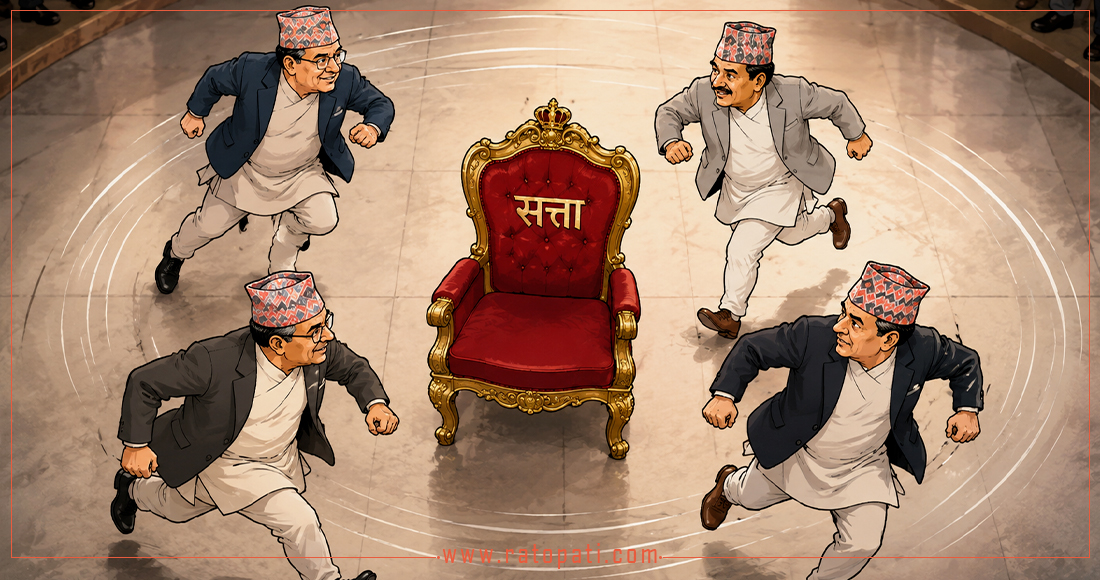
A peculiar yet significant scene is unfolding in current Nepali politics as discussions revolve around pre-declared or self-proclaimed prime ministerial aspirants. Although elections are yet to take place, the scramble for the premiership has already begun. Nepal's constitution is clear dash; it recognizes the leader of the party securing a majority in parliament as the Prime Minister.
If no single party secures a clear majority, the provision allows for an individual who can garner majority support with the backing of two or more parties to become Prime Minister. However, considering Nepal's current electoral system and multi-party structure, the probability of any single party achieving a clear majority appears very low.
Even before this constitutional process officially begins, desires, claims, and signals of wanting to become Prime Minister are already in the public discourse. Political parties and leaders seem more focused on showcasing their ambitions than waiting for the election results. There is a growing trend of making the Prime Ministerial post the central election agenda through social media, public speeches, and strategic signaling, indicating that personality-centric politics is overshadowing institutional politics.
The main players in this race dash; KP Sharma Oli, Gagan Thapa, and Balen Shah dash; present different backgrounds, political cultures, and working styles. But the single common thread connecting them is an intense aspiration for leadership.
- Oli and Balen: Same Arena, Different Characters
The competition between KP Sharma Oli and Balen Shah is currently visible within the same political arena. This competition is not just about direct electoral arithmetic but also a battle for shaping public perception and political narrative.
The National Independent Party's (RSP) strategy behind projecting Balen Shah as a prime ministerial candidate is actually linked to diverting attention from the cooperative scandal involving their chairman and aiming to secure more votes in the election. The strategy for RSP to use Balen as a symbol to attract Madhes sentiment and general votes is not unnatural.
This style is a continuation of the trend repeatedly used in Nepali politics: 'showing a goat's head to sell dog meat.'
On the other hand, KP Sharma Oli still maintains a strong organizational grip. His primary strengths are his party structure, access to state mechanisms, and extensive experience in governance. He has a history of running the government, enduring a party split, and re-consolidating the party. Therefore, his supporters view him as a mature leader who understands the system and processes.
Meanwhile, Rabi Lamichhane's team has been actively pursuing a strategy of fielding Balen in the election first and then sidelining him after the polls.
The strength of both these leaders is primarily based on public influence. Oli is a sharp orator, adept at mobilizing supporters through speeches and sarcasm. Balen, conversely, is a figure who emerged from the influence of social media and dissatisfaction against established powers.
His supporters consider him a courageous voice against the established system. When these two strong figures enter the same field, it is almost certain that one will be 'ringed out.' This clash is not just between individuals but a conflict between the established power (Oli) and new consciousness (Balen).
- Gagan's Mix of Energy and Risk
Gagan Thapa's situation is different and more challenging than the other two. Leaving his safe and familiar constituency to choose Sarlahi is a major political risk in itself. Entering the complex political geography of the Madhes, moving beyond his Kathmandu-centric image, can be considered his courageous step. Currently, he is established within the party as a leader challenging the old guard by advocating for generational transition.
Gagan possesses political consciousness, ideological clarity, and abundant youthful energy. He has attempted to present a clear vision regarding policy reform, education, and the health system. However, there is an equal amount of suspicion about whether he is choosing the wrong path in his haste to gain power. Winning internal party struggles is entirely different from winning a national election.
Sarlahi is a constituency where an independent candidate, Amresh Kumar Singh, won the previous election. This indicates that individual influence and dissatisfaction with established politics hold sway there. Against this backdrop, the path for Gagan is not easy. If he fails to address local issues, identity politics, and the existing discontent, his very energy might become counterproductive for him.
- Potential Post-Election Scenarios
The main question now is dash; what happens if two of these individuals win the election? According to Nepal's constitutional and multi-party structure, the probability of any single party achieving a clear majority is low. In such a scenario, the arithmetic of votes becomes decisive. If the major parties weaken, the key to government will fall into the hands of smaller but decisive parties, which is the perennial fate of Nepali politics.
In such a situation, who becomes the Prime Minister? The question of who is allowed to become Prime Minister is more important than who will become one. The formation of the government depends on the mathematics of the coalition and the vote of confidence. The irony is that all three figures appear, in a way, to be paper or aspirational Prime Ministers.
Some might win the election but fail to become PM, some might be in power but not get the post, and some might get the popular mandate but get trapped in the labyrinth of coalitions.
The success of these self-proclaimed Prime Ministers is not determined solely by their claims or personal popularity. Technically, there is no certainty that two of these three individuals will win the election. Even if two do win, the lack of a single majority will necessitate a coalition government, the true outcome of which remains in the womb of the future.
Ultimately, the spirit of the constitution, the structure of the multi-party system, and the balance of the popular mandate will be decisive. In Nepali politics, winning an election is not enough to become Prime Minister; the necessary trust, capacity for cooperation, and assurance of stability for running the government are equally essential.
When a single party majority seems impossible, smaller parties will hold the center of power. Therefore, the leader who embraces institutional stability and political maturity over personality-centric popularity will ultimately prevail. Ambition pursued without understanding the reality of the system can itself become a political obstacle.
This specific news has been automatically translated by AI. As a result, there may be some inaccuracies or language errors.