Court Orders Experts to Testify in Revenue Leakage Case Involving Former IRS Chief Sharma

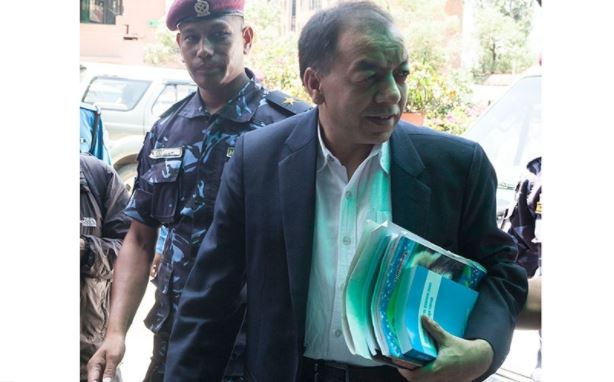
Kathmandu. The Special Court has issued an order to summon experts in the corruption case related to revenue leakage against former Director General of the Inland Revenue Department, Chudamani Sharma, and two others.
A bench comprising Special Court judges Narayan Prasad Poudel and Dilliratna Shrestha issued the order to summon experts in the case where Sharma, along with Lumbadhwaj Mahat, former chairman of the Tax Settlement Commission, and member Umesh Dhakal, are accused of corruption by granting a tax exemption of NPR 10.021901824 billion.
The Special Court has ordered the summoning of experts from the Office of the Auditor General, the Inland Revenue Department, and the Institute of Chartered Accountants of Nepal.
Previously, Chudamani Sharma and others had approached the Supreme Court, arguing that they were not given the opportunity to cross-examine the opinions of the experts when the Special Court convicted them of revenue leakage. Sharma and others claimed that the verdict against them was based on the opinions provided by experts from those bodies after the hearing concluded. He claimed that he was unaware of the expert opinions obtained in that manner and was not given a chance to cross-examine the experts' opinions.
At that time, the Special Court had sentenced the three officials of the commission to nine years in prison each. It also determined that NPR 6.15 billion in revenue corruption occurred through the Tax Settlement Commission, dividing this amount into three parts, ordering each to pay NPR 2.05 billion.
It was found that some taxpayers who had reached settlement agreements through the Tax Settlement Commission, chaired by Mahat in 2071 BS, were maliciously granted tax exemptions and waivers exceeding NPR 10.02 billion.
Sharma and Dhakal were members of the commission. The Commission for the Investigation of Abuse of Authority (CIAA) claimed that revenue that should have accrued to the state was not collected because the commission made agreements with taxpayers in a manner beneficial to themselves, going beyond the mandate given to the commission.
This specific news has been automatically translated by AI. As a result, there may be some inaccuracies or language errors.