Venezuela Accuses US of Using Country as 'Weapons Lab' During Maduro Abduction Attempt


Venezuela's Defense Minister alleged on January 3 that the United States used the country as a 'weapons laboratory' during the attempted abduction of President Nicolas Maduro and his wife, Cilia Flores.
According to the Venezuelan newspaper El Universal, Vladimir Padrino Lopez stated last week that the US used Venezuela as a testing ground for 'advanced military technologies,' based on artificial intelligence (AI) and weapons never used before.
On Sunday, US President Donald Trump told the New York Post that the US military did indeed use a weapon he called the 'Discombobulator.' 'I'm not allowed to talk about it,' he said. He claimed the weapon made 'equipment inoperable' during the operation.
Details of the US military mission to abduct Maduro have not been released, but the US has previously used weapons to disorient soldiers and guards or to disable equipment and infrastructure.
Here are the facts we know:
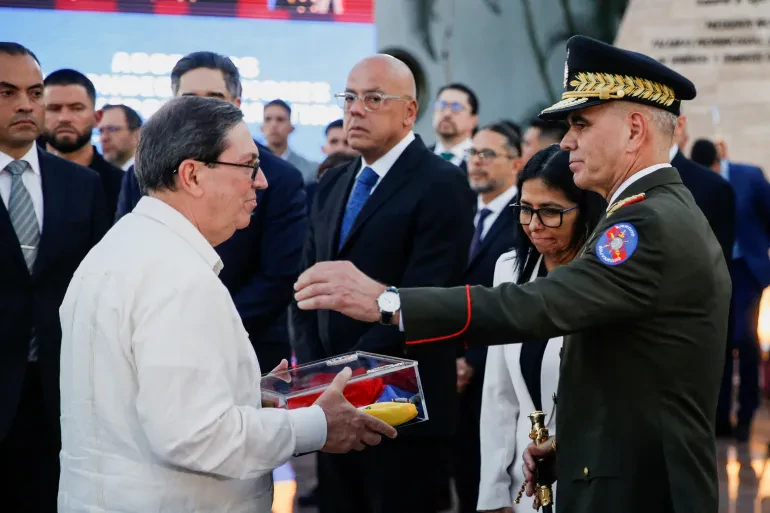
- What did the Venezuelan Defense Minister say?
On January 16, Padrino Lopez stated that 47 Venezuelan soldiers were killed in the US attack in Caracas. 32 Cuban soldiers guarding Maduro's security were also killed.
Then last week, he told El Universal, making the 'weapons lab' accusation, 'The President of the United States admitted that they used weapons that have never been used on a battlefield and that no one else in the world possesses. They used that technology against the Venezuelan people on January 3, 2026.'
He appeared to be referencing an interview Trump gave to the US news channel NewsNation, where Trump mentioned the use of a 'sonic weapon' (a weapon based on sound).

- What did Trump say about the US 'secret weapon'?
A few days after Maduro's attempted abduction, White House Press Secretary Karine Jean-Pierre reposted comments that appeared to be from a Venezuelan security guard posted on 'X'.
According to him, the US 'left something behind' during the operation that was 'like a very intense sound wave.' 'Suddenly, I felt like it exploded inside my head,' the security guard wrote, 'All of us started bleeding from the nose. Some were vomiting blood. We fell to the ground, unable to move.'
Al Jazeera could not confirm this account.
In his NewsNation interview last week, Trump stated that a 'sonic weapon' was used against Maduro's Cuban bodyguards in an area he described as heavily secured.
'No one else has this. And we have weapons that nobody knows about,' Trump said, 'I would say it's better not to talk about them, but we have some incredible weapons. That was an incredible assault. Don't forget that house was in the middle of a fortress and a military base.'
Then on Sunday, the New York Post quoted Trump as saying the US used a weapon designed to disable defensive equipment.
'The Discombobulator,' he said, 'I'm not allowed to talk about it.'
- What 'sonic' or other disabling weapons has the US been found to use in the past?
According to Elijah Magnier, a military and political analyst based in Brussels, speaking to Al Jazeera, the most famous 'sonic' systems the US uses are directional acoustic hailing and warning devices, specifically the Long Range Acoustic Device (LRAD).
'These are not conventional weapons. Instead, they are powerful, focused sound projectors used for tasks such as stopping ships, securing bases, protecting convoys, managing checkpoints, and sometimes crowd control,' he said.
The main purpose of these devices is behavioral control by sending voice commands loudly over long distances. They are designed to cause discomfort and compel people to obey orders or leave an area.
'LRADs have been deployed on ships to deter piracy, in port security, and by law enforcement agencies,' Magnier stated, 'At high output settings, these devices can cause pain, dizziness, nausea, or hearing damage, which makes their use sensitive and subject to scrutiny.'
However, LRADs are not designed to disable electronics or communication networks. Another weapon used to disorient people is the 'Active Denial System' (ADS), often mislabeled as a 'sonic' weapon, but it does not use sound.
'Instead, it uses millimeter-wave energy to create a harsh burning sensation on the skin, forcing people to move away,' Magnier said, 'ADS was sent to Afghanistan in 2010 but was returned without being used in combat. Like LRAD, ADS is designed to affect people, not machines.'
- How do these devices work?
The LRAD system can focus sound into a narrow beam. At low settings, it allows sounds to be heard clearly over long distances. But at high settings, it can be physically debilitating.
'These effects are purely physical and psychological,' Magnier said, 'Unlike electromagnetic devices, an LRAD cannot shut down missiles, radar, computers, or communication systems.'
ADS heats the outer layer of the skin, causing intense discomfort and forcing people to move away. 'It is a non-lethal area-denial tool intended for crowd control and perimeter defense,' Magnier said.
'Neither of these systems can actually disable air defense systems, communication networks, or military equipment,' he said, 'If equipment stops working, it is more likely due to electromagnetic, cyber, or electrical disruption methods.'
- What does the US use to disable systems and equipment?
Magnier said the US military is found to use several types of 'non-kinetic' and 'pre-kinetic' tools. These include:
• Electronic Warfare (EW): Which can jam radar systems, block communications, spoof GPS, and fool sensors. 'These actions help control the electromagnetic spectrum,' he said, 'EW makes it difficult for adversaries to understand what is happening and coordinate their defenses before or during an attack.'
• Cyber-physical actions: This involves sabotaging networks and industrial control systems. 'The most famous example of this is the 2009 'Stuxnet' campaign, which targeted Iranian nuclear centrifuge controllers and caused physical damage by altering their software,' Magnier said.
• Counter-electronics/Directed-Energy Weapons: These are mainly high-power microwave systems designed to disable electronics by sending microwave pulses into their circuits. 'The main US project for this is CHAMP (Counter-Electronics High Power Microwave Advanced Missile Project), created to disable electronics without using physical force,' Magnier said.
• Graphite or Carbon-Fiber Weapons: Which can short-circuit electrical grids, destroying them without destroying all equipment.
'These tools are a key part of the US military's approach to achieving 'information advantage' and controlling various domains of conflict,' Magnier said.
- How do these systems work, and when have they been used?
Electronic warfare alters or blocks the electromagnetic environment. It can distract radar systems by making them 'see' 'noise' or fake targets. It can stop radios from working and interfere with GPS and sensor systems.
'The goal is to blind, confuse, and disorient the enemy to create an opportunity for action,' Magnier said.
In the 2009 Stuxnet cyber campaign, a computer worm was inserted into the computers of an Iranian nuclear facility to cause mechanical damage by taking over industrial control systems. 'This operation is widely believed to have been carried out by US and Israeli intelligence agencies against Iran's nuclear program,' Magnier said.
High-power microwave systems can also disable electronics by flooding them with microwave energy, causing them to stop working without any visible damage. 'Public tests conducted in the early 2010s showed that these systems can disable selected electronic targets,' Magnier said.
Graphite or carbon-fiber weapons spread small conductive fibers that can short-circuit parts of the electrical grid. 'These weapons have been associated with major power outages in Iraq in 1991, Serbia in 1999, and Iraq again in 2003,' Magnier said, 'The basic strategy remains the same: first, shut down power, communications, sensors, and coordination, then launch physical attacks.'
- Has the US tested new weapons in other countries?
'Yes, and it's not just the US that does this. Modern wars often become the first real-world test for new technologies once they are ready to be used,' Magnier said.
The 1991 Gulf War was the first time stealth aircraft, precision-guided bombs, and electronic warfare were used on a large scale.
The 2009 cyber attack in Iran was the first time a cyber-physical weapon was used at a strategic level.
The GBU-43/B MOAB, known as the 'Mother of All Bombs,' was first used in combat by the US in Afghanistan in 2017. It is a non-nuclear explosive used for precision strikes against hardened underground targets like tunnels, delivering a massive blast wave.
'It is important to know that testing does not usually mean secret equipment testing,' Magnier said, 'Rather, it means using new equipment in real situations and improving it based on the results and reactions.'
All major countries secretly test new systems in areas like electronic warfare, cyber-operations, space targeting, signals intelligence, and special operations, he clarified.
'The main difference is not how secret the tools are, but how widely they are used, where they are based, and how willing countries are to use them.'
In some cases, like the Stuxnet attack, multiple countries work together. 'The US uses Israel as a testing ground for various types of weapons and other war equipment, mainly against Palestinians, in Lebanon, and in Iran,' Magnier said.
The US has also accused other countries of using 'sonic weapons' against its personnel. In 2017, it demanded an investigation into suspected sonic attacks that required treatment for several of its diplomats, forcing them to leave Havana (Cuba).
Then US Secretary of State Rex Tillerson stated that the US mission in the Cuban capital had been the target of health attacks that caused some personnel to lose their hearing.
The Canadian government also stated that at least one Canadian diplomat in Cuba was treated for hearing loss.
- What is meant by Trump's 'Discombobulator'?
There is no certified definition for any specific 'Discombobulator.' 'These terms are not technical and appear to be used as political labels for existing equipment,' Magnier said.
'The most logical approach is that this term refers to a group of known non-kinetic devices, not a new device.'
These could be:
• Cyber-disruption targeting command networks
• Targeted attacks and local power disruption against antennas, relays, and sensor nodes
To ground observers, it appears as if the systems suddenly 'stopped working,' Magnier said. However, he added that a sonic weapon is very unlikely to affect equipment in this manner.
'According to reports, Venezuela's Russian-made air defense systems failed, which could mean they were not well-integrated or prepared. This could be due to electronic warfare, node suppression, cyber attacks, or weak operations; it doesn't require a science fiction explanation. We have seen this happen to Russian weapons in Syria before an Israeli strike.'
Sonic weapons may have affected soldiers and guards. If physical symptoms appeared in people during the raid in Caracas, it does not indicate that a new 'sonic weapon' was used.
'These effects could be from blast overpressure, flash-bang devices, or other common disorientation tools,' Magnier said, 'There is no public evidence of a new type of weapon.'
This specific news has been automatically translated by AI. As a result, there may be some inaccuracies or language errors.
_wqJwwAzuWG.jpg)

_Mks4af4WAR.jpg)