Nepal Celebrates Saraswati Puja, Honoring the Goddess of Knowledge on Basant Panchami

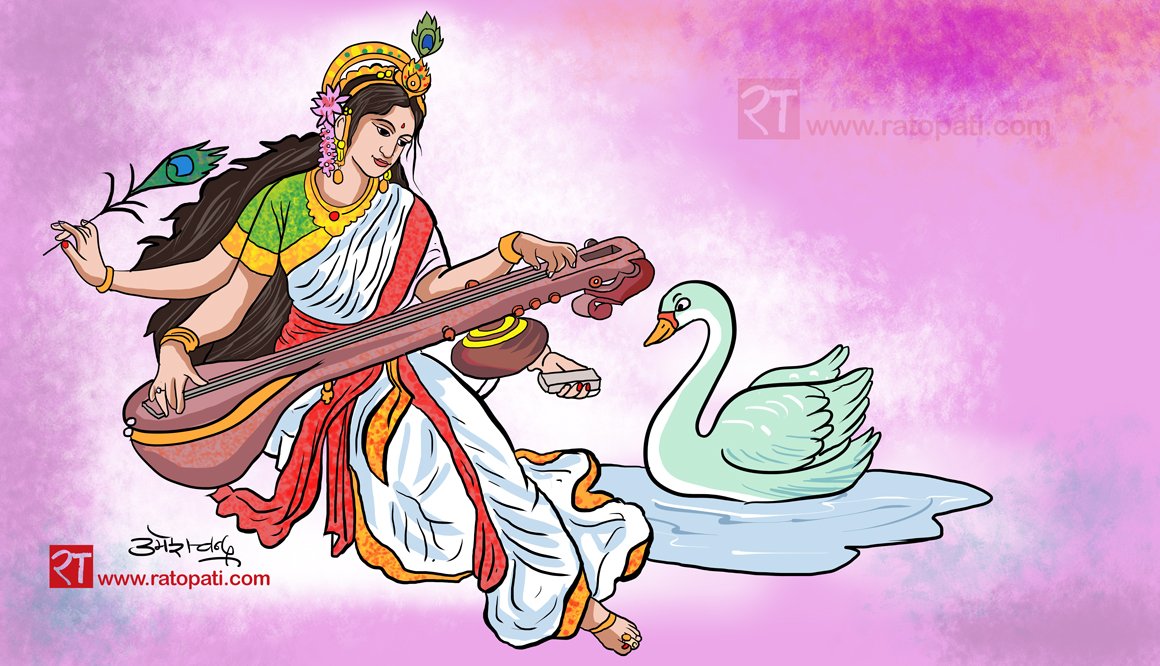
Kathmandu. Shri Panchami, observed every year on the fifth day of the bright half of the month of Magh, is being celebrated across the country today with the formal worship and adoration of Goddess Saraswati, the presiding deity of knowledge.
It is believed that worshipping Saraswati on Basant Panchami increases intellect and wisdom. Today, devotees throng Saraswati temples across the nation. It is customary to initiate literacy for young children who have not yet started school on this very day. There is a religious belief that teaching reading and writing on this day bestows good knowledge.
Devotees call the Goddess of Knowledge, who has a complexion as fair as the moon and holds a veena and a book in her hands, by various names such as Bharati, Sharada, Hansavahini, Jagannata, Vagishwari, Kaumari, Varadayini, Buddhidatri, Brahmacharini, Chandraghanta, and Bhuvaneshwari.
As she is the goddess of knowledge and creativity, writers, artists, journalists, teachers, and students especially worship their instruments of art and practice—pens, notebooks, brushes, and musical instruments—as manifestations of Saraswati. Tantriks, on the other hand, worship her as Tara Devi for the attainment of Tantric Siddhi (powers).
It is also believed that today marks the beginning of the spring season as the sun moves northward, making the days longer, hence the day is also called 'Basant Panchami.' The worship of Saraswati, also known in the Rigveda as Vagdevi, the consort of Brahma (Brahmayani), is highly significant because it is believed to grant all forms of knowledge, Siddhi, and wisdom. The Gandharva Purana mentions that initiating education after worshipping Saraswati on this day leads to all attainments.
It is believed that no specific auspicious time (muhurta) is required for social and religious rites such as marriages, Bratabandha (sacred thread ceremony), Gufa Rakhne (a rite for young girls), and Bel Bibaha (Ihi) on this day. However, as Venus is combust this year, these auspicious ceremonies will not be performed. On this day, children also begin their education and undergo ear and nose piercing.
Devotees, especially students, gather from early this morning for worship at Saraswati temples in the Kathmandu Valley, including Swayambhu, Maitidevi, and Nilasaraswati in Gaurighar, as well as in Lele, Lalitpur, and other districts. There is a religious belief that if one swallows the seven grains of Akshata (uncooked rice) offered to Saraswati without touching them with their teeth, knowledge and intellect will flourish, and the light of consciousness will be received from the Goddess of Knowledge.
Basanta Shrawan (Listening to Spring Melodies)
On this occasion, there is a tradition for the Head of State to listen to the 'Basanta Shrawan' at the Naasal Chowk of Hanumandhoka Durbar. Laxman Panthi, Executive Director of the Nepal Panchanga Nirnayak Bikas Samiti, informed RSS that the auspicious time set for President Ramchandra Paudel to observe Basanta Shrawan was at 10:27 AM on Friday.
The Hanumandhoka Durbar Preservation Office stated that the Vice President, Prime Minister, Ministers, Chairman and members of the National Assembly, heads and members of constitutional bodies, members of Provincial Assemblies, and others will be present during the Basanta Shrawan. The office confirmed that all preparations for the Basanta Shrawan are complete.
This specific news has been automatically translated by AI. As a result, there may be some inaccuracies or language errors.
_shBQSnE9IK.jpg)

_fkg5u05PqN.jpg)