Koshi Province Government Unveils Budget Amidst Economic Challenges

_Lc2GX1hZa3.jpg)
Biratnagar. A week has passed since the Koshi Province government unveiled a budget of 40 billion 44 crore 98 lakh for the upcoming fiscal year 2083/084. While presenting the budget, the Minister for Economic Affairs and Planning, Bidur Kumar Lingthep, described it as a 'blueprint for economic transformation'.
The budget prioritizes a 5 percent economic growth rate and the modernization of the agriculture and tourism sectors. As the first week since the budget's unveiling concludes, the private sector has termed the budget encouraging. Economists have drawn the government's attention to increasing budget expenditure capacity and removing economic resource contraction.
With the current fiscal year nearing its end and a disappointing budget expenditure situation, economists view the implementation of this budget as a test for the provincial government.
The provincial government's budget focuses on economic development, job creation, equitable distribution, poverty reduction, and sustainable infrastructure development, as claimed by Minister Lingthep. Through these programs, a target of achieving approximately 5 percent economic growth rate in the upcoming fiscal year has been set.
Minister Lingthep claims that this budget will positively impact the province's economy by increasing agricultural and industrial production, promoting tourism, providing quality health services, and building sustainable infrastructure. According to him, the successful implementation of the budget will have a constructive effect on the overall economy of the province.
'If we can implement this budget on time and correctly, it can bring positive changes to the lives of the people of Koshi Province and its economy,' he said.
Provincial Financial Situation
Although the external indicators of the provincial economy appear strong, the actual state of the province's economy seems weak. A slowdown and contraction have been observed in domestic production, utilization of industrial capacity, mobilization of development budget, and credit flow from banks and financial institutions.
The provincial government's own economic survey report indicates that despite a slight increase in the budget size and increased deposit mobilization in the banking sector, credit flow remains slow, capital expenditure is very low, and the real productive sector is contracting, resulting in ample liquidity in the Koshi Province economy but a sluggish investment environment.
According to Nepal Rastra Bank's data, agricultural production decreased by 4.4 percent in the first six months of the current fiscal year. A decline in paddy production by 4.0 percent and a lack of expected growth in cash crops like cardamom, tea, and broom grass have led to a contraction in the contribution of the agricultural sector.
According to the Koshi Province Economic Survey Report 2082/083, the province's Gross Domestic Product (GDP) at current prices is estimated to reach 10 kharba 43 arba 12 crore rupees. This accounts for 15.80 percent of the country's total economy. The province's economic growth rate at consumer prices is preliminarily estimated at 3.13 percent, a slight improvement compared to 2.72 percent in the previous year.
The sectoral contribution structure of Koshi Province's GDP shows a higher contribution from the agriculture sector and a slightly lower contribution from the service sector compared to the national average. The agriculture sector contributes 32.5 percent, which is the highest among all provinces. Similarly, the industrial sector contributes 17.7 percent, and the service sector contributes 49.8 percent.
According to Nepal Rastra Bank's data, agricultural production decreased by 4.4 percent in the first six months of the current fiscal year. A decline in paddy production by 4.0 percent and a lack of expected growth in cash crops like cardamom, tea, and broom grass have led to a contraction in the contribution of the agricultural sector.
Strong Public Access to the Banking Sector
Deposit mobilization and banking access in Koshi Province's financial system are becoming very strong, but the aspect of credit flow, which channels mobilized deposits into productive sectors, appears challenging.
As of Poush 2082, a total of 1,850 branches are in operation across the 14 districts of Koshi Province, including 764 commercial banks, 194 development banks, 36 finance companies, and 856 microfinance financial institutions. This network of banks and financial institutions has significantly contributed to increasing financial access throughout the province. During the same period, the number of depositors in the province reached 8.343 million, and the number of borrowers reached 317,530.
From Asar 2082 to Poush 2082, the total deposit mobilization by banks and financial institutions increased by 5.1 percent to 5 kharba 81 arba 24 crore rupees. The continuous flow of remittances, expansion of digital banking, and inflow of money from the informal sector into the banking system are seen as reasons for increased deposit mobilization. Savings deposits constitute the largest share of the deposit structure at 55.8 percent, followed by fixed deposits at 31.5 percent.
Out of the total loan of 6 kharba 12 arba 99 crore rupees disbursed in the province, loans are concentrated only in accessible and industrial districts. Morang district alone accounts for 38.1 percent, or 21 arba 3 crore 76 lakh, while Solukhumbu has the least, with only 0.6 percent, or 32 crore 84 lakh, in loan disbursement.
While deposits increased by 5.1 percent, credit flow is limited to 0.3 percent. As of Poush 2082, the total credit disbursement stood at 6 kharba 12 arba 99 crore rupees. Due to a lack of market demand, the previous impact of high interest rates, and extreme investor distrust, new credit disbursement has not occurred.
In Poush of the previous year, Koshi Province's credit disbursement was 5 kharba 77 arba 71 crore, and deposits were 4 kharba 77 arba 93 crore. However, by Poush 2082, deposits increased to 6 kharba 52 arba 11 crore, while the credit disbursement ratio decreased compared to the previous year. This indicates ample investable funds in banks, but banks are unable to mobilize that amount due to a lack of loan demand. Some serious structural and operational problems are evident in Koshi Province's financial market, hindering the equitable distribution of financial resources.
Out of the total loan of 6 kharba 12 arba 99 crore rupees disbursed in the province, loans are concentrated only in accessible and industrial districts. Morang district alone accounts for 38.1 percent, or 21 arba 3 crore 76 lakh, while Solukhumbu has the least, with only 0.6 percent, or 32 crore 84 lakh, in loan disbursement. Similarly, Jhapa has 13 arba 9 crore, and Sunsari also has a loan disbursement of 11 arba 69 crore rupees.
These three accessible districts alone account for nearly 90 percent of the province's total loans. On the other hand, districts like Taplejung, Sankhuwasabha, Solukhumbu, Okhaldhunga, Khotang, Bhojpur, Terhathum, and Panchthar have less than 1 percent share in loan disbursement. This indicates extreme scarcity of financial resources in hilly and remote areas and over-concentration in accessible areas.
There has been a significant contraction in concessional loans and refinancing provided with the objective of creating self-employment for the poor and at the household level. From Asar 2082 to Poush 2082, concessional loans decreased by 27.9 percent, limited to 7 arba 85 crore rupees.
It appears necessary to increase the flow of financial resources to small entrepreneurs, the Dalit community, and youth employment in education.
The total savings of cooperatives have increased by 17.0 percent to 3 arba 27 crore rupees, but a 2 percent decline in the number of employees and difficulties in loan recovery indicate that the cooperative sector is under internal pressure. The crisis seen in some cooperatives operating in urban areas has eroded depositors' trust in cooperatives.
From Asar 2082 to Poush 2082, loans disbursed by banks and financial institutions to the agriculture sector of Koshi Province decreased by 2.0 percent to 55 arba 16 crore 84 lakh rupees. In Poush 2081, such loans were 56 arba 90 crore 18 lakh rupees. This represents 9 percent of the total loan disbursement.
Satisfactory Revenue Collection, Disappointing Budget Expenditure
While revenue collection is satisfactory compared to the Koshi Province government's expenditure, it is not in line with the target. By the month of Jestha in the current fiscal year, revenue collection in the provincial government's account has reached 29 arba 42 crore 50 lakh 85 thousand 36 rupees. This is 81.68 percent of the target. The budget expenditure situation of the Koshi Province government, which has the primary responsibility of injecting liquidity into the economy and stimulating economic activities, is disappointing. With one month left in the fiscal year, the Koshi Province government's expenditure is only half of the total budget, i.e., 45.5 percent (16 arba 39 crore 32 lakh rupees). The total budget of the Koshi Province government, with the addition of grants from the federal government, is 36 arba 2 crore 14 lakh 72 thousand rupees for the current fiscal year.
The status of the province's capital (development) expenditure appears weak. The government had allocated 17 arba 14 crore 34 lakh 80 thousand rupees as capital budget for the current fiscal year. However, by the end of Jestha, only 6 arba 83 crore 23 lakh 82 thousand rupees (39.8 percent) have been spent. In the month of Jestha alone, the provincial government spent 1 arba 54 crore rupees.
Industrial and Service Sector
_ETk715EaiH.jpg)
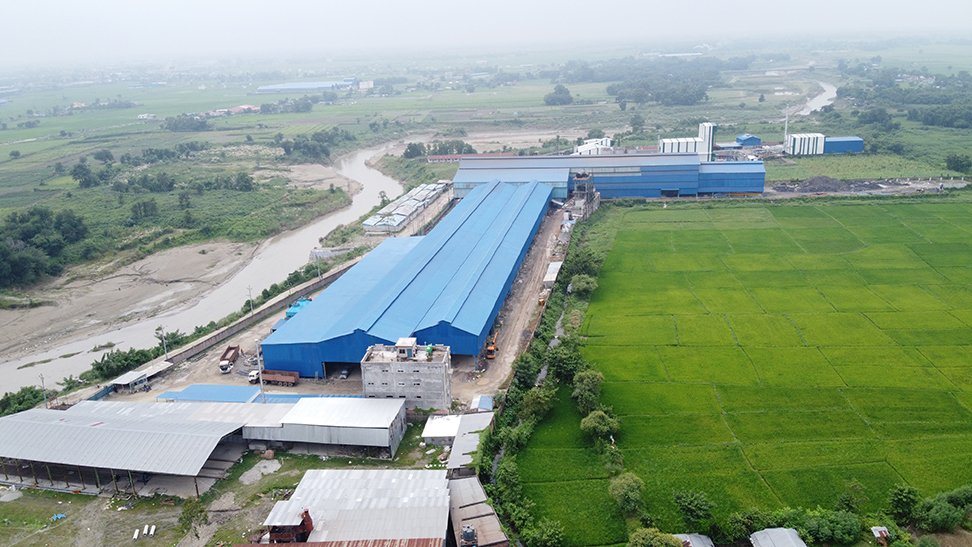
Due to the financial sector's inability to support the real economy, the industrial and service sectors of Koshi Province are not functioning at their full potential. According to Nepal Rastra Bank's data, the average capacity utilization of sample industrial establishments in Koshi Province is only 42.9 percent. Last year, it was 48.6 percent.
Industries are operating at less than half capacity due to extreme market demand shortages and high raw material costs.
While the capacity utilization of the soybean oil industry is 99.5 percent, the capacity utilization of industries producing vegetable ghee and domestic metal goods is the lowest, limited to only 4.3 percent. Bar, cement, footwear, and textile industries are in crisis due to competition from cheap imported goods and low domestic infrastructure development.
The budget statement presented by the Minister for Economic Affairs and Planning of Koshi Province, Bidur Kumar Lingthep, claims a 5 percent economic growth in the upcoming fiscal year. Indra Bahadur Angbo, a former Minister for Economic Affairs and Planning of the province, however, states that the provincial government has not allocated the budget in a way that would achieve this target.
The average occupancy rate of tourist hotels in Koshi Province has decreased to 33.4 percent, down from 53.4 percent last year. During the same period, the number of foreign tourist arrivals has decreased by 10.7 percent. The tourism business is under pressure due to a decline in arrivals of Indian and third-country tourists and sluggish domestic travel.
The number of real estate registrations decreased by 8.3 percent during the review period. However, the revenue collected from real estate registration increased by 54.0 percent to 2 arba 2 crore 72 lakh rupees. The decrease in the number of transactions while revenue increases indicates an increase in government valuation and tax rates, which could further contract the real estate market.
Suggestions from Stakeholders and Experts
Analysts say that the government must take immediate steps to remove the existing despair and contraction in Koshi Province's economy and financial market and make it dynamic. Subodhraj Pyakurel, former Vice-Chairman of the Koshi Province Planning Commission, states that political leadership must focus on production while managing political pressure.
'Plans should be advanced only after considering resources and priorities. Morality, accountability, and knowledge are key. The province's development is possible only by focusing on production and directing the budget to the right places,' he said. He emphasized the need to increase development budget expenditure.
Rajendra Raut, Provincial President of the Federation of Industries and Commerce, Koshi, said the provincial budget is transformative. 'The budget has focused investment on sectors that enhance the production capacity of indigenous products like tourism and agriculture,' he said. While programs like promoting industries based on local raw materials and domestic production, and celebrating tourism years are good, he believes that the overall economic situation of the province can improve only by increasing capital expenditure.
Entrepreneurs emphasize the need to build special industrial parks and cold storage for the internal processing of Koshi Province's main cash crops like tea, cardamom, ginger, and broom grass. 'By certifying the international quality of produced goods and branding them to increase exports, the province's trade deficit can be reduced,' said Chudamani Bhattarai, Executive Chief of Industry Organization Morang.
Expressing concern over the decline in hotel occupancy to 33 percent, tourism entrepreneur Bhavesh Shrestha said that promotional campaigns should be conducted in neighboring Indian states (Bihar and West Bengal) by integrating Koshi Province's main tourist areas (Sagarmatha, Pathibhara, Halesi, Barahachhetra) into package tourism.
The budget statement presented by the Minister for Economic Affairs and Planning of Koshi Province, Bidur Kumar Lingthep, claims a 5 percent economic growth in the upcoming fiscal year. Indra Bahadur Angbo, a former Minister for Economic Affairs and Planning of the province, however, states that the provincial government has not allocated the budget in a way that would achieve this target.
'It is wrong to say that economic growth will occur because the federal and local governments will do the work. The provincial government has not allocated the budget accordingly. It is necessary to increase production by focusing on agriculture, tourism, and creating an investment environment, which is not provided for in the budget,' Angbo said.
Economist Dr. Arjun Baral says that although the budget expects change, the reality is weak. 'It is natural for every budget to expect change. The problem lies not in the size of the budget but in our spending capacity and habits,' Baral said. 'Provinces are already based on very weak internal resources, and on top of that, political instability and our spending system have prevented capital expenditure from increasing as expected.'
He stated that success or failure of the province depends on relying on federal government grants and the effectiveness of local governments. 'Looking at past practices, there is no basis for confidence. Let's hope that if capital expenditure can be increased, it will have a positive impact on the productive sector,' Baral said. 'The budget is a legal and paper document. If political parties, the federal government, local levels, the employee mechanism, and the provincial government are honest, the expectations set by the budget may be met.'
This specific news has been automatically translated by AI. As a result, there may be some inaccuracies or language errors.

_YTl5TbWyKa.jpg)