
Bhaisepati Ministerial Quarters Reconstruction Delayed Due to Protests and Price Hikes


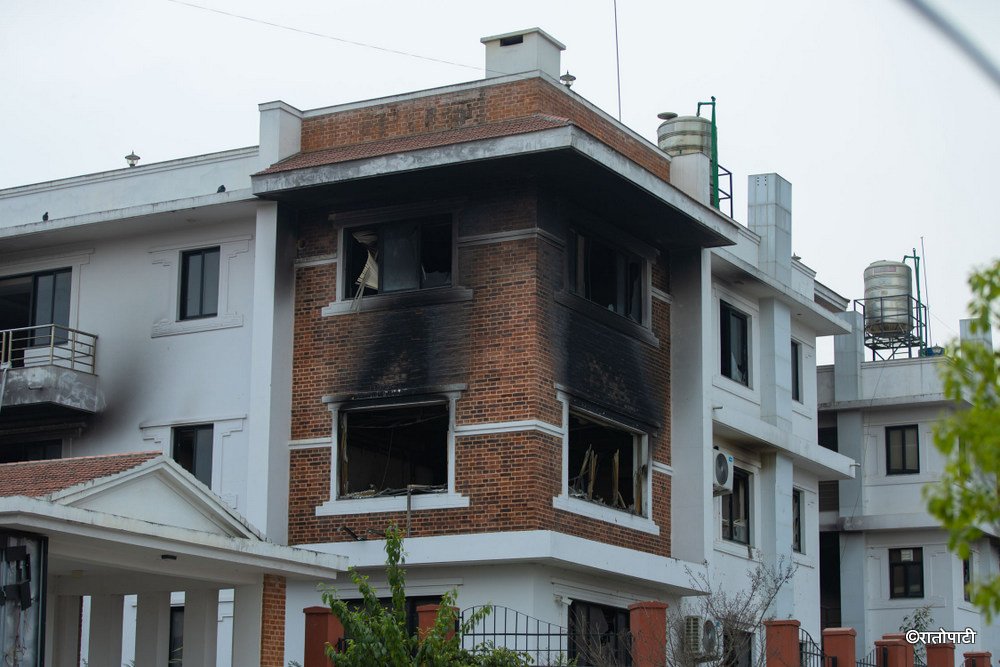
Kathmandu. The reconstruction of the state-of-the-art ministerial residence in Bhaisepati, completely destroyed by arson during the Genji movement, could not be completed within the stipulated time. The Federal Secretariat Construction and Management Office under the Ministry of Physical Infrastructure and Transport stated that the construction of 11 contracted blocks has been prolonged due to the protests and price hikes by construction entrepreneurs. Superintendent Engineer of the office, Chakravarti Kanth, told Ratopati that the reconstruction of the minister's quarters, which was targeted to be completed by the end of Asar, has been affected by price increases and protests by construction entrepreneurs. 'During this time, construction entrepreneurs took to protests. Also, the work slowed down due to the price hikes in the market,' Engineer Kanth said, 'Now, along with the construction work, the contract for furnishing has also been awarded and the work is underway.' He clarified that it is not possible to say exactly what percentage of work has been completed as some buildings have suffered 10 percent damage and others up to 90 percent. According to the office, out of the 27 blocks of the minister's quarters, contracts were awarded for 11 blocks with the aim of completing them by the end of Asar. The remaining 16 were contracted in the second phase. However, the reconstruction and interior decoration (interior) work of all 27 blocks is now being carried out simultaneously. The estimated cost for the reconstruction and decoration of all these blocks is approximately 38 crore 60 lakh rupees.
Reconstruction of 5 Blocks Completed
After the buildings were completely damaged by arson, the government proceeded with the reconstruction process after conducting a detailed damage assessment (DDA) of the buildings. According to Arun Bhujel, Information Officer and Engineer at the Federal Secretariat Construction and Management Office, the reconstruction of the minister's quarters has been carried out through contract agreements divided into three separate phases. The contract for the first phase of 11 blocks was called on February 11, with work progressing based on a contract of approximately 8 crore 60 lakh rupees. 'The target was to complete the construction of the first phase of 11 blocks by the end of Asar. However, the structural (civil) work of only 4 to 5 buildings has been completed, and the interior and furnishing work is underway,' said Information Officer Bhujel, 'Work is also progressing rapidly on the remaining buildings. Instead of handing over all buildings at once, we have adopted a strategy of handing over the buildings as soon as their interiors are completed, based on priority.' According to Bhujel, contracts have also been managed for the second and third phases of reconstruction. Contracts worth approximately 15 crore rupees each have been signed for the second and third phases, and work is progressing rapidly.
Extreme Housing Crisis for Ministers
On August 24, the day the Bhaisepati ministerial residence was set on fire, then Prime Minister KP Sharma Oli resigned. Subsequently, the country took a new political course, and an interim government was formed. However, due to the destruction of the ministerial residence, the ministers of the interim government faced a major housing problem. Ministers who owned houses in the Kathmandu Valley stayed in their own residences, but ministers without houses in the Valley were forced to live in rented houses. Then-interim government's Minister of Education, Dr. Mahabir Pun, set an exemplary but forced practice of sleeping on a bed in the ministry and carrying out daily tasks from there, citing that it would not burden the state financially.
After the elections, a new government was formed. However, the concern and crisis of 'where to live?' remain for the ministers. Some ministers are taking shelter in the old ministerial residence in Pulchok, Lalitpur. Minister of Science, Technology and Innovation, Dr. Mahabir Pun, is again staying in the ministry. The old ministerial residence in Pulchok, with 14 buildings constructed in 2028 BS and 5 more added in 2054 BS, was used as a ministerial residence for a long time. After the new structure was built in Bhaisepati, those old buildings were renovated and used as judges' residences. However, after the Bhaisepati residence burned down, some ministers in the Rastriya Swatantra Party-led government are forced to live in those old and cramped buildings. This crisis is likely to continue for ministers until the Bhaisepati residence is fully ready.
Work on Singha Durbar and Shital Niwas Yet to Begin
The Genji movement not only affected the Bhaisepati ministerial residence but also the country's main administrative center, Singha Durbar, and the President's residence. According to the Federal Secretariat Construction and Management Office, the repair and reconstruction of minor ministries and other small structures within Singha Durbar, which were damaged during the movement, have been completed. However, the reconstruction of the four major buildings, considered highly important for the state, has not yet begun. According to Engineer Chakravarti Kanth, the reconstruction of the west part of Singha Durbar's main administrative building (towards the gallery meeting room, which suffered the most damage), the Ministry of Home Affairs, the Ministry of Health, and the President's residence (Shital Niwas) are still pending. The office stated that the preparatory work, including the tender process, required for the reconstruction of these important buildings has been completed, and construction work will begin soon.
Structure worth One Billion, Ash in an Instant
The then government, finding the old ministerial residence in Pulchok, Lalitpur, dilapidated and cramped, constructed a state-of-the-art and grand ministerial residence in Bhaisepati on a 96 ropani, 10 ana plot of land. The complex, built at a cost of approximately 1 billion 3 crore rupees, offered high-level facilities including a community hall, gymnasium, and swimming pool, in addition to residences for ministers. The complex, built after a long wait and with a large investment, began to be occupied by ministers of the then KP Sharma Oli-led government from August 2082 BS. Less than a month after moving in, the Genji movement, which intensified nationwide, reached Bhaisepati. On August 24, the situation became very tense after protestors surrounded the ministerial residence from all sides. As the anger of the protestors became uncontrollable, it became impossible to evacuate the then ministers by road. Finally, the Nepal Army had to rescue the ministers by helicopter and move them to a safe location. Immediately after the ministers were rescued, protestors entered the residence, set fire to the state-of-the-art housing complex, and caused extensive vandalism, turning the billion-worth structure into ruins and ashes in an instant.
This specific news has been automatically translated by AI. As a result, there may be some inaccuracies or language errors.
_ufmo8stvl7_xyceyxrbf6_CvCBw1rk0X.jpg)


_6x26AmZer0.jpg)