
Courts Damaged in Protests Remain in Ruins, Justice Delayed

Pokhara. There is an old and famous legal principle, 'Justice delayed is justice denied.' This means that justice given after the time has passed has no justification. It does not provide relief to the victim.
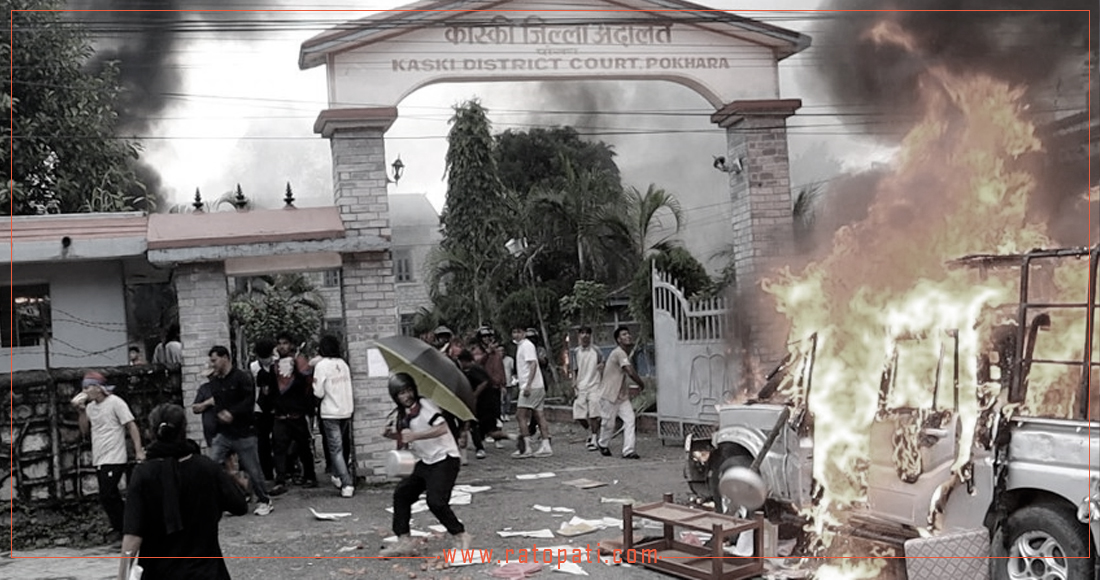
During the Genji protests on the 23rd and 24th of last Bhadra, the judiciary came under the target of the protesters. Fire was set and vandalism occurred in every area connected to law and justice, including the District Government Attorney's Office, the High Government Attorney's Office, the District Court, and the High Court.
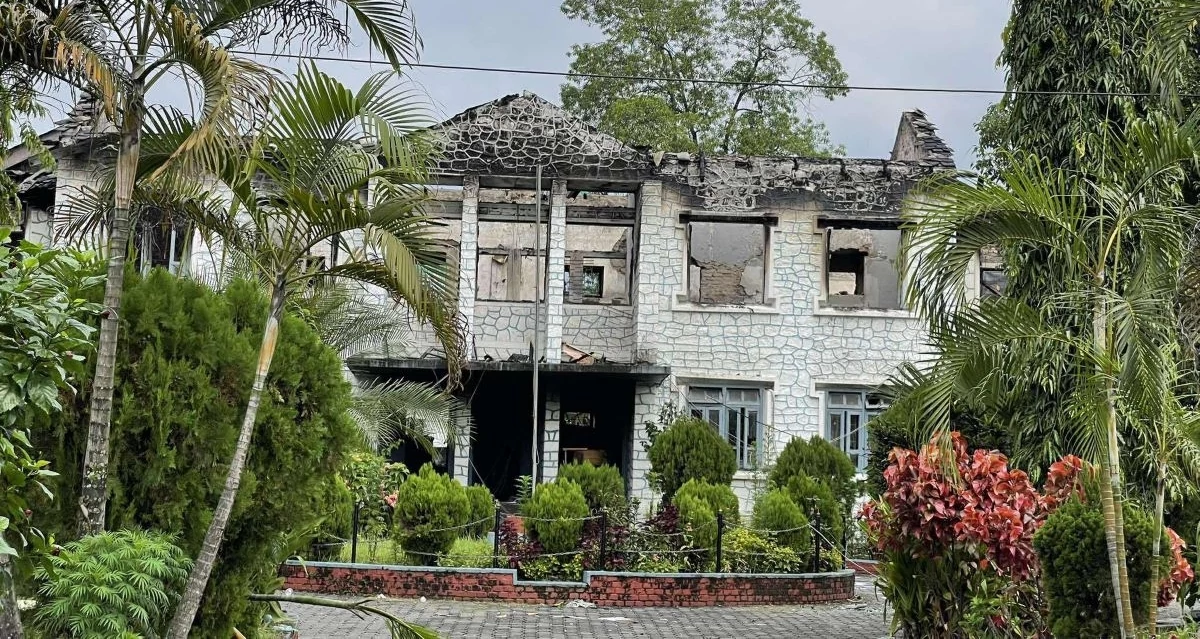
Although it cannot be definitively stated, those who are interested consider the 'Rabi Lamichhane file' to be the main reason for the fire in the Pokhara and Kaski courts. There may be other reasons as well. The court buildings that were destroyed by fire at that time are still in ruins. The district court's operations have been conducted from the residences (quarters) of judges and staff. The main court building was burned down to the extent that it had no roof. The situation is the same today as it was yesterday. The situation of the High Court, located near the District Court, is also the same.
Approximately one year has passed since the complaint of the High Court Pokhara has been stuck at the Kaski District Police Office. The police have neither investigated nor initiated the process of prosecution.
The judiciary, which always dispenses justice to everyone, has itself been subjected to injustice for a year due to the executive. A few days after the court was burned, the High Court summoned the police to the scene and handed over the evidence. Normally, a complaint goes from the police, the District Government Attorney's Office, and then to the court. The police investigate and submit it with evidence to the Government Attorney's Office.
The government attorney further investigates and files a case in court based on the evidence. However, for about a year, the complaint of the High Court Pokhara has been stuck at the Kaski District Police Office. The police have neither investigated nor initiated the process of prosecution.
"We prepared the panchnamas immediately after the court was burned. The work of filing the case is the responsibility of the Government of Nepal," said Nil Paneru, Upper Registrar of the High Court. "So far, no case has been filed by the investigating and prosecuting bodies."
The court has handed over videos and photos of the building being set on fire to the police office as evidence. At that time, fire was set to specific sections. The court stated that the sections where case files were kept were particularly damaged. According to Nepal's criminal justice system, only the Government of Nepal and the Government Attorney's Office have the authority to investigate and prosecute cases where the government is the plaintiff.
DSP Birendra Kumar Paswan, Information Officer of the Kaski District Police Office, said he would provide information after inquiring further. "A panchnama alone does not lead to filing a case. Let's see if there is a complaint," he said. "If there is a complaint, the investigation will determine whether to file a case."
The burned case files have been collected by the court from copies held by lawyers, police, and stakeholders. Approximately 400 case files were destroyed by fire during the protests. Even in this situation, the work of dispensing justice is being carried out somehow. "The court itself burned down, and we are in a situation where we have to seek justice ourselves," says Chief Judge Dr. Ratna Bahadur Bagchand. "Even after being burned, we are providing justice to everyone."
Due to the Genji protests, the daily operations have been affected by the burning of the building, and there has also been a contraction in case filing and judgments.
Registrar Ramu Sharma informed that the High Court building alone suffered damage worth approximately 5 crore rupees, and a report has been sent to the Supreme Court for reconstruction. "The details of the damage have been sent to the higher authorities. So far, 5.5 million rupees have been received, and we have already completed the work with it," he said. "The remaining work will be done once the budget arrives." One 12-room building of the court is still unusable. The High Court has 7 judges, but only 4 benches.
Even if the investigation is delayed, it is possible to file a case against it. However, no one has filed a case against the injustice suffered by the court. Recently, the Ministry of Home Affairs has directed its subordinate offices to be lenient regarding the Genji protest incidents. As a result, the police are not taking action against those involved in the vandalism and arson that occurred at that time.
Due to the Genji protests, the daily operations have been affected by the burning of the building, and there has also been a contraction in case filing and judgments. In the fiscal year 2082/083, there were a total of 2,069 cases, including old and new ones. There were 1,319 new cases and 750 cases carried over. Out of these, 1,570 cases have been disposed of, and 499 cases have been carried over to the current year.
Compared to the previous year, the rate of case disposal has decreased. In the last fiscal year 2081/082, out of 3,420 cases, 2,670, or 78 percent, were disposed of. However, long-pending cases have been reduced to zero. Last year, there were 4 cases pending for more than 18 months, but now there are no such cases left, informed Registrar Sharma. Nowadays, cases related to divorce and domestic incidents are more frequently filed in the court.
This specific news has been automatically translated by AI. As a result, there may be some inaccuracies or language errors.




_18aawmzmsd_sTzy83VQGv.jpg)
