New Monkey Species Discovered in Democratic Republic of Congo

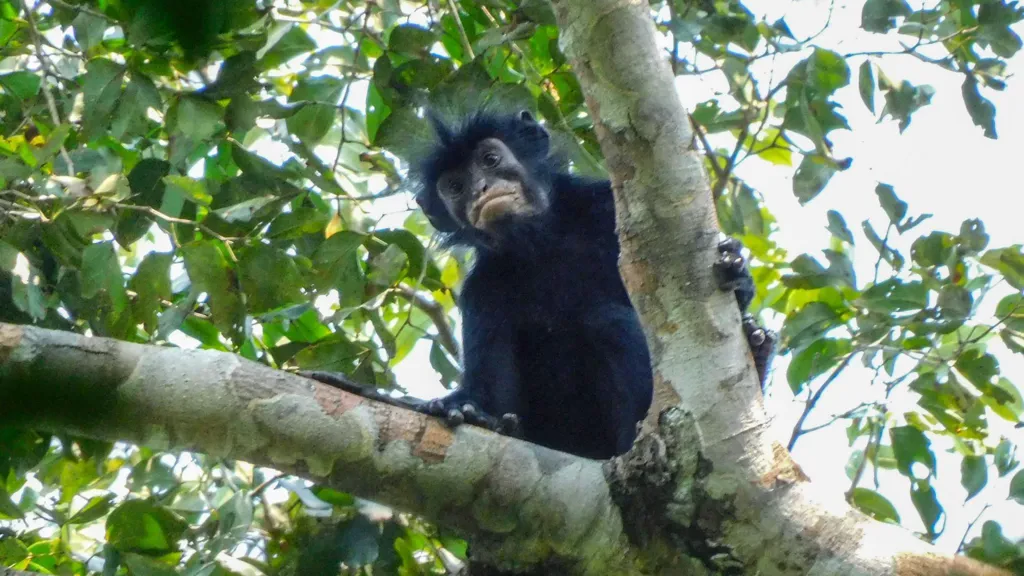
Congo. A monkey living in the jungles of the Democratic Republic of Congo, with attractive pink-orange lips and a black face, has been confirmed as a new species for science. This black-furred creature was found and photographed hidden in the high tree canopy of the dense tropical jungle of the Lomami National Park, located in the east of the country.
Conservationists working there first reported seeing this unusual-looking animal in 2008. But at that time, they could only take a blurry photograph. Ten years later, after seeing it again, an international team began searching for and studying this monkey, which revealed it to be a previously unknown species.
This is only the fifth new species of monkey discovered in Africa in the last 75 years. Junior Ambo, a PhD student at Florida Atlantic University, played a key role in this discovery, which included audio recordings, photography, and detailed genetic studies. The findings of this research have been published in the journal 'PLOS ONE'.
Ambo told BBC News that it was a 'wonderful feeling' to be able to look into the face of an animal whose existence very few people knew about. In this context, discovering a species means officially recording it and confirming that it is genetically distinct. Some local residents already knew about the existence of this monkey and call it 'Liqueley'.
According to Ambo, these monkeys are somewhat shy and tend to hide high up in the trees. During their research, they interviewed people in 52 villages near the animals' habitat. But only people in eight villages had seen them before.
A team of researchers from Congo, America, and Germany has given this animal the Latin name 'Colobus congolensis', appreciating the country's natural diversity. This monkey belongs to the large group of Colobus monkeys. Professor Kate Detweiler of Florida Atlantic University said, 'These are truly important African monkeys that do not have thumbs.'
She added, 'They are herbivores living in the upper canopy of the forest and are an important part of the ecosystem.' Researchers estimate that they play a significant role in seed processing and germination in the forest.
According to Professor Detweiler, the unusual and bright face of these monkeys may serve as a visual cue for other animals, potentially helping to attract mates or recognize each other. These monkeys also have a distinct roaring sound.
Ambo said, 'You often hear their voices, but you don't see them.' According to researchers, these animals are rare and confined to a specific part of the forest where they can find the food and habitat they need.
Researchers hope that this species can now be officially protected, as these animals have been hunted for their meat. According to researchers, many questions remain about this new and mysterious species. They plan to conduct more detailed surveys to estimate their population and study their behavior.
This specific news has been automatically translated by AI. As a result, there may be some inaccuracies or language errors.