
Mechi Highway Section Blocked Due to Heavy Rainfall, Disrupting Traffic to Eastern Hill Districts

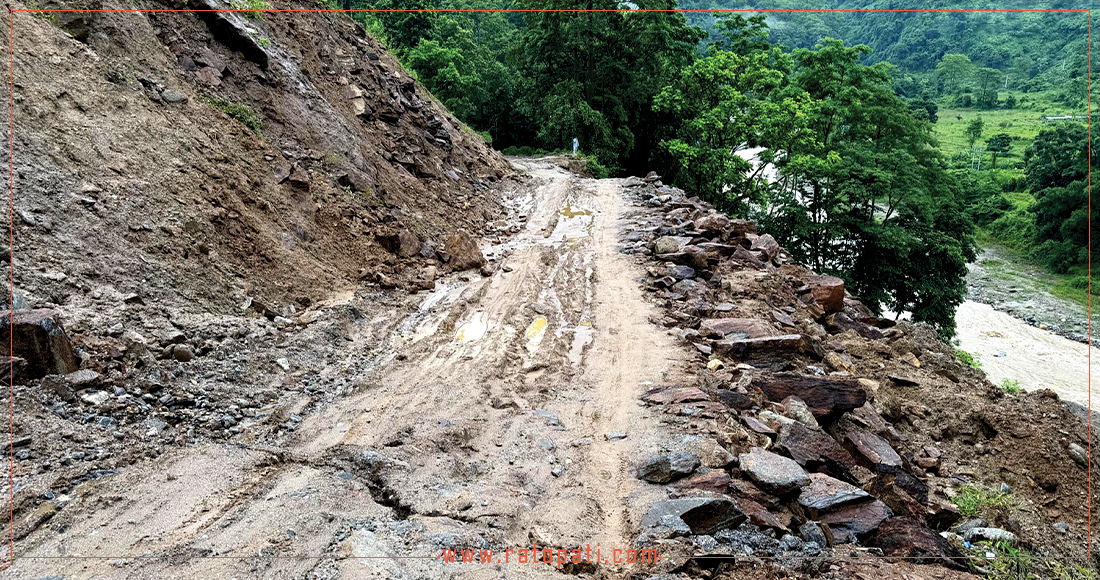
Biratnagar. The Rajduwali section of the Mechi Highway has been blocked again due to continuous rainfall for the past few days. This has severed the direct road connection of the eastern hilly districts of Ilam, Panchthar, and Taplejung with the Terai. Not only the main highway but also alternative routes have been washed away by floods and landslides, making it difficult to transport essential goods to these three districts.
The Rajduwali section in Ilam had been at risk for the past four days. On Monday, the road further subsided, halting all types of vehicles, both small and large. The alternative route, Simlagoai-Tilkeni, which was immediately put into use after the highway was blocked, has also been closed after the diversion on the Jogmai River was washed away by the flood. Similarly, traffic has been completely halted as floodwaters are flowing over the diversion of the Puwa River on the Kichana-Kanchenjunga Fast Track connecting to Jhapa.
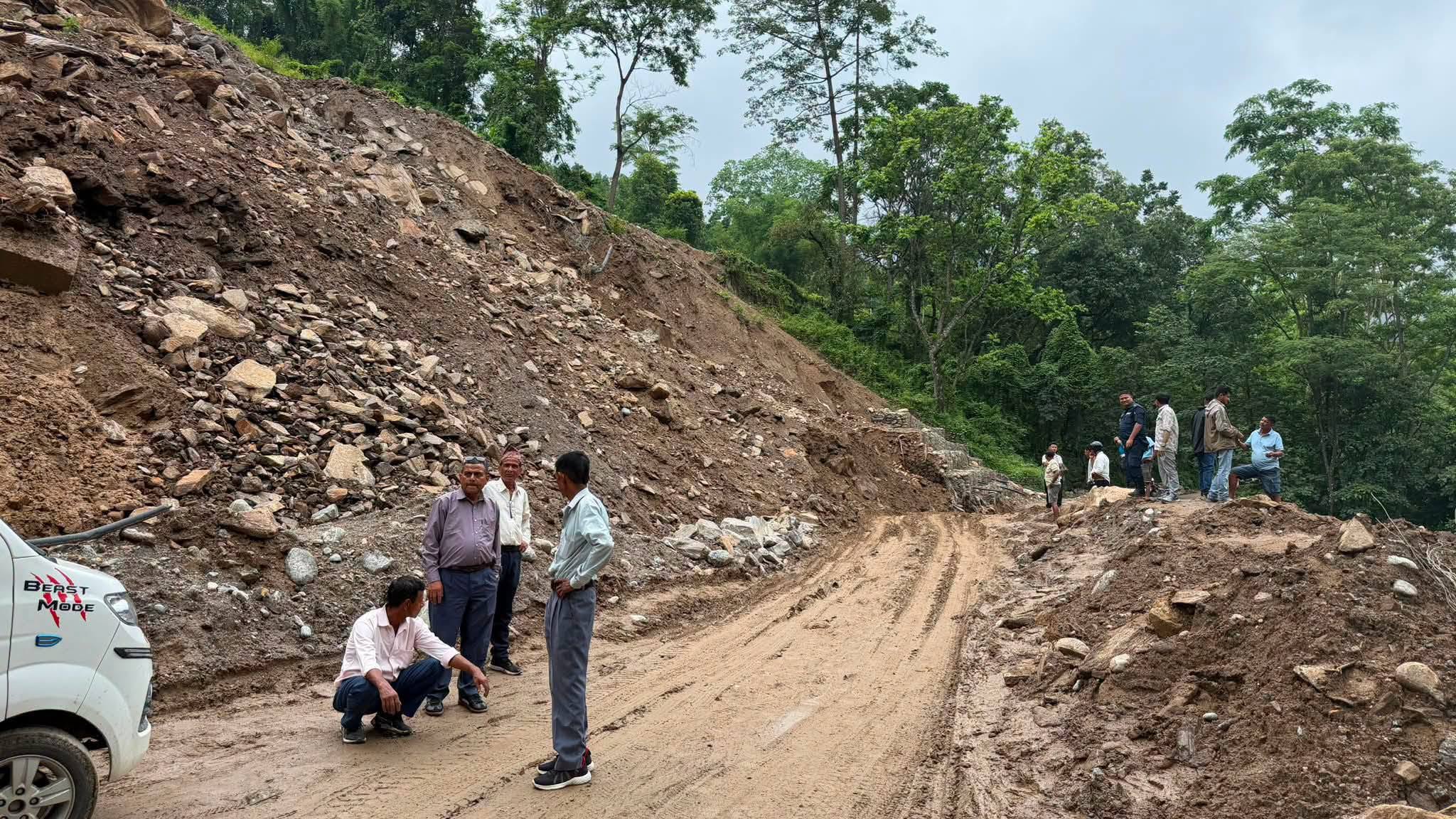
The crisis has deepened due to the delay in the import of Bailey bridges from India, which were supposed to be installed over the Puwa and Jogmai rivers. According to the Division Road Office, it will still take 15 to 20 days for the Bailey bridges to arrive. With the highway blocked, a large number of cargo vehicles and fuel tankers are stranded on the other side of the Mai River.
According to transport entrepreneur Grishma Subba, it is currently impossible to transport vehicles through the landslide-affected area. He said, 'Efforts are being made to transport goods somehow using small vehicles through the alternative unpaved road at Simlagoai, but this has significantly increased transportation costs. Transporting goods by small vehicles incurs an additional fare of up to five thousand rupees per trip.'
There is a compulsion to transport LP gas cylinders and petroleum products by small vehicles. Shortages of daily necessities have already begun to appear in Ilam headquarters and Billante Bazaar and surrounding areas. Complaints have surfaced in the market about the unnatural increase in the prices of food, vegetables, and gas, citing increased transportation costs.
Ilam Municipality Mayor Kedar Thapa stated that the municipality is vigilant to prevent artificial scarcity and price hikes in the market. 'As the lifeline of the hilly districts has been disrupted, there are sporadic complaints about shortages of consumer goods and price increases in the market. We are intensifying market monitoring in coordination with the Chamber of Commerce and the District Administration Office. Anyone found exploiting consumers during this crisis will be brought under the purview of action,' Thapa said.
The price of construction materials has also seen significant fluctuations due to high transportation costs. There is a shortage of iron rods, bricks, gravel, and sand, and the price of cement has increased by up to one hundred and fifty rupees per bag. According to construction entrepreneurs, many development projects have also been affected as transportation vehicles are stuck on the other side of the Mai River.
The export of agricultural produce, considered the main source of income for the eastern hills, has also come to a halt due to the road blockade. Products like tea, ginger, ghee, chhurpi, broom grass, and Akabare chili are on the verge of rotting as they cannot be sent to the Terai markets and India.
It is currently the main season for tea, but tea gardens and processing industries are on the verge of closure due to the inability to transport tea and the shortage of fuel (diesel) in the factories. The electricity supply in this region is also not regular and reliable, requiring generators to be run with diesel. However, with diesel tankers unable to arrive due to the road blockade, tea industry operators are facing a double blow. According to entrepreneurs, finished tea products are piling up in warehouses, leading to losses worth millions.
The biggest impact of the severed road network is on emergency patients and new mothers. As there are no well-equipped and reliable hospitals in Ilam, Panchthar, and Taplejung, critically ill patients have to be referred to Jhapa or Biratnagar. 'During the daytime, it might be possible to somehow transport patients across the landslide-affected Rajduwali section by carrying them or moving vehicles, but at night, if someone becomes critically ill, there is no way to get them to the hospital. In such a situation, chartering a helicopter seems to be the only option, which is far beyond the reach of ordinary citizens,' said transport entrepreneur Subba.
The landslide at the Rajduwali section is not a new problem. It has been a recurring issue during the monsoon for the past 5-6 years. The severe floods and landslides on October 4 and 5 last year further weakened this section. Since then, even with normal rainfall, this section has been prone to subsiding and washing away.
According to Indra Bahadur Angbo, a provincial assembly member from Panchthar, the geographical structure of Rajduwali is weak, and its permanent solution lies in shifting this section of the Mechi Highway to a safer location or developing a reliable alternative route. 'Alternative routes like Damak-Chisapani, Letang-Budhabare, or Damak-Rabi are all unpaved. The Tamor Corridor also gets blocked as soon as it rains. Therefore, it is necessary to upgrade the Tamor Corridor road to be operational throughout the year,' Angbo said.
Angbo stated that despite numerous efforts to make the road sustainable at the Rajduwali section for a long time, they have not been successful. However, he mentioned that an alternative route will be ready within the next year. 'Positive changes are expected in the transportation sector of the eastern hills within the next year. The upgrading and blacktopping of the Ranke-Bhedetar road section are progressing rapidly. Furthermore, the main bridges of the Tamor Corridor are also nearing completion within the next year. Once these roads are fully operational, the dependency on the Rajduwali section will be reduced, and the eastern hills will have a strong alternative route,' Angbo said.
Former minister and Ilam provincial assembly member Rambahadur Magar blamed the federal government's lack of attention towards the eastern hilly districts for the current difficulties. 'The federal government has shown no interest. If there had been interest, the road would have been built by now,' he said.
Mayor Kedar Thapa also admits that finding a permanent solution for Rajduwali is long overdue. 'We have repeatedly urged the federal government and the Ministry of Physical Infrastructure to find a permanent alternative for the Rajduwali section. As this is a federal highway, a permanent solution is not possible with local resources alone. It needs to be prioritized nationally to determine its diversion or new alignment,' Thapa said.
Mayor Thapa also suspects that the perennial landslides and road subsidence at the Rajduwali section may not be solely due to natural rainfall but also due to water leakage from local hydropower projects. According to him, water has been observed flowing continuously underground in that area for the past few years. 'There is widespread suspicion that water is leaking from the penstock pipes or dams of hydropower projects in that area. Technical analyses also indicate that water seeping into the ground is causing the soil in Rajduwali to become loose and wash away,' said Mayor Thapa.
Earlier, geologists, consultants from the Ministry of Physical Infrastructure of the Nepal Government, had also conducted field studies in the area. The technical team also stated that improper water drainage and leakage of water underground could be the main reasons for the road subsidence.
This specific news has been automatically translated by AI. As a result, there may be some inaccuracies or language errors.

_gcmnFrn8Po.jpg)