Government Fears Press, Undermining Democratic Values


Democracy's greatest strength is not just elections, but also the freedom to question. Governments can change, prime ministers can change, ministers can change. But the fundamental values of democracy must not change. The most important of these values is—free press.< /p>
Freedom of the press is not established to make any government fail or to weaken the सत्ता. Its purpose is to make the government accountable to the people, to monitor public power, and to ensure citizens' right to know. Nepal's constitution has given every citizen the right to freedom of expression and information. Journalism plays a role in practically implementing that constitutional right. Therefore, a journalist questioning the government is not anti-government activity, but a natural practice of democracy.< /p>
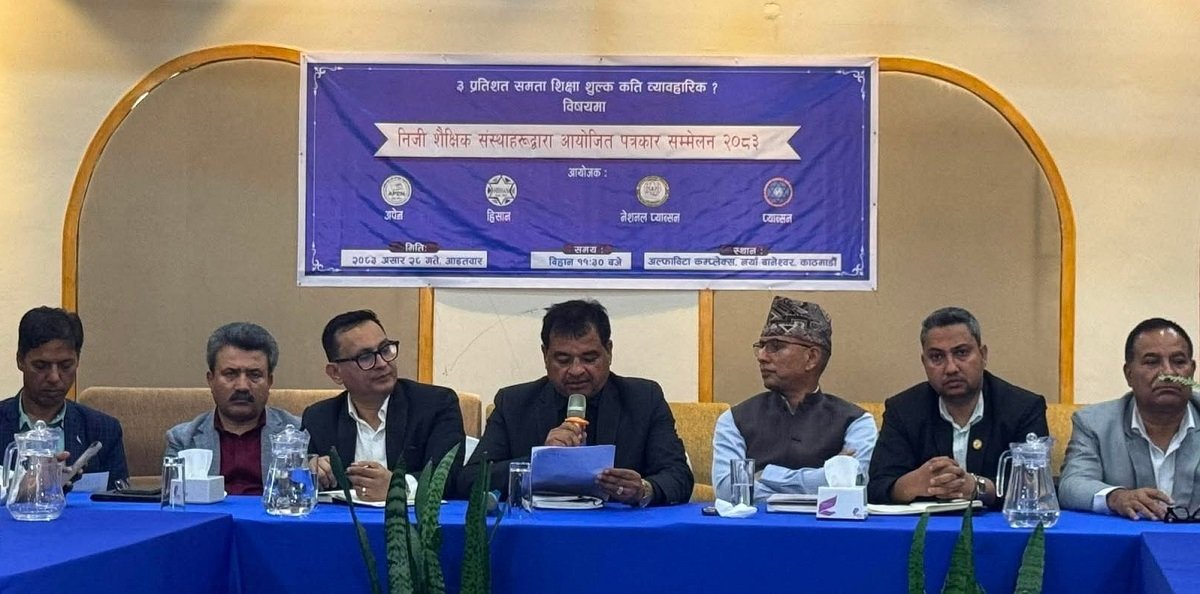
However, the trend seen in Nepal in recent months has increased concern. On public occasions, when journalists ask questions to the prime minister or ministers, the scenes of evading questions, not wanting to respond, or expressing dissatisfaction towards journalists have been repeatedly publicized.< /p>
Not only this, some supporters of the government on social media have also increased the trend of accusing media outlets and journalists who publish critical news of 'not letting the government work', 'spreading negativity', or being 'prejudiced'. Such a trend increases the risk of weakening the healthy democratic relationship that should exist between the government and the press.< /p>
International reports have also indicated this concern. Although Nepal's position has improved somewhat in the 2026 World Press Freedom Index published by Reporters Without Borders, it has been mentioned that the environment for journalists to work has become even more challenging.< /p>
Similarly, Media Action Nepal's Press Freedom Report—2026 has expressed serious concern over the increasing pressure on press freedom by documenting threats, attacks, legal pressure on journalists, and various types of obstacles to independent journalism. These reports are not just international assessments; they are also warning signs arising in Nepal's democratic practice.< /p>
In this context, a serious political question has arisen. When today's ruling leaders were in opposition and the media criticized the then government, they considered it an important act of democracy. They presented investigative journalism as a symbol of courageous journalism. They considered questions raised about corruption, irregularities, and policy decisions as the basis of public accountability. But after the change of power, why has the same questioning become uncomfortable today?< /p>
Does the correctness or incorrectness of a journalist's question depend on the government? Or does the standard of democracy change with the change of power?< /p>
In a democracy, questions arising about the government are not a sign of failure. Rather, the cessation of questions is a cause for concern. Where journalists start to fear, citizens also gradually become silent. Where criticism is considered a narrative created by the enemy, transparency weakens. And where power is placed above questioning, the very soul of democracy weakens.< /p>
This does not mean that the media is flawless. Factual errors can occur in journalism, there can be disagreement with editorial decisions, or a news item may be incomplete. But in a democratic society, the solution is not to threaten journalists, declare media as enemies, or suppress criticism. The solution is to refute with evidence, provide public clarification, and use quasi-legal mechanisms like the Press Council.< /p>
Turning institutional disagreement into personal attack does not align with democratic culture.< /p>
In reality, the government itself relies on the media to convey its achievements to the public. During elections, the press is also the medium to convey its agenda, manifesto, and vision to the public. Therefore, the perspective that the press is a friend of democracy when positive news comes and an enemy when critical news comes is inconsistent with democratic values.< /p>
In countries with mature democracies, the strength of the government is measured not by the questions of journalists, but by the trust of the people. A government that answers questions based on facts, evidence, and work, rather than evading them, is considered democratically strong. The ability to tolerate criticism is the measure of the maturity of democratic leadership.< /p>
At the juncture where Nepal stands today, there is a dire need for dialogue between the government and the press, not confrontation. A political culture of listening to criticism, not suppressing it, must be developed. Freedom of the press is not a right to be used according to the government's convenience; it is a constitutional right of the citizens. Therefore, respecting it is not an optional decision for any government, but a democratic responsibility.< /p>
If the government is fully confident in its policies, decisions, and work, why should it be uncomfortable with journalists' questions? In a democracy, a question is not an insult to the government, but the right of the people. And a government that can respect that right is truly a democratic, confident, and strong government.< /p>
This specific news has been automatically translated by AI. As a result, there may be some inaccuracies or language errors.

_acsSMbCX4V.jpg)