Nepal's Budgetary Performance Shows Imbalance and Challenges Over Three Fiscal Years

Kathmandu. According to the details of the daily receipts and expenditures of the Government of Nepal, the budget implementation status of the country has appeared imbalanced and challenging in the past fiscal years.
A comparative study of the data until Asar 26 of the three fiscal years published by the Office of the Auditor General shows that the contraction in the government's revenue collection and the sluggishness in capital, i.e., development expenditure, have created serious pressure on the country's economy.
The budgetary progress until Asar 26 of fiscal years 2080/081, 2081/082, and 2082/083 clearly indicates that a large portion of government expenditure is concentrated only on current and administrative work. Comparing the target and progress of all types of government revenue and total receipts, a gradual fluctuation is observed.
In fiscal year 2080/081, the target for total receipt collection was 14 lakh 72 thousand 847 lakh rupees, or 14 kharba 72 arba 48 crore 47 lakh rupees, but only 10 lakh 24 thousand 370 lakh rupees, or 10 kharba 24 arba 83 crore 70 lakh rupees, were collected. This is a progress of 69.6 percent.
In the following year, fiscal year 2081/082, the target for total receipts was set at 14 lakh 71 thousand 629.5 lakh rupees, or 14 kharba 71 arba 62 crore 95 lakh rupees, and 11 lakh 35 thousand 31 lakh rupees, or 11 kharba 35 arba 30 crore 31 lakh rupees, were collected, achieving a progress of 77.15 percent.
Similarly, in fiscal year 2082/083, a target of 15 lakh 33 thousand 446.9 lakh rupees, or 15 kharba 33 arba 44 crore 69 lakh rupees, was allocated for receipts, and 12 lakh 18 thousand 898.9 lakh rupees, or 12 kharba 18 arba 89 crore 89 lakh rupees, were collected, achieving a progress of 79.49 percent. Although the percentage of revenue collection appears to have increased slightly, the progress of tax revenue and foreign grants has not been as expected year after year.
Looking at the comparative status of expenditure, a significant difference is observed between the allocated budget target and the actual expenditure rate. In fiscal year 2080/081, the total expenditure target was 17 lakh 51 thousand 121 lakh rupees, or 17 kharba 51 arba 13 crore 21 lakh rupees, of which 13 lakh 57 thousand 226 lakh rupees, or 13 kharba 57 arba 52 crore 26 lakh rupees, were spent, which is 77.51 percent.
In fiscal year 2081/082, the expenditure target was increased to 18 lakh 60 thousand 30 lakh rupees, or 18 kharba 60 arba 3 crore rupees, and 15 lakh 5 thousand 738 lakh rupees, or 15 kharba 5 arba 57 crore 38 lakh rupees, were spent, achieving a progress of 80.93 percent.
In fiscal year 2082/083, the total expenditure target was allocated at 19 lakh 64 thousand 100 lakh rupees, or 19 kharba 64 arba 11 crore rupees, but only 15 lakh 65 thousand 390 lakh rupees, or 15 kharba 65 arba 13 crore 90 lakh rupees, were actually spent, which is 79.69 percent.
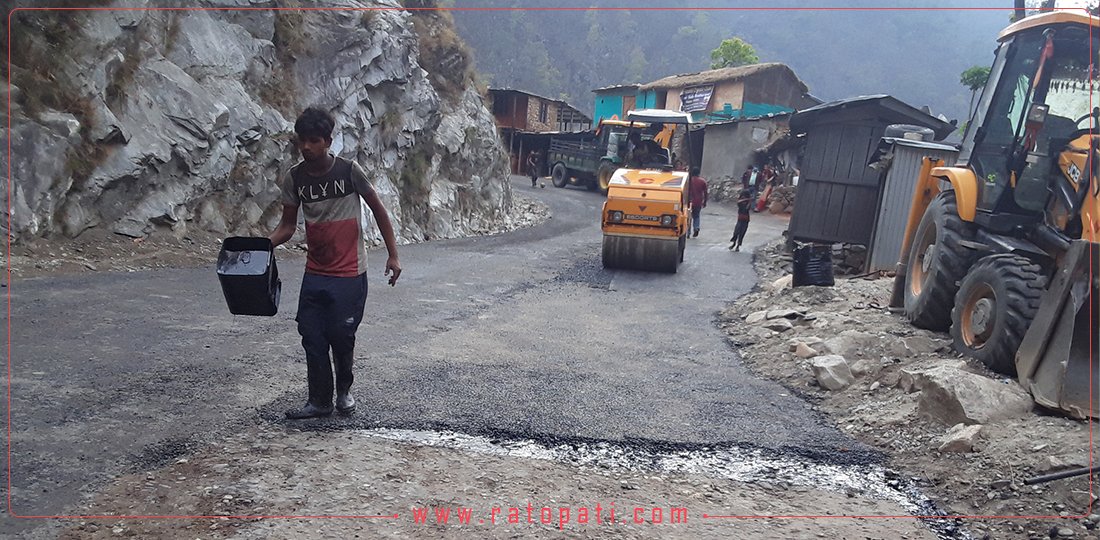
The government's capacity to spend on capital expenditure, which is directly related to the country's infrastructure development, has remained consistently weak. Until Asar 26 of fiscal year 2080/081, only 57.15 percent of the total capital allocation, or 1 lakh 72 thousand 624 lakh rupees, equivalent to 1 kharba 72 arba 62 crore 40 lakh rupees, was spent on development.
In the second year, fiscal year 2081/082, although there was some improvement in capital expenditure, it was limited to 59.23 percent, or 2 lakh 8 thousand 639 lakh rupees, equivalent to 2 kharba 8 arba 63 crore 90 lakh rupees. More concerning is that by Asar 26 of fiscal year 2082/083, this expenditure has further declined to only 44.51 percent, or 1 lakh 81 thousand 562.5 lakh rupees, equivalent to 1 kharba 81 arba 56 crore 25 lakh rupees.
In contrast, expenditure related to current expenditure and principal and interest payments has always remained above 80 percent. Due to weak revenue collection and increasing expenditure, the government has consistently faced a large budget deficit.
In fiscal year 2080/081, the budget deficit was 3 lakh 32 thousand 856 lakh rupees, or 3 kharba 32 arba 85 crore 60 lakh rupees. In the second year, this deficit increased to 3 lakh 70 thousand 707 lakh rupees, or 3 kharba 70 arba 70 crore 70 lakh rupees. In fiscal year 2082/083, a budget deficit of 3 lakh 46 thousand 240.1 lakh rupees, or 3 kharba 46 arba 24 crore 1 lakh rupees, was recorded by the end of Asar.
Thus, analyzing the budget of three consecutive fiscal years shows that the government has not been able to improve its capital budget spending capacity, and only the burden of internal debt and budget deficit has increased, indicating the need for serious policy reforms for long-term economic balance.
This specific news has been automatically translated by AI. As a result, there may be some inaccuracies or language errors.
-purbadhar-bikas_OADnJGgqAk.jpg)