Indigenous Nationalities Commission Proposes 25-Point Constitutional Amendment

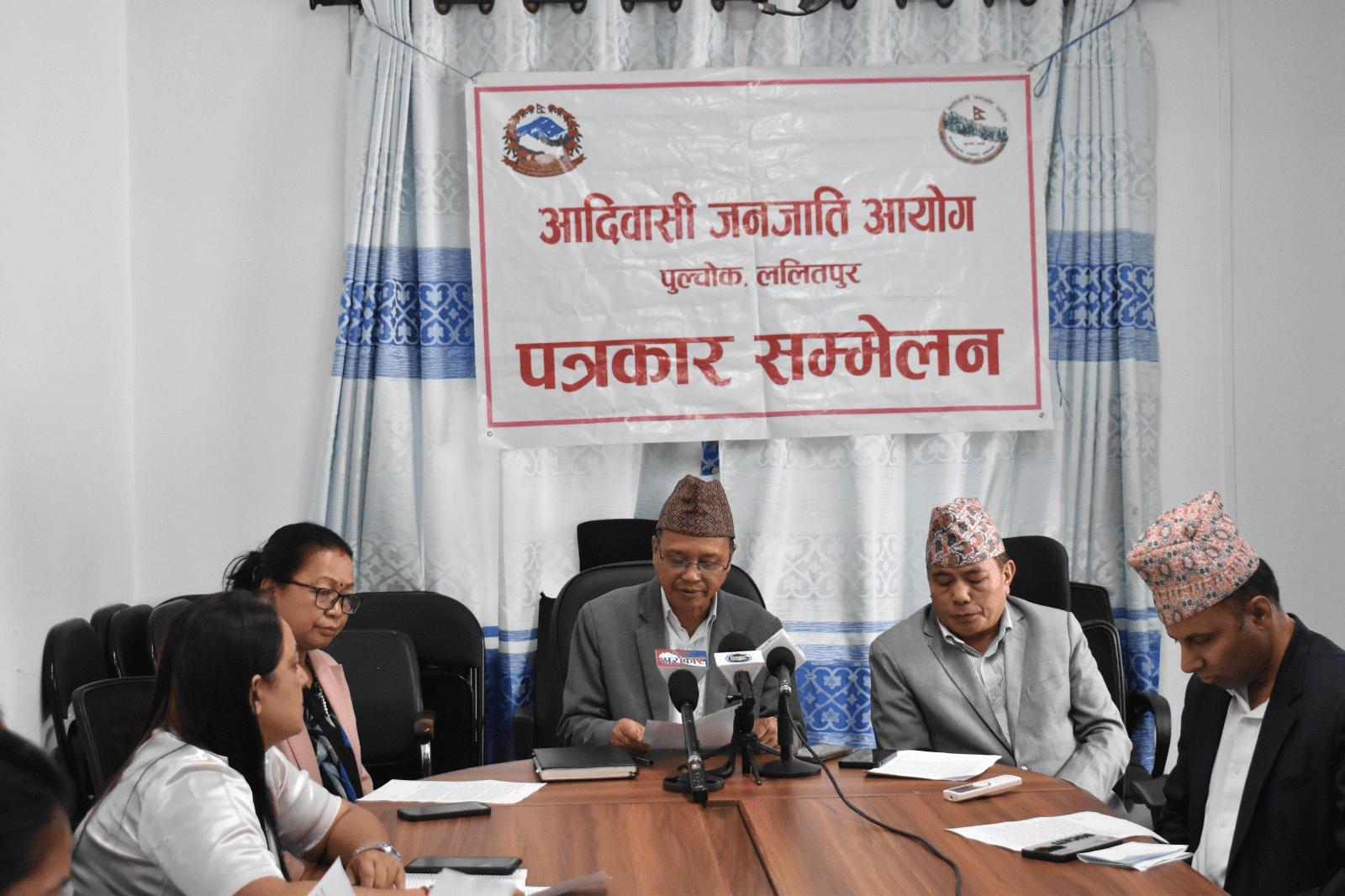
Kathmandu. The Indigenous Nationalities Commission has put forward a 25-point amendment proposal demanding revisions to the current constitution of Nepal.
The commission presented its demands at a press conference. The commission has demanded constitutional amendment to ensure proportional representation of Indigenous Nationalities, Madhesi, Dalit, Muslim, and women, and to institutionalize identity and rights.
The commission has proposed significant changes to the country's national identity and linguistic system. Among these, it has been demanded that the rhinoceros be designated as the national animal instead of the current cow. Similarly, the commission has drawn the government's attention to arrange for all languages spoken and written by indigenous nationalities to be made the language of government work, and to be able to sing the national anthem in the languages specified by province.
The commission states that the state should take responsibility for the linguistic and cultural preservation of each community, and citizens should also have a responsibility in this. It has been proposed to create 4 levels of state structure: federal, provincial, local, and protected or autonomous areas, by changing the existing state structure, and to establish protected or autonomous areas accordingly.
To prevent displacement in the name of development, a guarantee has been demanded that no development and construction plans or projects should displace indigenous communities from their traditional occupations, businesses, and lands without their free prior informed consent.
The commission has also demanded a fully proportional system in the formation of major positions at the federal level and the Council of Ministers. It is the commission's demand that the President and Vice-President should be elected from different genders and communities respectively, and the federal Council of Ministers should be formed based on the principle of proportionality according to population. It has also been demanded to ensure proportional representation in the first-past-the-post electoral constituencies based on ethnic population.
Furthermore, it is the commission's conclusion that it would be appropriate to make one woman mandatory for the Speaker and Deputy Speaker of the House of Representatives and the Chairperson and Vice-Chairperson of the National Assembly, and to select them based on a rotational system from the Khas Arya, Indigenous Nationalities, Madhesi, Dalit, or Muslim communities.
Emphasizing the issue of full proportional inclusivity in the judiciary, the commission has demanded proportional representation of Khas Arya, Indigenous Nationalities, Madhesi, Dalit, and Muslim based on ethnic population in the appointment of judges in the Supreme Court, High Court, and District Courts. The proposal mentions that in the structure of the Judicial Council, which includes the Chief Justice and the Minister of Law, the government should appoint 4 additional members ensuring proportional inclusivity of these communities.
Regarding the provincial system, the commission demands proportional representation based on the population of the respective province when forming the provincial Council of Ministers and in the first-past-the-post system. In addition, it has been proposed to prioritize Indigenous Nationalities, Madhesi, Dalit, and Muslim when selecting the Chief Minister and Provincial Speaker.
The commission has argued that these amendments are indispensable for the full implementation of the rights guaranteed by international treaties and the United Nations Declaration for the Indigenous Nationalities community, demanding that the current commission's name be 'National Indigenous Nationalities Commission' and its functions, duties, and authority be clearly and strongly stated in the constitution.
This specific news has been automatically translated by AI. As a result, there may be some inaccuracies or language errors.