Number of Devotees and Exercisers Increases at Historical Maulakalika Temple

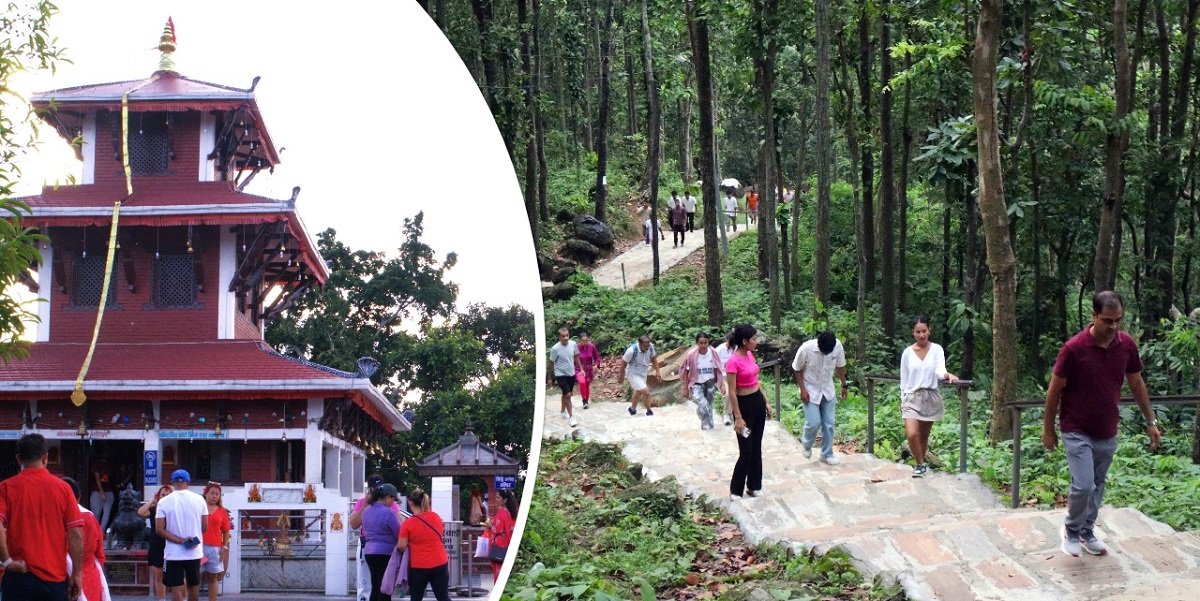
Nawalparasi. The number of people coming to the historical religious site Maulakalika Temple, located in Gaindakot-1 of Nawalparasi (Bardaghat-Susta East), for worship and exercise is increasing. This temple, situated on a hilltop about four kilometers north of the Mahendra Highway from Gaindakot, is also visited by locals for daily exercise.
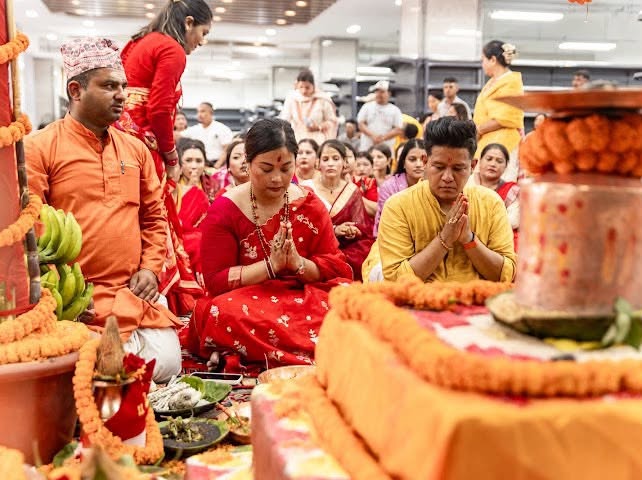
Khagendradas Kandel, Chairman of the Religious Service Committee Maulakalika, mentioned that devotees come from far and wide to see Goddess Kali, and locals also come for daily physical exercise. "Devotees come to this historical Shaktipeeth not only from Nepal but also from India," he said, "but local youths come to the temple daily for exercise."
Kandel stated that the number of devotees is higher on holidays compared to regular days. "More than two thousand devotees visit the temple daily," said Chairman Kandel, "but on Saturdays and other holidays, and during festivals, there is a huge crowd of devotees here." Kandel added that there is a significant presence of devotees during special occasions like Navadurga (Bada Dashain), Maghe Sankranti, Saraswati Puja, Chaitra Dashain, and New Year.
"During Dashain and New Year, people have to wait for five to six hours in line to see the Goddess here," Kandel said, "and we face significant management challenges during these special festivals."
The Maulakalika Bhagawati temple is located on a hilltop in a hilly forest area at an altitude of 561 meters above sea level. The historical significance of this place stems from the 16th century when Palpa King Manimukunda Sen created a symbolic presentation site in the name of Goddess Kalika, which led to the naming of this mountain (Maula Pahaad), according to the temple's chief priest, Kshetraprasad Parajuli. "In the 16th century, this area was part of the Palpa kingdom. King Manimukunda Sen had established a barrack for his security," he said, "The king used to bathe and worship here. The soldiers established the deity and worshipped her as a form of faith."
Parajuli mentioned that the old structure of the temple was completely destroyed in the earthquake of 1990 BS (1933 AD), and the place where Maulakalika Mata was worshipped became a forest. "About 40 years after the earthquake, a Brahmin named Kashinath Poudel had a dream where a woman in white clothes told him, 'I am the Goddess, rescue me, I am stranded under a large Sal tree on a hill'," he said. "The next day, when the Brahmin went to tell his neighbors, Kumar Singh Gurung believed him and, with his help, cleared the jungle, finding a large Sal tree at the hilltop, according to local accounts." Parajuli added that after digging at the base of the tree, they found a rusted bell, a grinding stone, and a stone idol of Goddess Kalika, after which a place of worship was established.
"Due to the influence of the Kalika that originated here, devotees started coming from various places," said Parajuli. "As devotees from different places began to say that their wishes were fulfilled due to faith and devotion, the number of devotees coming here has continuously increased." According to Parajuli, in Hindu mythology, Goddess Kali or Kalika Mai is considered a symbol of energy, power, and new beginnings. "The temple has been rebuilt many times by the local community," he said.
Being close to the urban area, the number of locals coming to the temple for worship of Goddess Bhagawati and for physical exercise is increasing day by day. "We come to the temple regularly to improve our running and for various exercises," said Shubham Adhikari from Gaindakot. "I regularly visit the temple as physical fitness is necessary for preparing for the Lahure (army recruitment)." Youths preparing to join the Nepali Army, Indian Army, and British Army come to the temple daily for running.
Samir Gurung, who has completed his Grade 12 exams from a private college in Gaindakot, said he visits the Maulakalika Temple on Saturdays and holidays. "I aspire to become a British Lahure, so I am working hard," he said. "We climb the temple in groups, and it takes about 20 minutes to reach the temple by running." Gurung mentioned that while they climb the uphill path carrying weights in winter, they run empty-handed during the summer months.
Ramanresh Yadav, who came from Janakpur in Dhanusha to visit Maulakalika, said it was easy to reach near the temple by auto-rickshaw. "We came to see the glory of Maulakalika Mata," he said. "We were in Devghat for a meeting, and we took the opportunity to visit Maulakalika Mata."
Yadav added that upon reaching the temple after feeling hot at the foothills of Maulakalika Temple, the sight of Goddess Bhagawati and the environment there gave him a unique sense of happiness.
Yoga leaders Ram Dev and Acharya Balakrishna also visited and toured the temple in 2011. It takes climbing approximately 1,882 steps to reach the temple via the staircase route. Currently, reaching the temple is made easier by walking, small vehicles, and a cable car.
This specific news has been automatically translated by AI. As a result, there may be some inaccuracies or language errors.