Irrigation Expansion Boosts Farming in Mangsebung

_xNfaHPeaw1.jpg)
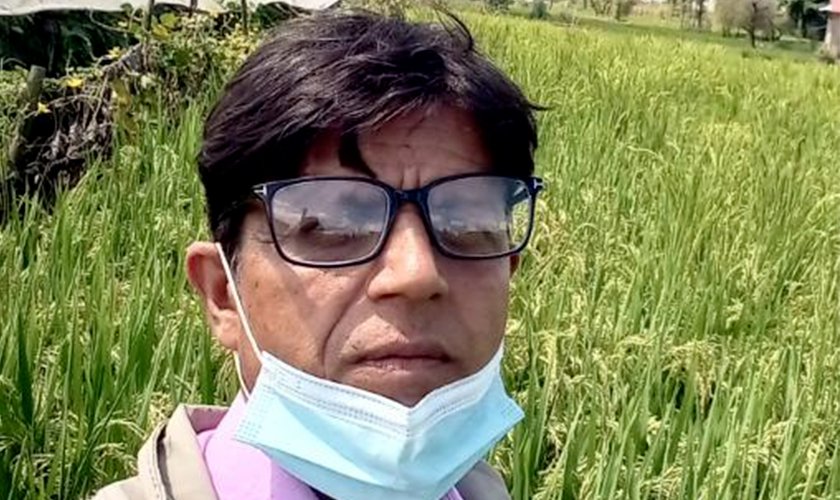
ILAM. Farmers in Ilam's Mangsebung Rural Municipality-2, Malbanse, have no problem cultivating paddy this year. Those who have been relying on rain-fed agriculture for years are now free from their old problem. The construction of concrete irrigation canals under the Small Irrigation Program has brought smiles to the faces of farmers in Malbanse. "In the past, we used to wait for rain-fed water; this year, we are freed from that compulsion with the expansion of irrigation facilities from the beginning," said the plan consumer committee chairman, adding, "I and more than 50 farmers here have been freed from the old suffering."
More than 50 farmers, including Magar, are happy with the construction of a systematic irrigation canal under the Small Irrigation Program in Malbanse. A Twanagre-Balbanse irrigation canal has been constructed from the Twanagre stream at a cost of Rs 30,36,000 in his locality. With the construction of the canal, farmers in Malbanse are happy to be freed from the hassle of waiting for rain-fed water for years.
Farmer Tikaram Kerung of Mangsebung-5 is also happy. Kerung and almost all the farmers in the ward are happy as concrete canals have been constructed from the local Mewa Khola irrigation scheme, bringing plenty of water to the fields. Kerung said that the irrigation project has provided great relief to the farmers of Mewa Tole, who were forced to leave their fields barren due to lack of water.
Magar and Kerung are just examples. Hundreds of farmers in Mangsebung are excited by eight small irrigation programs operated in four wards of Mangsebung. Farmers are excited as irrigation facilities have reached barren fields.
In the fiscal year 2082-083, eight concrete canals, including maintenance, have been constructed in Mangsebung at a cost of Rs 1,17,41,711. The Ratuwa Khola-Baghmara-Singphere-Marchebung irrigation scheme in Ward No. 4, which started construction last year and was incomplete, has been completed this year with an additional cost of Rs 10,45,039. Similarly, the Mewa Khola irrigation scheme has been completed in Ward No. 5 at a cost of Rs 24,91,812.
Similarly, five irrigation schemes damaged by the flood that occurred with the Ghopte rain on October 18 have been repaired. According to Mangsebung Rural Municipality Small Irrigation Program Focal Person Officer Sixth (Engineer) Yuvraj Dahal, the repair of the Hangmayak irrigation scheme in Ward No. 1, damaged by the flood, has been completed at a cost of Rs 15,79,603. In Ward No. 2, the Lampate irrigation scheme has been repaired at a cost of Rs 8,68,492, the Ahale-Dovan-Sajbote-Satbise irrigation scheme at a cost of Rs 5,18,467, the Mulkulo irrigation scheme at a cost of Rs 15,10,290, and the Fewaa Bikasé irrigation scheme at a cost of Rs 6,91,953, informed Focal Person Dahal.
With the expansion of irrigation facilities in the rural areas of Mangsebung, farmers have started producing seasonal grains and vegetables. The daily lives of the farmers have also changed. "In the past, we had to wait for rain-fed water to plant paddy during the season, and sometimes we had to leave the fields barren due to untimely rain," said Gajendra Rai, a farmer from Singphere, Mangsebung Rural Municipality-4, recalling the past. "Now that water is coming through concrete canals, we are relieved; we are now free from the compulsion of waiting for rain-fed water."
Focal Person Dahal said that irrigation facilities have been expanded to about four thousand ropanis of land in Mangsebung. More than 500 households of farmers have directly benefited from the expansion of irrigation facilities. The Swiss government contributed 30 percent, the federal government, provincial government, and the concerned local government contributed 20 percent each, and local consumers contributed 10 percent of the cost for the operation of the schemes.
With the expansion of irrigation, it is expected that the production and productivity of indigenous grains, cash crops, and vegetables will increase in Mangsebung. "If the local community and consumers pay attention to the conservation and promotion of the projects, the projects will not only be sustainable but also increase production and productivity," said Focal Person Dahal. In Mangsebung, grains such as paddy, maize, millet, buckwheat, wheat, cash crops like large cardamom, ginger, coffee, potato, amriso, and vegetables like tomato, akbare chili, radish, cauliflower, cabbage, beans are cultivated commercially.
The Small Irrigation Program is being operated in Mangsebung and various other municipalities in the district with the support of the Swiss government, with the objective of increasing employment opportunities for youth in their own country by attracting them to the agricultural sector, increasing production and productivity in agriculture, and increasing income through the commercialization of the agricultural sector.
This specific news has been automatically translated by AI. As a result, there may be some inaccuracies or language errors.