Ring Road Service Lanes Hampered by Unregulated Parking

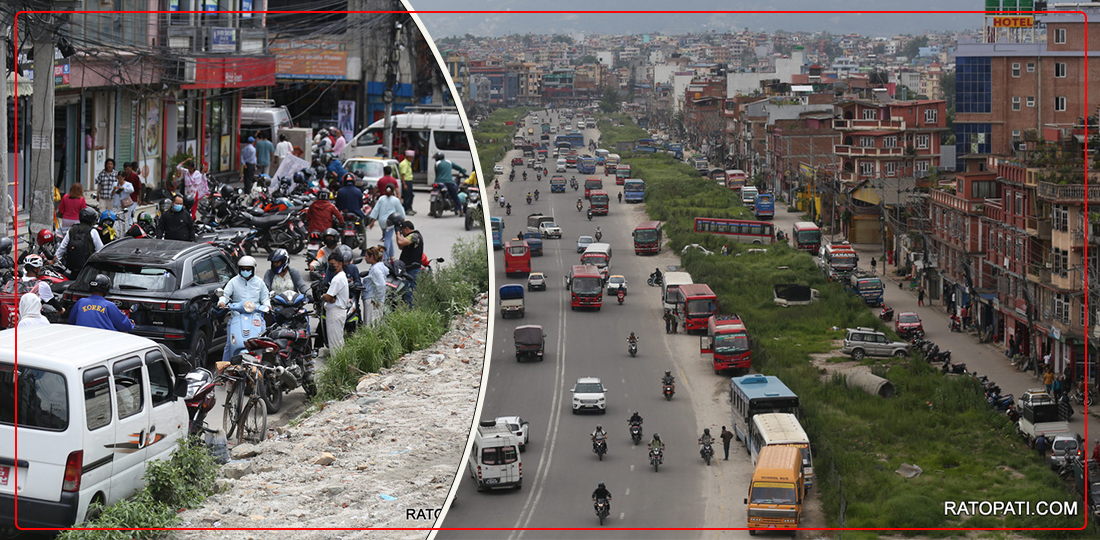
Kathmandu. Anyone traveling through the Samakhushi–Kalki service lane of the Ring Road currently feels like they have reached a parking area, not a road. Due to the haphazard parking of vehicles on the service lane of the second section of the 27-kilometer Ring Road encircling Kathmandu's core area, there is difficulty in commuting on the service lane itself.
Although eight years have passed since the expansion of the first section (Koteshwor–Kalki) of the Ring Road was completed, the plan to expand the second section from Kalki to Basundhara with the assistance of the Chinese government has not yet been implemented. The expansion work has not moved forward due to unresolved issues regarding the removal of houses and structures on the approximately 600-meter road section from Basundhara to Narayan Gopal Chowk.
_726xJZvJ5w.jpg)
While the road expansion is being delayed, shops and businesses operating on the outer side of the Ring Road are using the service lanes as parking and loading/unloading areas for goods. This has been affecting vehicle movement.
_Zouxq8BzTc.jpg)
Especially in the Halchowk–Swayambhu area, transport companies, garages, and warehouses are using the service lanes for parking large freight vehicles. In some places, the service lanes have become narrower due to the accumulation of old and broken-down vehicles and various materials.
_cS6z05lVFS.jpg)
The government had also fenced the Ring Road area a few years ago targeting the expansion of the second section. However, the fence is nowhere to be seen in many places now. Even though vehicles are parked in areas where the fences have been removed, effective monitoring by the concerned bodies and traffic police is not visible.
An agreement on the project implementation was signed between Infrastructure Development Minister Sunil Lamsal and the Chinese Ambassador to Nepal, Chang Mao Ming, for the expansion of the second section of the Ring Road. Although it was announced at the time that construction work would begin soon, there has been no significant progress to date.
_1oBVPTcdVC.jpg)
The Chinese government has agreed to provide approximately 11 billion rupees in grants for this project. The path to advance the project opened after the Council of Ministers made a decision regarding construction materials and customs exemption on February 24, 2024 (Falgun 12, 2082 BS). The expansion work will be carried out on the 8.2-kilometer road section from Kalki to near Basundhara Chowk.
_wg3HxKU6rP.jpg)
According to the approved design, a concrete bridge will be constructed at Dhungeadhara. Additionally, three disability-friendly overpasses will be built. These bridges are planned to be constructed between Sitapaila, Balaju–Machhapokhari, and Samakhushi–Basundhara Police Post. Streetlights from Kalki to Basundhara will also be installed by the Chinese government during the road expansion.
_gXo9GFT5gR.jpg)
The expansion work of the first section of the Ring Road, Koteshwor–Kalki, started in 2012 (2069 BS) and was completed in 2018 (2075 BS). A government-to-government (G2G) agreement between Nepal and China was signed in 2018 for the expansion from Kalki to Basundhara. Currently, a four-lane road is operational from Kalki to Sitapaila, and a two-lane road from Sitapaila to Basundhara. After the expansion is completed, the main road will be eight lanes, excluding the service lanes.
The third section of the Ring Road, from Narayan Gopal Chowk to Chappal Karkhana, approximately 700 meters, has already been constructed by the Nepali government with its own investment. The Department of Roads Division Office Kathmandu has stated that preparations are underway for the expansion of the approximately 1.2-kilometer road section from Chappal Karkhana to Dhobi Khola Bridge.
_wARTI517wM.jpg)
_X0UqKR3mSX.jpg)
_sAsS41nIBi.jpg)
_TARA7BK0X1.jpg)
_zws5itJtTO.jpg)
_36YA2RaA74.jpg)
_JsaQNYO6p8.jpg)
_qgCbnscqOt.jpg)
_FM7Uw9Mv1I.jpg)
_7RcTuDq8XG.jpg)
_bUZn49mz9C.jpg)
_qfd31WfgJX.jpg)
_MaSePqTU7u.jpg)
_ETCZe9tYbz.jpg)
This specific news has been automatically translated by AI. As a result, there may be some inaccuracies or language errors.