Government's First 100 Days: Mixed Progress on 100-Point Agenda

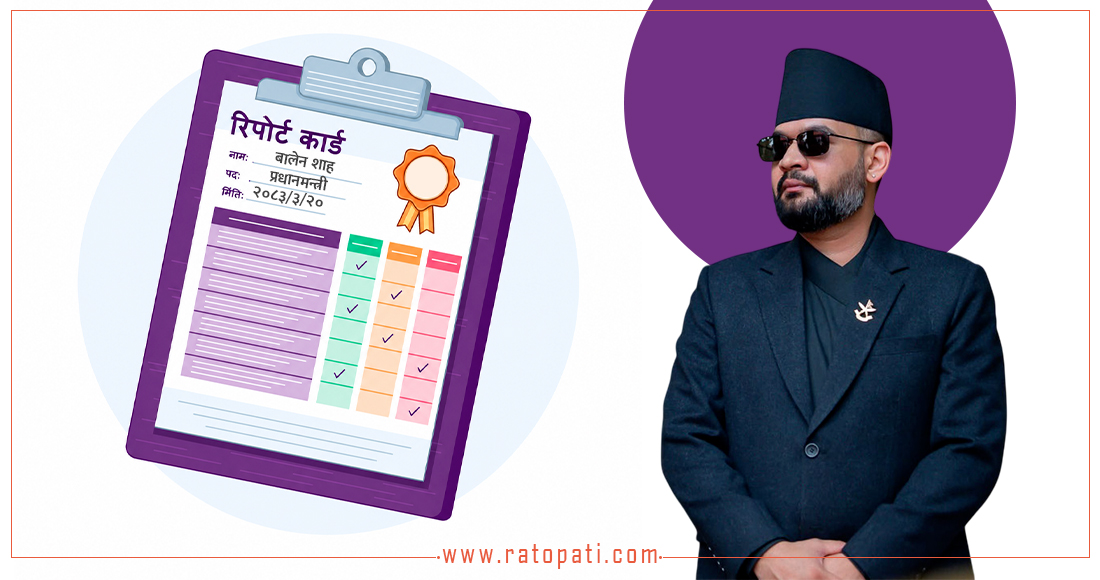
Kathmandu. The first 100 days of the government led by Balendra Shah (Balen) have been completed. In this period, there is a practice of not criticizing the government's work progress much, so it is called the 'honeymoon period'. In this period, the government gives an initial indication of its direction and capability.
This time, immediately after the formation of the government, a 100-point agenda was brought to be started or completed within 100 days. While previous political governments have been practicing bringing a 'minimum common program', the single government of the Rastriya Swatantra Party (RSP) has presented its own 100-point agenda.
Looking back after 100 days, the government appears to be only partially successful in the progress of its own agenda. While the government's work progress has been more effective in making policy decisions and enacting laws, the government has appeared very weak in service delivery and relief matters that citizens directly experience.
- Only 20 Points Fully Implemented, More Than Half Disappointing
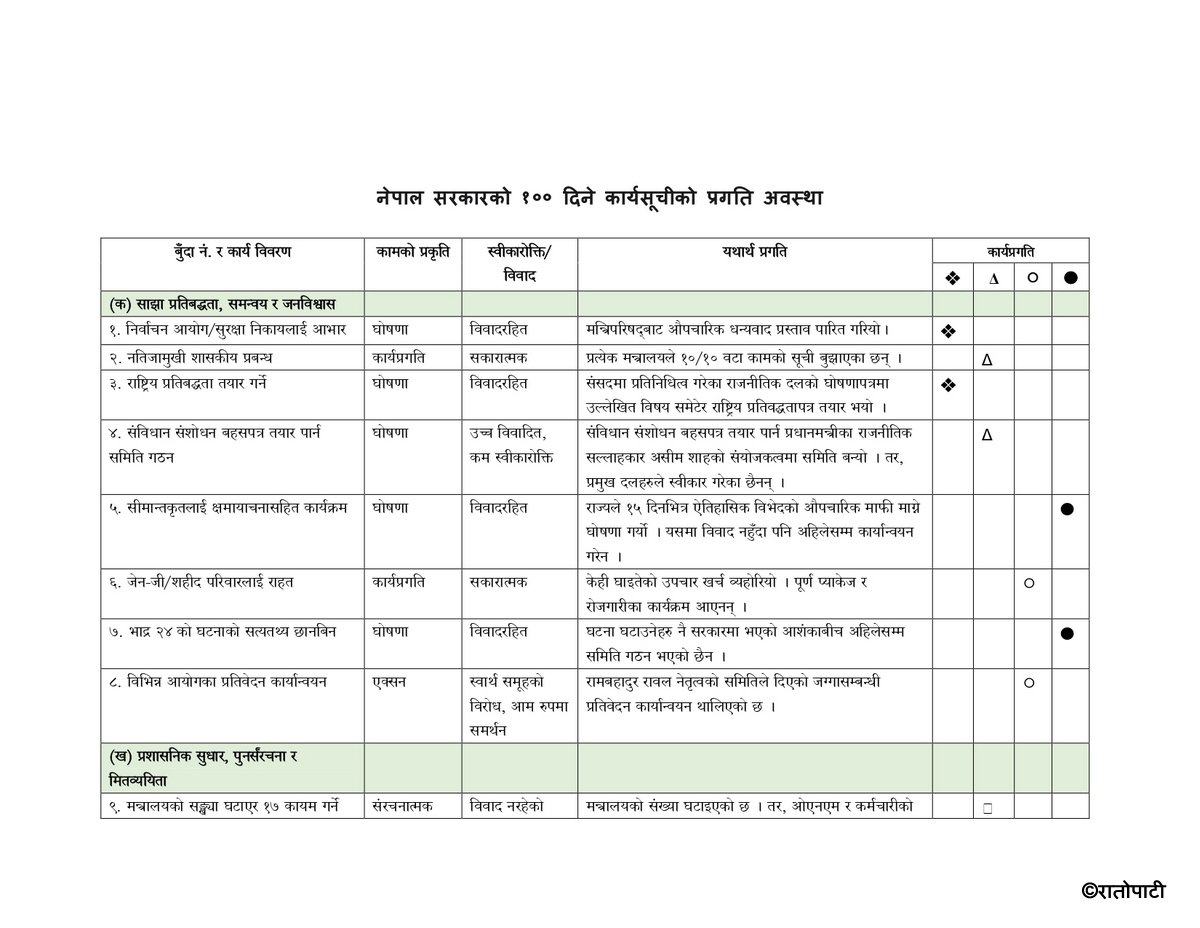
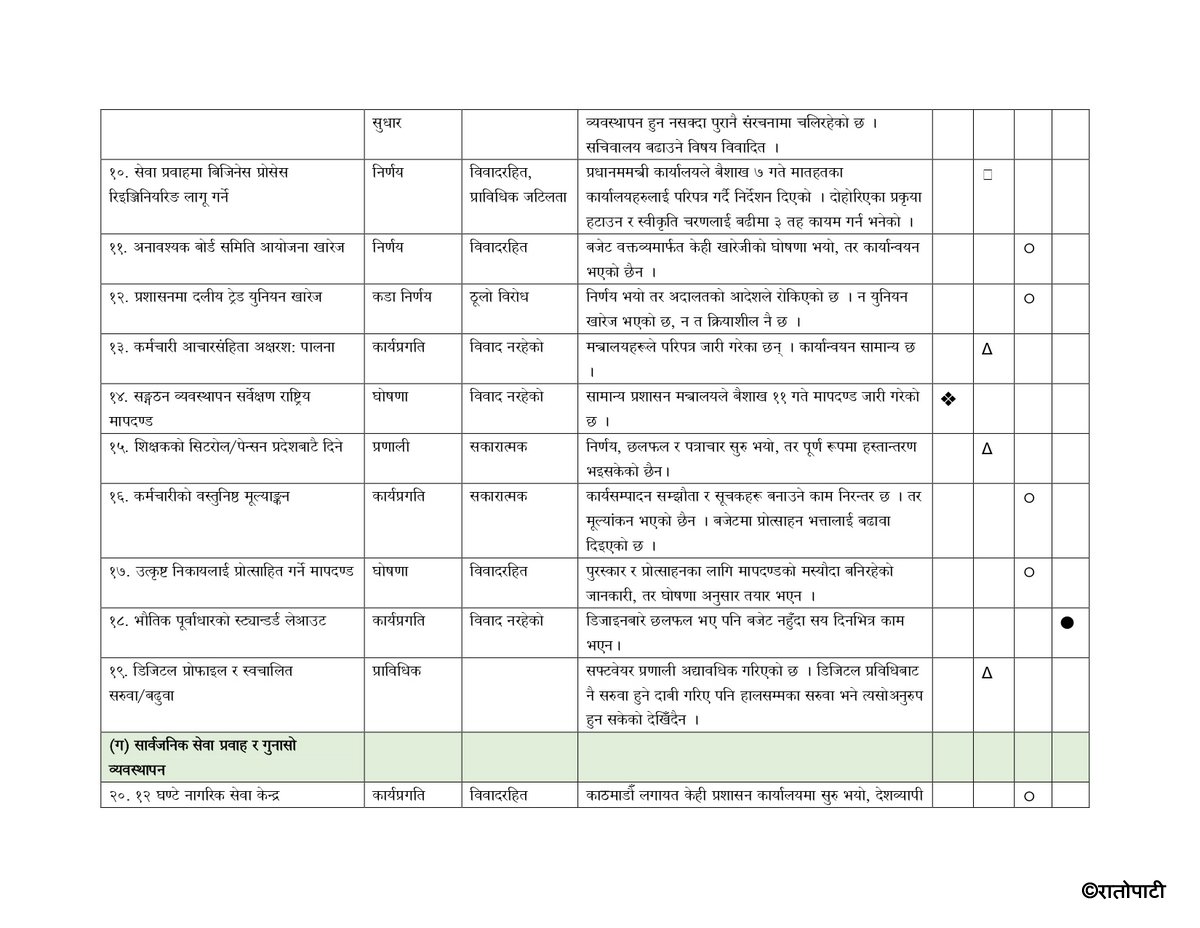
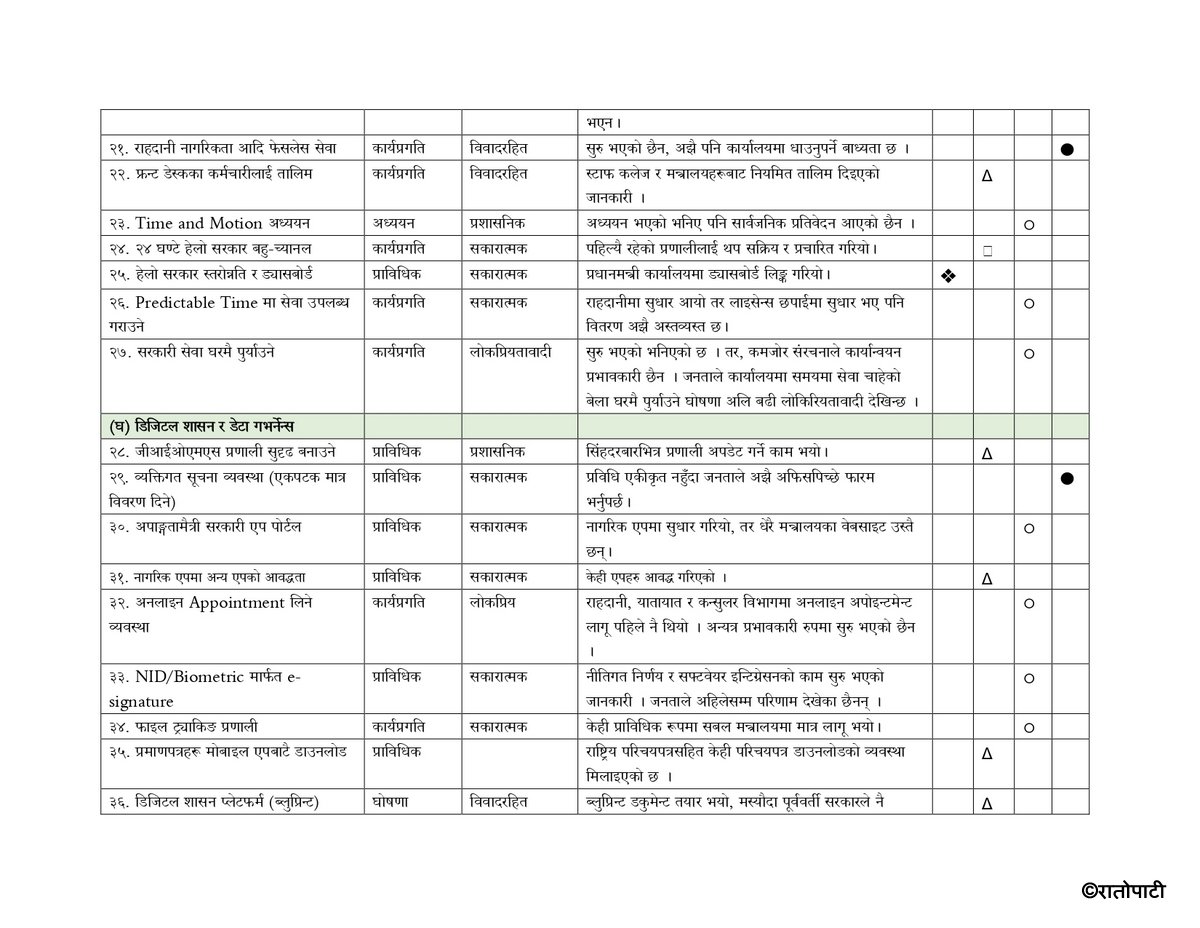
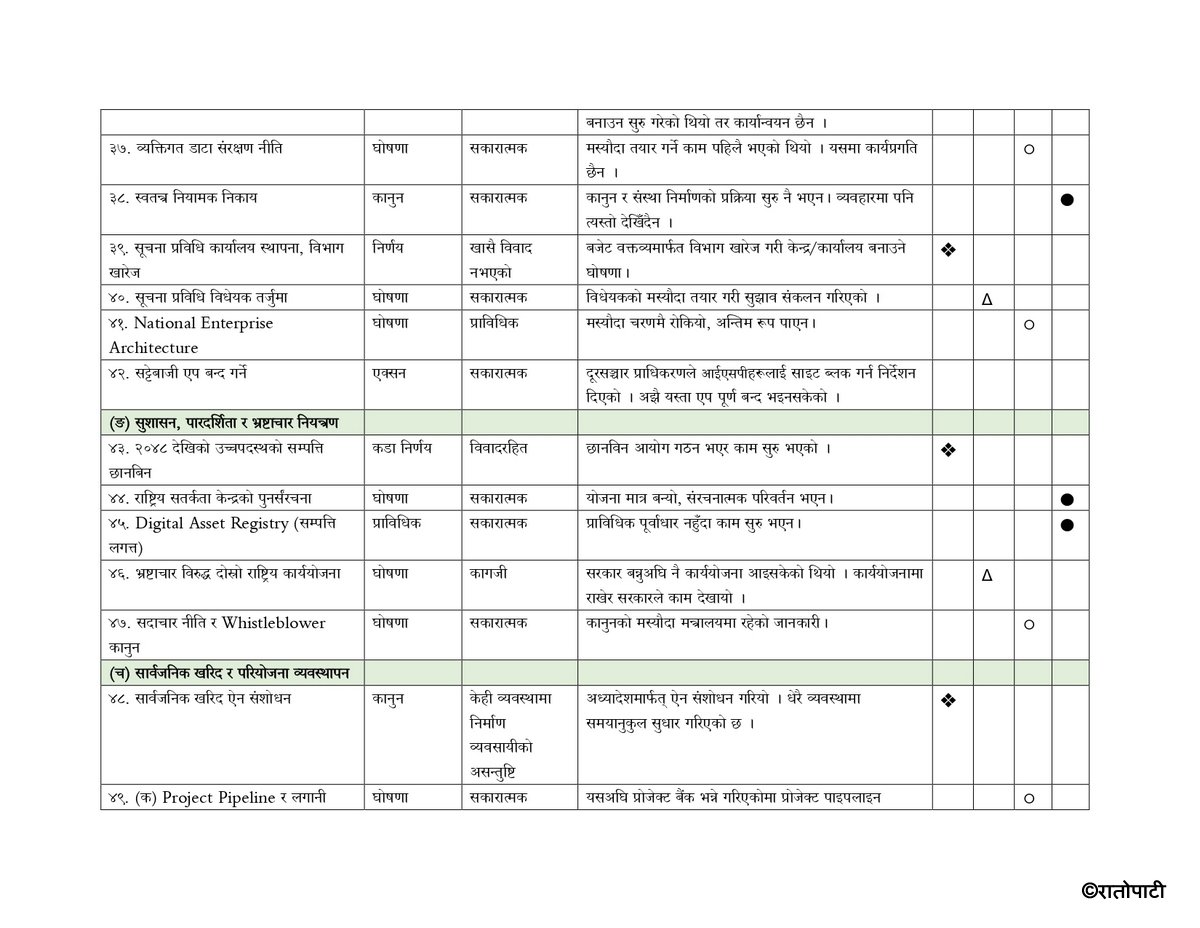
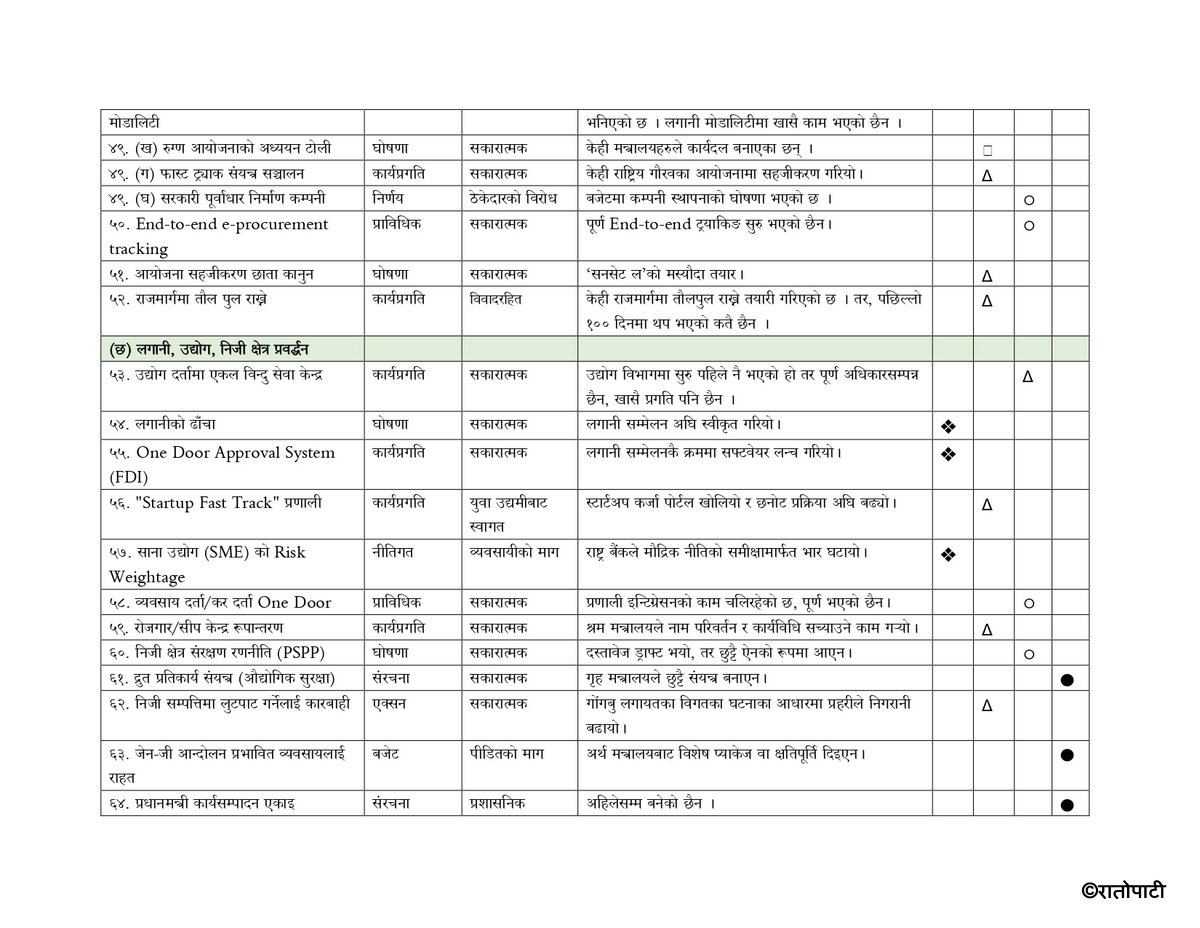
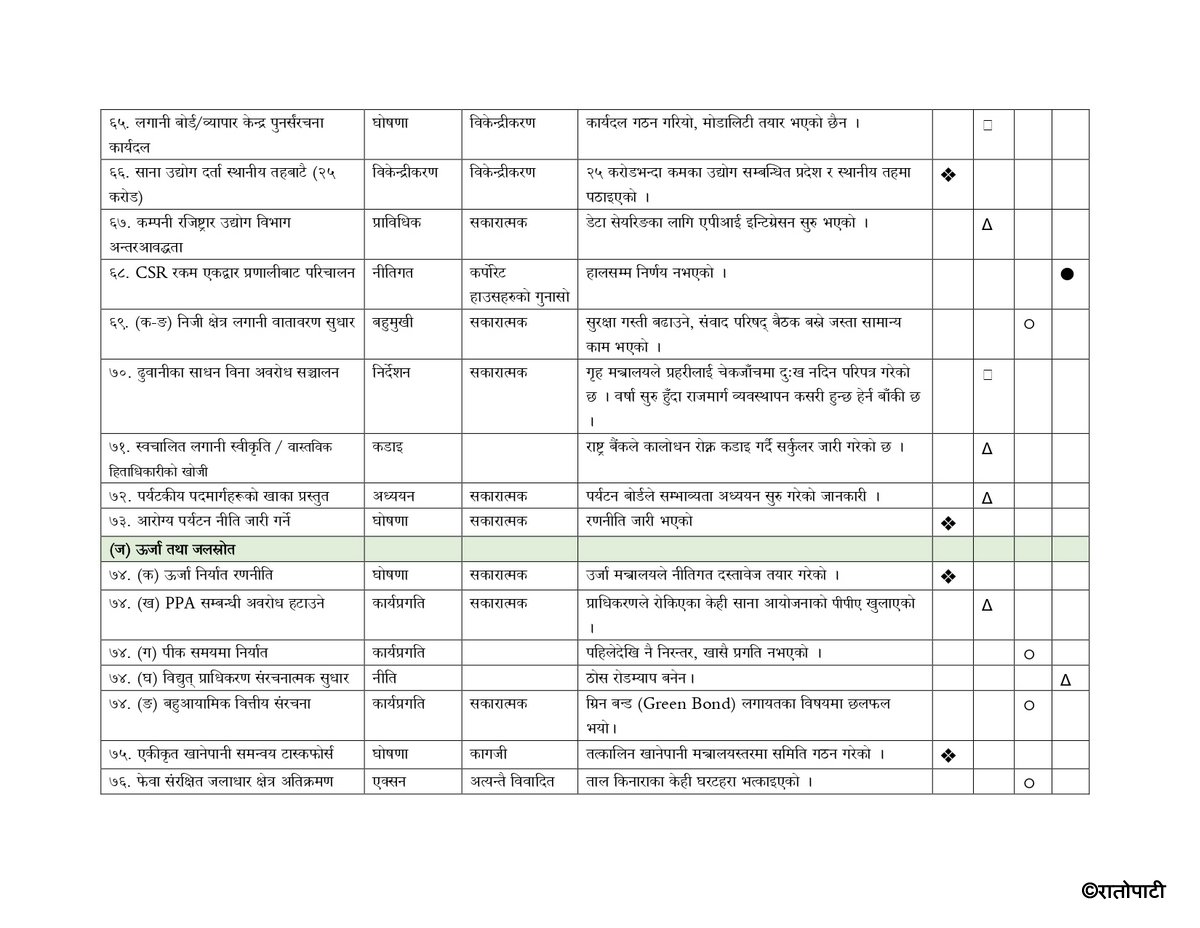
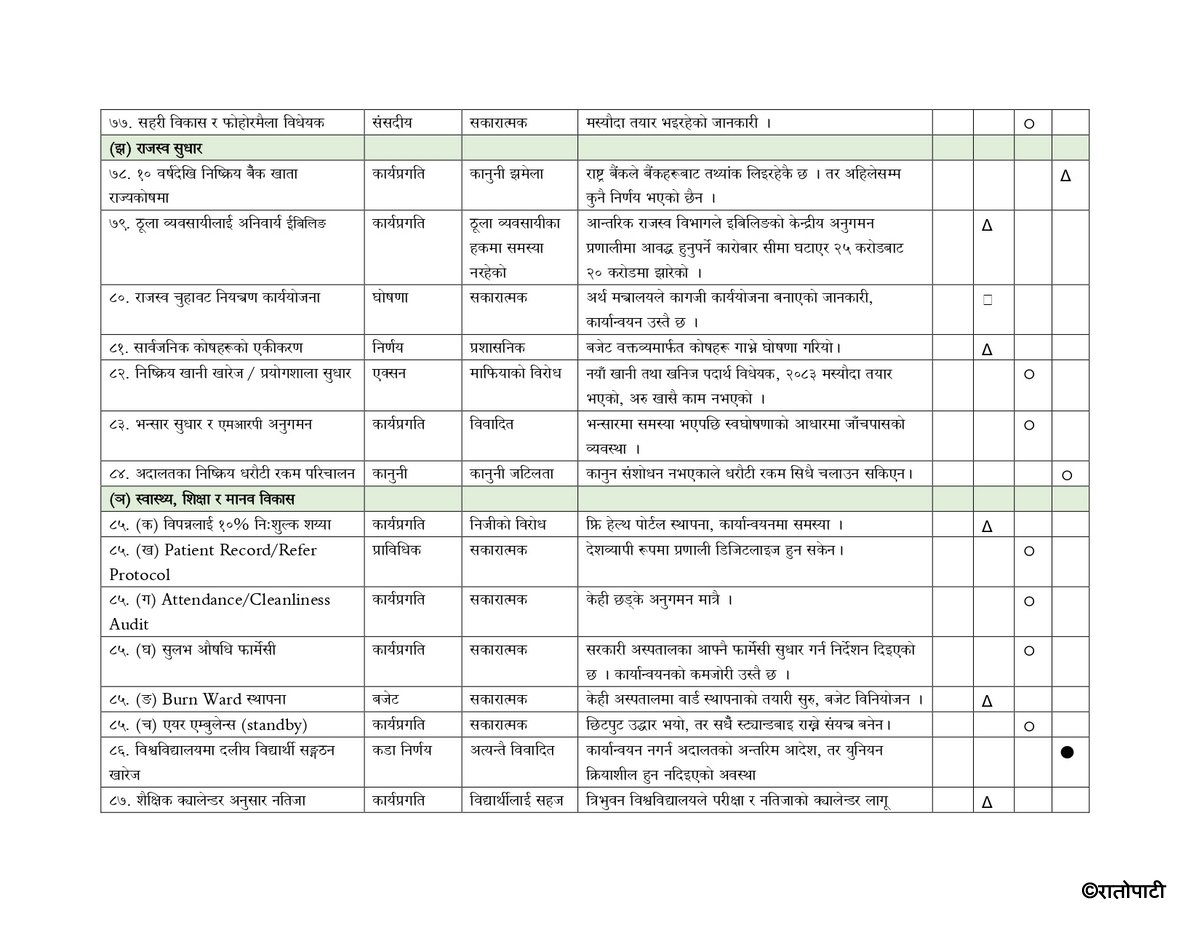
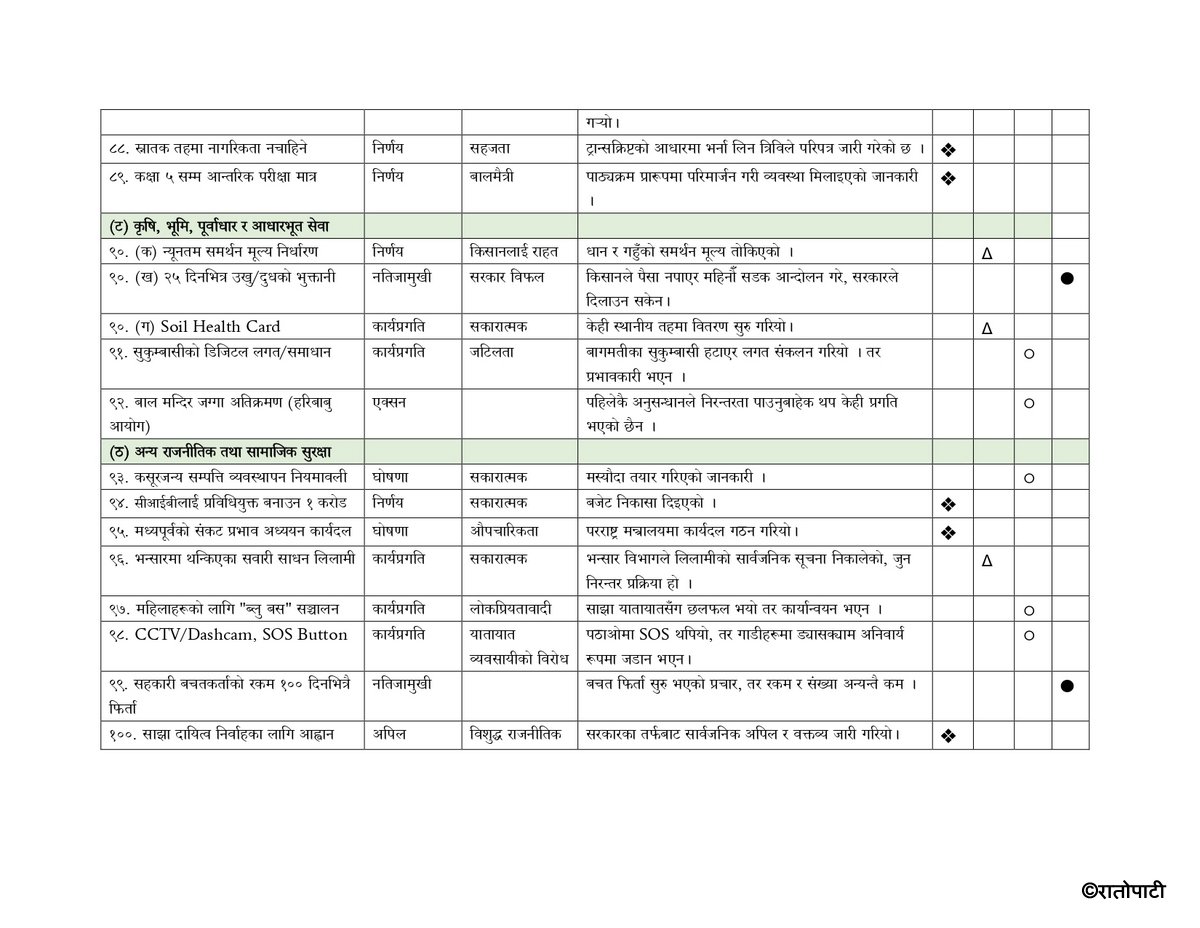
We have classified the points announced by the government to be completed within 100 days into four categories: completed as announced, significant progress, partial progress, and work not started at all. This classification has been done based on the legal arrangements made by the government, circulars, and direct and indirect information provided.
Out of the hundred points, the government has fully implemented about 20 points. This mainly includes policy decisions, issuing ordinances, technical preparations for investment summits, and the formation of some high-level commissions.
Similarly, there are 33 points with significant progress. This includes draft laws being prepared, systems being developed, and some ministries submitting work lists. This indicates that the government is active in its work, but it will still take time to see results.
Work has started on 31 points of the agenda, but progress is only partial. Points like 'discussion started', 'correspondence made', or 'effort made' are included in this. There has been zero progress on the remaining 16 points so far.
- Analysis of Sectoral Work Progress is as Follows
The government's 100-point agenda was divided into 11 sectors. This included administrative reform, restructuring, and frugality to political and social security. A brief description of the government's work progress in the relevant sector is presented here:
1. Common Commitment, Coordination, and Public Trust
The government's presence in this sector has been mixed. The government has completed the work of formally thanking the bodies that assisted in the election and preparing a national commitment letter. However, the government appears to have backed down on sensitive issues related to public trust. Although an apology to the marginalized and an investigation into the incident of Bhadra 24 were announced, a committee has not even been formed yet.
2. Administrative Reform, Restructuring, and Frugality
Although the government tried to take some bold steps in the administrative sector, they were not without controversy. Although the number of ministries was reduced to 17, work is still being done in terms of structure as different ministries. The decision to increase the number of secretariats has reduced the government's popularity.
Similarly, although an ordinance was brought to abolish party-based trade unions, it has been stopped due to a court order. However, the issuance of circulars by ministries for strict adherence to employee conduct and the submission of their work agendas can be considered positive. However, the abolition of some boards and committees announced in the budget is yet to be implemented.
3. Public Service Delivery and Grievance Management
The government's performance in service delivery, which citizens directly experience, has been the weakest. There has been no progress so far on the ambitious goal of making passport and citizenship distribution 'faceless'. Citizens are still forced to go to offices and stand in line.
Although the announcement of delivering government services to homes has been symbolically implemented, it has failed due to a weak structure. However, linking the dashboard to further activate 'Hello Sarkar' and starting 12-hour service in some administrative offices can be considered minor improvements.
4. Digital Governance and Data Governance
The government has achieved some technical success on the path to Digital Nepal. There has been minor progress in strengthening the 'GIOMS' system and sharing data from the Company Registrar. Arrangements have been made to download certificates from the National ID card. However, due to the lack of an integrated digital system, the compulsion for the public to fill out forms in different places for the same details has not been removed.
5. Good Governance, Transparency, and Corruption Control
Regarding corruption control, while it was said that the assets of high-ranking officials since 2048 BS would be investigated, the government has formed a commission to investigate high-ranking individuals since 2062/63 BS. However, the government has not been free from controversy due to the directive that current ministers and members of parliament will not be investigated.
It is said that a second action plan against corruption has been made and a code of conduct policy is being formulated. However, it remains to be seen how many actual corruption files these mechanisms and policies will open.
6. Public Procurement and Project Management
In this sector, the government has decided to amend the Public Procurement Act through an ordinance to remove obstacles in development construction, which can be considered a significant achievement. The government has stated that studies of sick projects are underway and a 'Sunset Law' is in the process of being drafted. This can be considered a partial achievement.
- 7. Investment, Industry, and Private Sector Promotion
Decisions such as launching software for foreign investment, approving investment structures, and reducing 'risk weightage' on loans for small and medium-sized enterprises have sent a positive message to the market. However, the lack of concrete steps by the Ministry of Finance regarding relief for businesses affected by the Gen Z movement shows a gap between the government's commitment and its actions.
- 8. Energy and Water Resources
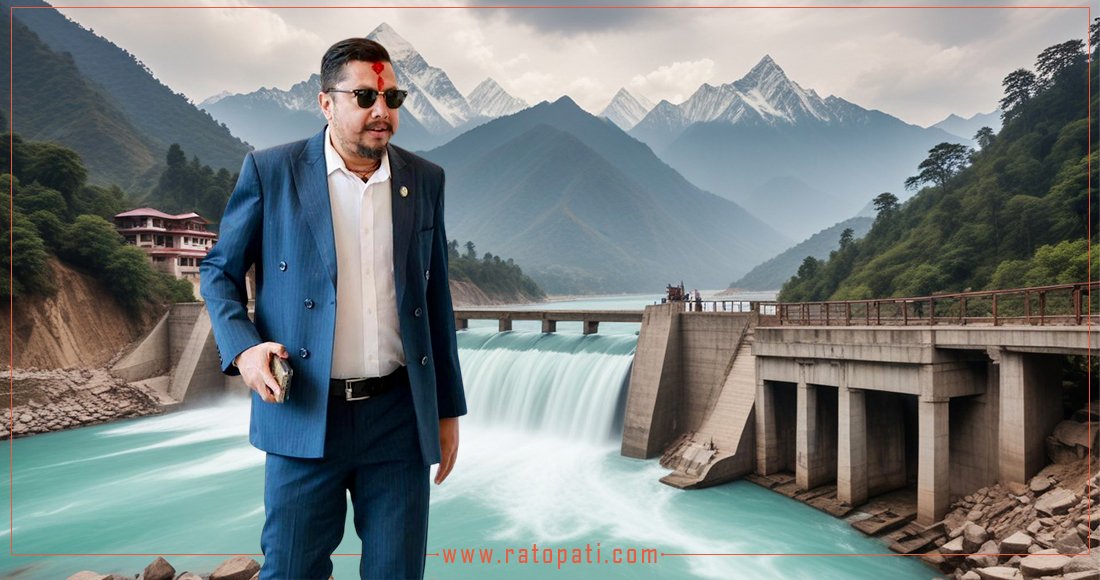
The preparation of an energy export strategy, the removal of PPA-related obstacles, and the opening of PPAs for small projects are considered achievements in this sector. However, the PPA problem for large projects has not yet been resolved. Although there has been little progress in managing wasted electricity, a coordination committee for integrated drinking water has been formed.
- 9. Health, Education, and Human Development
The government has announced that the portal for 10 percent free beds for the poor has been operational and the educational calendar has been implemented. However, its implementation has not been effective yet; health institutions are saying that this is not possible. Although the government announced preparations to establish burn wards, this has been limited to only a few hospitals.
- 10. Agriculture, Land, Infrastructure, and Basic Services
The government has faced the most criticism in this section. The promise to pay sugarcane and milk farmers within 25 days could not be fulfilled. The shortage of fertilizer persists, and efforts to solve the landless problem have also not been effective.
11. Political and Social Security
Although there was widespread publicity about returning the funds of cooperative depositors within 100 days, there has been negligible practical achievement. However, the allocation of budget to make CIB technology-friendly and the process of auctioning confiscated vehicles at customs can be considered satisfactory, although these are not issues that have a major impact on people's livelihoods.
This specific news has been automatically translated by AI. As a result, there may be some inaccuracies or language errors.

_Y03gLkOgqA.jpg)