Prachanda Questions Election Process, Criticizes Government Policies

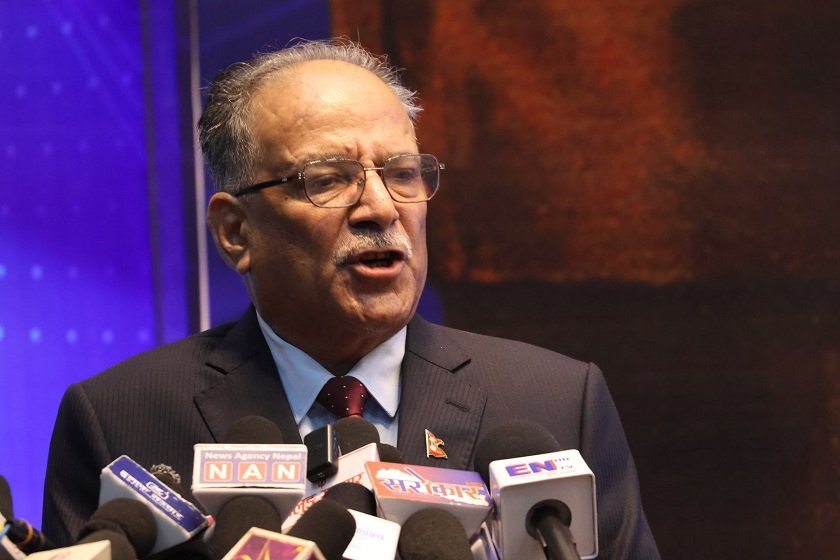
Pokhara. Nepali Communist Party coordinator Pushpa Kamal Dahal Prachanda has raised questions and doubts about the election process of Falgun 21. He argued that the Janji movement of Bhadra 23 and 24 was a counter-revolution and the election of Falgun was its continuation.
‘Looking at this election, extremely unnatural and strange scenarios have been seen here. Ballot papers have been printed, ballot boxes have reached, and voters have also cast votes,’ he said, ‘Until the evening of the 17th, more than 300 to 400 votes would not come to your area, and suddenly on the 21st, 45,000 votes come to your party for a candidate who said they would come to your party after the election. This result itself is not being digested by the candidate themselves.’
He said that those calling themselves leaders of the Janji movement are not actually Janji and are not the leaders of this movement. ‘Those who are called activists of the Janji movement are not actually Janji and they are not the leaders of this movement,’ he said.
Prachanda said that despair has spread among the party's leaders and cadres. He admitted that some questions have arisen among the cadres and it is difficult for the party to address them.
‘It is natural to be worried and concerned about what will happen now. Rastriya Swatantra Party's place is also full, those who were going to get it have already got it. There may be despair among you that there is nowhere else to go and no new party will be formed,’ he said, ‘But amidst this despair, we have no option but to evaluate the situation and revive and strengthen the organization.’
Addressing the Gandaki Province level cadre gathering in Pokhara, Prachanda said that in the last 20 years, the party leadership and cadres have been stuck only in short-term tactics, abandoning long-term strategy.
‘In the past, we were clear about strategy and determined tactics accordingly. But after the peace process and constitution building, we forgot about ideology and strategy and remained engrossed only in tactics,’ he added, ‘We got entangled in the struggle for positions, prestige, and personal gain. This weakened our class base and people stopped seeing us as different from traditional political forces.’
Coordinator Prachanda accused the government of attacking the rights of the federalism, inclusivity, and oppressed classes, women, Dalits, indigenous nationalities, and Madhesi communities established through the people's war and people's movement. He accused the current government's policies, budget, and programs of neglecting the working class and only benefiting the big capitalist class.
‘Now, by openly raising the issue of abolishing provincial assemblies, attacks on federalism have begun. Under the pretext of constitutional amendment, attacks are being made on the fundamental principles of the constitution,’ he says, ‘We had created a constitution oriented towards socialism in this country through great struggle and sacrifice, but now it is being pushed towards abolition. We must be serious and aware of such steps that seek to nullify the basic structures of federalism and the constitution.’
This specific news has been automatically translated by AI. As a result, there may be some inaccuracies or language errors.

_sucFhOEREN.png)

-education-and-sport_c0BHyFjlfq.jpg)
_jngkj3r13m_7PHWnhfPpk.jpg)