America's Rise and Fall: A Historical Perspective

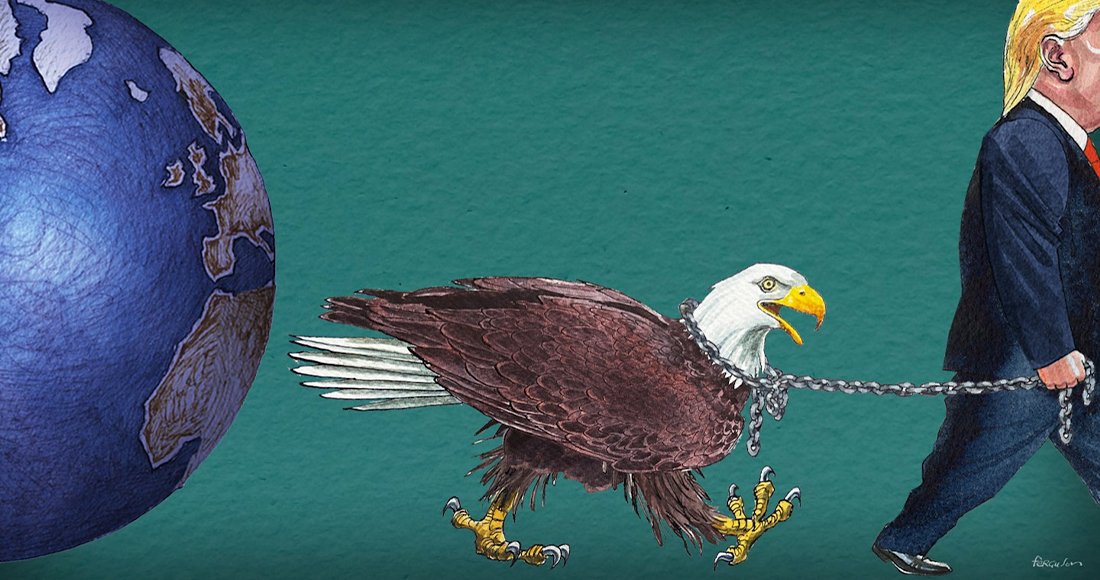
America was the winner of the 20th century. With the collapse of the Soviet Union in 1991, America not only gained unparalleled economic and political power but also carried values that everyone praised, such as constitutional government and freedom. But that did not last forever.
To understand the story of America's victory and failure, we have to go back at least to the 19th century. In the mid-19th century, European empires, especially Great Britain with its vast empire and steam engine power, ruled the earth. By 1914, the 'Second Industrial Revolution' was completed. America led it. It led in various fields such as chemicals, electricity, telephones, medicines, 'internal combustion engines' and the resulting flight, and radio. As a result, big changes began to be seen. The era of globalization is also a part of it.
There was also a change in the balance of power. The rise of imperial Germany in Europe was the biggest event. Another such event was the rise of Japan. The biggest of all was the rise of America. By 1914, America had become the world's largest economy. In Europe at that time, there was a struggle between the rising Germany and the established Britain, France, and the other empire, Russia, over who would be influential. But that was not the central question. Rather, the central question was when America would become the dominant power. But Germany, Britain, France, and Russia at that time did not think so.
By the end of the First World War, America had become the arbiter of Europe's fate as well. Unfortunately, America supported a peace that was not easy to implement. The withdrawal of various powers from such peace proposals, internal political conflicts and upheavals in many countries, and the inflation and widespread unemployment of the 1920s ultimately pushed the world into World War II.
America called the victory over the totalitarian concepts of fascism and communism, and the defeat of its geopolitical rivals Germany, Japan, the British Empire, and the Soviet Union, a 'unipolar state'.
The time of World War II was a bit different. Due to the ideological influence of the 19th century and the competition with Soviet communism, which was built on the ruins of the Russian Empire, America not only got involved in the war but also started the Cold War immediately after the war. Europe was divided in this war. The western part of Europe became dependent on America. The European empires did not survive. Also, there was an agreement on social democracy. The concept of an uncontrolled free market was rejected. Regulated (to some extent controlled) capitalism emerged as the new system. Despite the 'neoliberal' revolution of the 1980s, that system remained. Only the style of regulation was changed to some extent.
Between 1989 and 1991, the Soviet Union and its empire completely disintegrated. America called the victory over the totalitarian concepts of fascism and communism, and the defeat of its geopolitical rivals Germany, Japan, the British Empire, and the Soviet Union, a 'unipolar state'. Today, history laughs at all this. Within 35 years of its triumph, the role America took as a stabilizing dominant power has disappeared. America's situation is like Britain's in the 1890s. All these changes are transforming the system into chaos and victory into defeat. This entire process is happening simultaneously in the economic, technological, and political spheres.
The most important of all these are the rise of China, the digital revolution, and the victory of right-wing populism.
In the 1970s, China was separated from its alliance with Russia. Immediately thereafter, Deng Xiaoping chose the path of 'reform and opening up'. Another superpower emerged. For the first time in this century, America had to face a comparable rival. At the beginning of this century, as in the 19th and 20th centuries, America led the liberal era. Under this, the process of a second globalization took place with the help of advanced information technology and communication.
Undermining the rule of law, world-leading science, reliable alliances, and confidence in economic and political stability.
Financial crises and large-scale migration are other extraordinary events. Major social and political changes have occurred, similar to those before World War I. These have been and continue to be initiated, in part, by political struggles. Most of the changes in the 19th century were based on the demands of class and nation. Now, demands related to gender, caste, and identity are more prevalent. As in the past, a traditionalist and nationalist counter-revolution can be seen rising now.
America is now on the verge of celebrating its 250th anniversary. At this time, both America and the world order it created are in crisis. The administration in America is not only corrupt and incompetent, but it is also aggressive towards the values and principles taken by the founders of the American state. The American Declaration of Independence declared freedom from dictators. But now Donald Trump himself has had to become a dictator. Even worse, Trump is now trying to dismantle all systems that curb power.
Undermining the rule of law, world-leading science, reliable alliances, and confidence in economic and political stability. The government, which should run on the basis of law, is being run on orders and whims. Democracy has been in trouble for two decades. According to a study by an organization called 'V-Dem', only 7% of the world's population lives under liberal democratic rule. Xi Jinping must be smiling. Today's times are reminiscent of the years before 1914. The question is how it will end.
The world that many of us hoped for when the Soviet Union disintegrated 35 years ago, and which was primarily created by America, is now disappearing.
Amidst all the negative news, there is good news too. The risk of war between superpowers has greatly reduced due to nuclear weapons. None of the major powers today are afflicted by 20th-century militarism. There is no blind militarism like in the 1930s and 40s. Another good news is that today's governments seem to be primarily focused on the prosperity of their people. The unprecedented economic growth seen after World War II inspired demands for prosperity everywhere, which continues to this day.
In all these contexts, there is also sad news. Today we are facing challenges that we can only solve together. The global environment is one example. Managing the impact of transformative new technologies, especially AI, is another example. At the very least, we have come to a serious question again: Will arbitrary rule become the established global norm, or will freedom and democracy still prevail?
The world that many of us hoped for when the Soviet Union disintegrated 35 years ago, and which was primarily created by America, is now disappearing. America's own situation is also becoming similar for now. Certainly, we learn from history. But sadly, our tendency to forget is equally strong.
This specific news has been automatically translated by AI. As a result, there may be some inaccuracies or language errors.

_sucFhOEREN.png)


-education-and-sport_c0BHyFjlfq.jpg)
_jngkj3r13m_7PHWnhfPpk.jpg)