GANDAKI PROVINCE: HIV Cases Rise Amidst Declining Condom Use

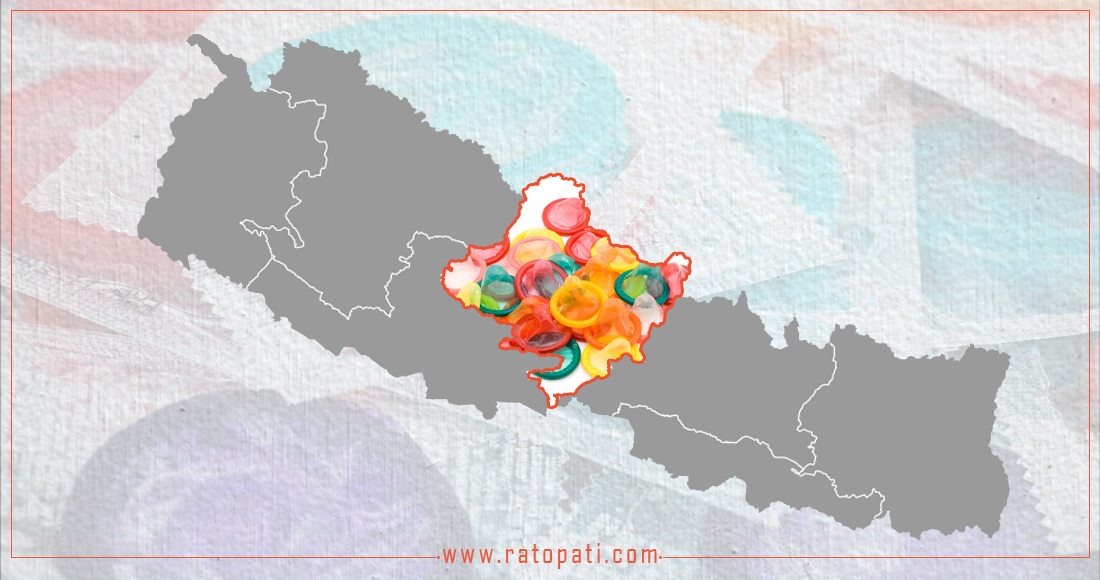
Pokhara. The number of HIV-infected people has increased in Gandaki Province this year. The data from the Ministry of Health, Gandaki, shows that while the use of condoms, a reliable and accessible means of preventing HIV infection, is declining, the number of infected people is increasing.
According to the Provincial Public Health Office, Kaski, condom distribution has decreased by 27 percent in the last three years.
Statistics show that 2,397,698 condoms were distributed across the province in the fiscal year 2080/81, but this number has decreased to 1,733,259 by May of the current fiscal year 2082/83. In the three-year period, more than 664,000 condoms have been distributed less.
On the other hand, the number of infected people has further increased in the current year. In the fiscal year 2081/82, 210 people tested positive, while 156 people were found in the last fiscal year 2081/82. By the end of May of the current year, this has increased to 179 people. The increase in the number of infected people is also due to the expanded scope of testing.
The government tested only 38,364 people in fiscal year 2080/81, while 27,740 people were tested in fiscal year 2081/82. The Ministry of Health stated that 52,687 people have been tested in the current fiscal year. Physician Dr. Rajendra Poudel of Pokhara Institute of Health Sciences said that the rate of confirmed infections has increased due to the expanded scope of testing.
According to studies, the main cause of HIV transmission in Nepal is unsafe sexual contact. Statistics show that about 66 percent of HIV infections are transmitted through unsafe contact. Looking at the infection statistics, Kaski district is at the highest risk.
Out of the 179 infected people identified in the province in the current year, 141 people, or 78.7 percent, are from Kaski district alone. Condom distribution has decreased significantly in Kaski, which is at high risk. In three years, it has decreased from 511,778 to 411,039.
Poudel stated that there are technical challenges in the necessary infrastructure for the treatment and health monitoring of HIV-infected individuals in Gandaki Province. The non-operation of the CD-4 count machine and viral load testing machine at Pokhara Institute of Health Sciences has caused problems in the regular monitoring of infected individuals undergoing ART treatment.
'There are 3,171 infected individuals receiving ART services. Regular health monitoring of them is difficult,' he said, 'Currently, the service is being continued by arranging an alternative manual testing system from the Provincial Disease Control Center.' Injecting drug users are also at high risk. To control such infections, 131 people have been enrolled in the Opioid Substitution Therapy service by May.
Of these, 69 are receiving methadone and 62 are receiving buprenorphine. In addition, due to the risk of further tuberculosis infection among the infected, the government has stated that TB-HIV integrated treatment services are being operated in 11 places, including 10 hospitals and 1 primary health center in the province, to reduce this risk.
- Does HIV also transmit from mother to child?
The Government of Nepal has set a national goal to completely eradicate HIV transmission from mother to child by 2026. Under this strategy, a program to prevent transmission from mother to child has been implemented in Gandaki Province.
Although HIV testing of pregnant women is done annually across the province, the rate of confirmed infections is low. According to the latest three-year data from the Provincial Public Health Office, more than 132,000 pregnant women have been tested in three years.
To prevent transmission from pregnant women to their newborns, free HIV testing for pregnant women has been arranged in government health institutions. In the fiscal year 2080/81, 52,668 pregnant women were tested.
In the fiscal year 2081/82, 46,236, and by the end of May of the current fiscal year 2082/83, 33,170 pregnant women have been tested. In all three past fiscal years, only 5 pregnant women tested positive for HIV infection annually in Gandaki Province.
Among the 5 infected pregnant women identified by the end of May of the current fiscal year 2082/83, 2 are from Syangja, 1 from Kaski, 1 from Gorkha, and 1 from Nawalparasi East. Pregnant women who test positive are immediately enrolled in ART treatment services to protect the newborn from infection.
This specific news has been automatically translated by AI. As a result, there may be some inaccuracies or language errors.