Armed Police Force Enhances Preparedness for Monsoon Disasters

Kathmandu. The Armed Police Force has increased its activity across the country, keeping in mind the risk of monsoon-induced natural disasters. The Armed Police Force has kept 21,699 personnel specially trained and ready for immediate rescue in disasters such as floods, landslides, and inundation.
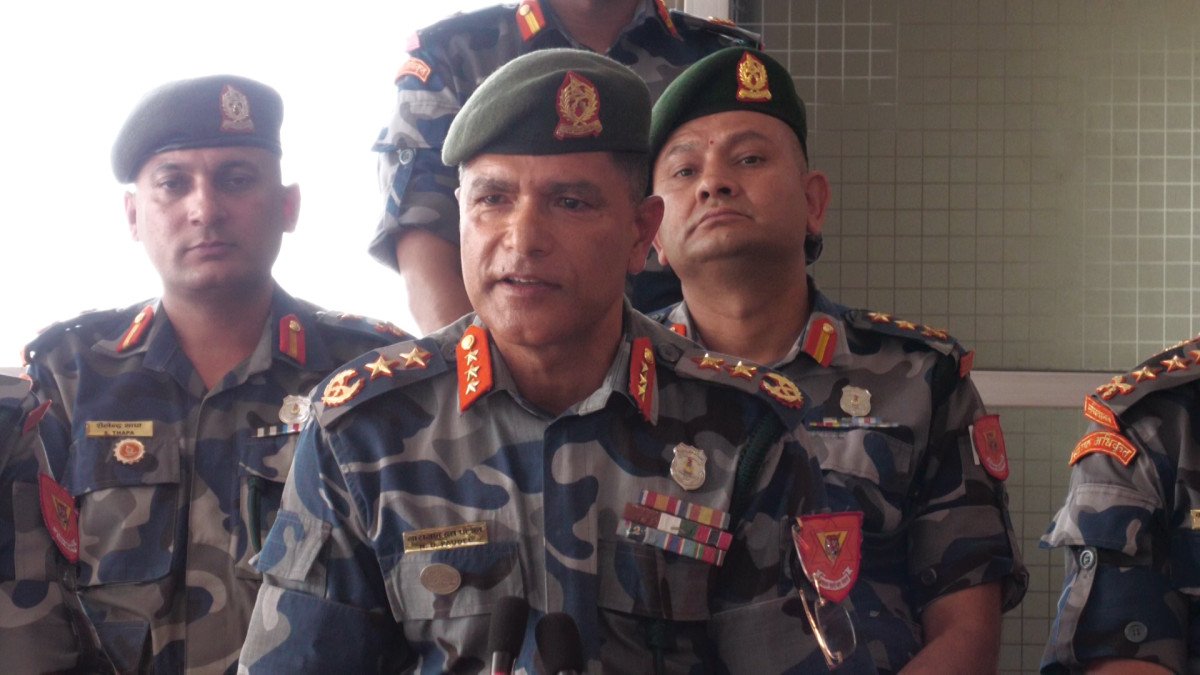
Speaking at a press conference on Thursday, Armed Police Inspector General Narayanadatta Poudel said that the organization is working with disaster management, border security, and economic governance as its main priorities to improve the organization's image.
Inspector General Poudel informed that arrangements have been made for 8,180 armed police personnel across the country to be on 'standby' 24 hours a day for disaster response. To reach remote and high-risk areas where rescue teams find it difficult to reach immediately during disasters, 54 'temporary monsoon response bases' have been established in all seven provinces.
Among these, there are 6 bases in Koshi, 11 in Madhesh, 16 in Bagmati, 4 in Gandaki, 7 in Lumbini, 2 in Karnali, and 8 in Sudurpaschim Province. Similarly, permanent disaster management bases with manpower and resources are kept ready in 16 highly risky areas including Mulghat in Dhankuta, Chatara in Sunsari, and Nijgadh in Bara.
To make rescue operations more effective, a team of 134 divers with necessary equipment has been deployed in 11 high-risk areas across the country. The Armed Police currently has 82 rafting boats and 53 motorboats ready. 4,710 skilled personnel with specialized training are deployed with rescue equipment.
For emergency health services, 8 'mass casualty vehicles', 8 'A' class ambulances, 10 'immediate response teams', and 13 heavy equipment (dozers, loaders, etc.) have been placed in various provinces.
To receive immediate disaster information, the Armed Police has launched the 'APF Community Alert System' mobile app. Through this system, information received from the community reaches the operations room immediately, and a quick rescue team is mobilized. Response plans have been made based on immediate data received from the Department of Hydrology and Meteorology.
To increase community participation in disaster management, 1,741 disaster volunteers have been prepared, and a network of more than 168,000 'disaster indicators' has been created at the local level.
At the press conference, Inspector General Poudel said that the concept of 'Border Interaction Team' (BIT) has been introduced to facilitate the movement of citizens at border crossings and control border crime. He stated that a policy of zero tolerance will be adopted within the organization to control revenue leakage and ensure economic transparency.
'BIT will be implemented as a pilot project to facilitate movement at major crossings, make the screening process effective, and coordinate with peer security agencies,' Poudel said. He also informed that a new law related to the Armed Police Force is in the process of being formulated and that the 'Policy Research and Planning Directorate' has been upgraded for policy and structural development.
This specific news has been automatically translated by AI. As a result, there may be some inaccuracies or language errors.