
Four Ordinances Advance to Become Law, Four Face Invalidation

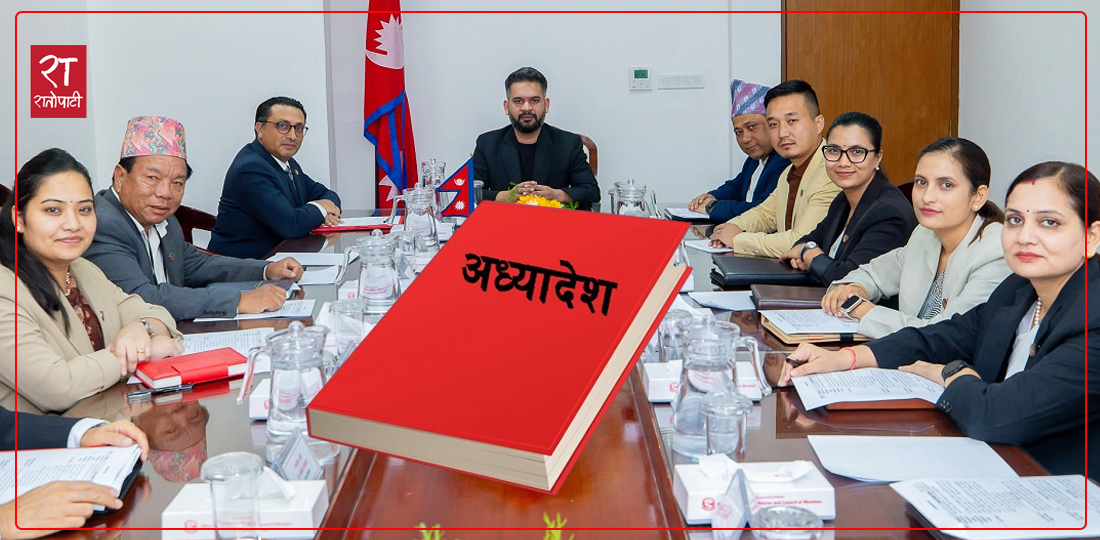
Kathmandu. Of the 8 ordinances brought by the government of the National Independent Party (NIP) with a single majority, four have moved forward in the process of becoming laws, while the remaining four are increasingly likely to become automatically invalid.
Based on the government's recommendation, President Ramchandra Paudel issued 8 ordinances in April.
According to a statement from the President's Office, President Paudel issued the Constitutional Council (Work, Duties, Rights and Procedures) (First Amendment) Ordinance 2083 on April 22, and an ordinance to amend some Nepal laws 2083 on April 20.
On April 19, he issued the Ordinance to Amend Some Nepal Laws Related to Health Sciences Institutes 2083, the Special Arrangement Ordinance on the Removal from Office of Public Officials 2083, and the Ordinance to Amend Some Nepal Laws Related to Universities 2083. On April 18, President Paudel issued the Prevention of Money Laundering (Third Amendment) Ordinance 2083, and on April 17, the Public Procurement (Second Amendment) Ordinance 2083 and the Cooperatives (First Amendment) Ordinance.
The Constitution of Nepal has a provision that the government can issue ordinances, and these ordinances are presented in the first meeting of the Federal Parliament after their issuance.
Article 114 of the Constitution states, 'Except when both houses of the Federal Parliament are in session, the President may issue an ordinance on the recommendation of the Council of Ministers if immediate action is necessary.' The same article, in subsection (2), states, 'An ordinance issued pursuant to subsection (1) shall have the same force as law.'
Subsection (a) of that subsection states that 'every such ordinance shall be presented in both houses of the Federal Parliament after its issuance, and shall become automatically invalid if not accepted by both houses.' Similarly, (b) states that the President may revoke an ordinance at any time, while (c) states that if not invalidated or revoked under clause (a) or (b), it shall become automatically invalid 60 days after the meeting of both houses.
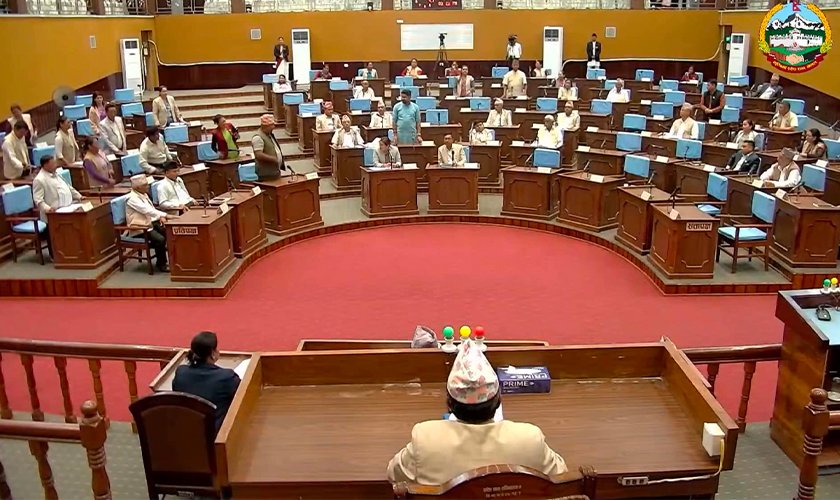
Both houses of the Federal Parliament convened on April 28, after the ordinances were issued. On the same day, 8 ordinances from the government were presented in both houses (House of Representatives and National Assembly).
According to Article 114 of the Constitution, if these ordinances are not passed by both houses and authenticated by the President within 60 days from then, i.e., by June 9, they will become automatically invalid.
With 15 days remaining until June 9, the meetings of both houses have been called for Thursday. The House of Representatives has been called for 11 AM and the National Assembly for 1:15 PM.
However, the government has not yet presented a proposal to accept four ordinances in the Federal Parliament. According to the Federal Parliament Secretariat, the government has not presented a proposal to accept the Special Arrangement Ordinance on the Removal from Office of Public Officials 2083, the Constitutional Council (Work, Duties, Rights and Procedures) (First Amendment) Ordinance 2083, the Ordinance to Amend Some Nepal Laws Related to Universities 2083, and the Ordinance to Amend Some Nepal Laws 2083.
Federal Parliament Secretariat Spokesperson, Joint Secretary Ekram Giri, stated that four ordinances have been accepted by the Federal Parliament and are on the path to becoming bills. 'The Public Procurement (Second Amendment) Ordinance, the Prevention of Money Laundering Ordinance, the Ordinance to Amend Some Nepal Laws Related to Health Sciences Institutes, and the Cooperatives (First Amendment) Ordinance have been approved by both houses and are on the path to becoming law,' Spokesperson Giri told Ratopati. The meetings of the House of Representatives and the National Assembly held on June 20 approved these ordinances. Spokesperson Giri informed that the concerned ministries have already registered replacement bills after the ordinances were approved.
There is a legal provision that the parliament must approve ordinances presented in the parliament for them to proceed. However, the government has not even presented four ordinances for approval.
There is a time limit in the regulations for bills registered in parliament to mature. According to the regulations, after a theoretical discussion in the house, MPs are given 72 hours to register amendment proposals. This provision exists in both the House of Representatives and the National Assembly.
After amendment proposals are submitted, both houses must complete the process of discussing and passing them clause by clause. The government faces another problem in the National Assembly. Out of the 275 members of the House of Representatives, 182 are from the NIP. However, the NIP has no presence in the National Assembly.
In the National Assembly, where it has no presence, the government's Law, Justice and Parliamentary Affairs Minister Sobita Gautam had repeatedly discussed the ordinances with the parties. The leader of the main opposition party Nepali Congress in the National Assembly, Kamal Pant, informed that Minister Gautam had discussed the ordinances with them multiple times, and they agreed to advance only four ordinances.
'The Law Minister discussed the ordinances with us repeatedly. We agreed to advance four ordinances,' said leader Pant to Ratopati. 'After that, four ordinances were presented for approval and have been approved. The remaining four ordinances have not been presented by the government because we requested their invalidation.'
Pant informed that the government did not present the ordinances for approval because they could not compromise on the Constitutional Council and some Nepal Laws Amendment Ordinances.
This specific news has been automatically translated by AI. As a result, there may be some inaccuracies or language errors.

_KDY0kg6t86.jpg)
_sCLDfWVnnm.jpg)