Trillionaires Pose Dire Threat to Democracy
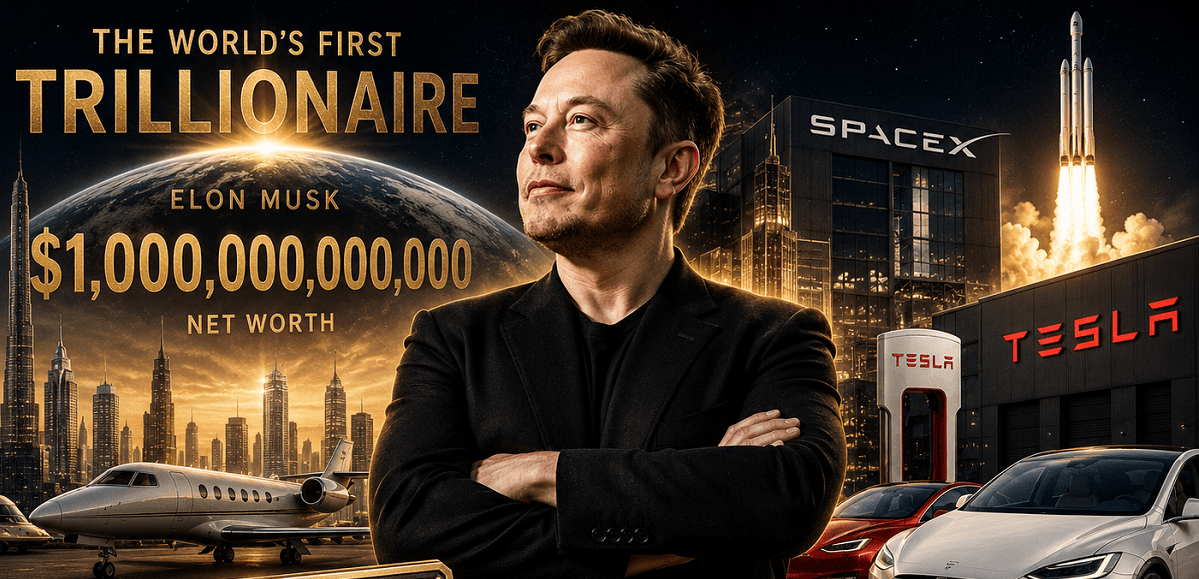
Elon Musk's company 'SpaceX' has recently been listed in the stock market just a few days ago. With this, there is an atmosphere of great celebration from Wall Street to Silicon Valley. Musk's wealth has reached one trillion dollars or 10 kharba dollars.
The figure of trillions is now being seen among the super-rich in the world. Along with this, a simple but extremely serious truth has also become clear to us. That is - the presence of trillionaires in the world economy is also a major political and economic problem. This is not just normal, but the real problem of the world today.
To put it more simply, there is a fundamentally tense relationship between extreme wealth and democracy. Having excessive wealth always means having excessive power. It has the power to weaken competition, shape public discourse in its favor, influence policymaking, sway election outcomes, and hinder social progress.
This problem is not new at all. From Aristotle's time 2,000 years ago to thinkers on democracy at the London School of Economics today, everyone has spoken about the bad form of excessive wealth concentration in society.
Among those who make such critical comments are traditional thinkers like James Madison. Madison, one of the framers of the US Constitution and still considered an ideal by traditionalists, stated that wealth inequality is as toxic to democracy as war.
He writes, 'Even during wartime, the discretionary powers of the country's executive are expanded. Access to appointments, rewards, and distribution of money in various offices increases.'
The trend of wealth concentration is even more widespread in America. There, the share of wealth of the super-rich is even greater compared to the extreme concentration seen at the beginning of the 20th century. Around 1910, America was considered the peak of the 'Gilded Age'. At that time, just four American companies accounted for 4 percent of America's total gross domestic product.
For some time after World War II, the concentration of excessive wealth seemed to decrease somewhat. As a result, we stopped discussing this problem. Due to the effects of the war and measures like progressive and inheritance taxes used in taxation, the top marginal tax rates had reached close to one hundred percent.
This was the situation in both America and Britain for a few decades after the World Wars. The problem of excessive wealth concentration seemed to be almost disappearing. But today, the problem of excessive wealth concentration has reappeared with full force.
In 1989, the 'Sunday Times' newspaper published its first list of the rich. According to this, 0.1 percent of the rich in Britain owned 5 percent of the total gross domestic product of the entire UK through two hundred families. Today, the same group of the UK's population owns 20 percent of the gross domestic product. This means that if that group spends all its wealth, it has the capacity to purchase one-fifth of the goods and services that Britain produces in a year.
The trend of wealth concentration is even more widespread in America. There, the share of wealth of the super-rich is even greater compared to the extreme concentration seen at the beginning of the 20th century. Around 1910, America was considered the peak of the 'Gilded Age'. At that time, just four American companies accounted for 4 percent of America's total gross domestic product. Today, 0.00001 percent of the population, which includes 19 families, has the capacity to purchase 14 percent of America's total goods and services if they spend all their wealth.
Similarly, in 2022, Elon Musk was able to spend a whopping 44 billion US dollars to buy Twitter. Another wealthy individual, Larry Ellison, can buy TikTok, CBS, and CNN. These billionaires accounted for 20 percent of the total donations collected for the 2024 US elections.
When the power of wealth falls into the hands of an arrogant individual, people face life-and-death situations as a result. The personal qualities or kindness of a billionaire become secondary. No matter how virtuous a wealthy person is said to be, no one should wish for a situation where 1 trillion dollars is in the hands of a single individual.
Sometimes it is said that the wealth of such billionaires is mostly not real but 'virtual'. According to them, these billionaires do not have all their wealth in cash but it exists only in a conceptual form. According to those who hold this view, these billionaires are less influential than various unions or advocacy groups. Super-rich individuals may not be fatal.
But this view is wrong. In reality, excessive wealth is always real. Moreover, many of the problems in today's world are occurring due to the influence of those who own that excessively concentrated wealth on policymaking.
Trump's company, Tesla, which became the first trillionaire, was founded in 2003. Until 2020, this company was not profitable. But that did not stop him from buying Twitter. And it did not stop him from using the running social network for various political and ideological issues. Along with this, Donald Trump's second term victory is also linked.
Musk's devotion to Trump even earned him a ministerial-level position. He also got the opportunity of 'DOGE', the 'Department of Government Efficiency'. Along with this, he also got the freedom to cut government spending as he pleased.
During his tenure, 'DOGE' shut down 'USAID', causing malnutrition, HIV, and other preventable disease control programs running in many countries around the world to suddenly stop. According to a study published in 'The Lancet' journal, due to this cut in aid, about 14 million people are facing death by 2030. Of these, 4.5 million are children under 5 years old. Therefore, excessive wealth is never 'virtual'.
When the power of wealth falls into the hands of an arrogant individual, people face life-and-death situations as a result. The personal qualities or kindness of a billionaire become secondary. No matter how virtuous a wealthy person is said to be, no one should wish for a situation where 1 trillion dollars is in the hands of a single individual.
In such a situation, there is a widespread imbalance of power. It disrupts the market and also seriously affects our democratic ideals.
The Way Forward
There can be many policy measures to control the power of the super-rich. One context must not be missed in all such solutions. That is - the super-rich are currently almost outside the tax net.
In my book 'We Need to Tax Billionaires', published with a summary of many recent research findings on this topic, I have shown that the super-rich pay extremely low income tax. They can find many ways to show low income. For example, we can look at a remarkable instance of Jeff Bezos.
In one financial year, he showed himself to be so poor that he even took tax deductions for children. While such actions, using legal loopholes, may appear legal at first glance, they lead to a widespread concentration of wealth and power at the highest level.
For comparison, we can take the bad decision of British Prime Minister Keir Starmer to cut the winter fuel allowance for pensioners in 2024. It was estimated that this would create a fiscal saving of about 1.5 billion pounds.
The most effective way to stop super-rich individuals from doing this is to tax their wealth. Such a tax should be unavoidable and a minimum amount must be paid. In a report prepared by me for the 'G-20' in 2024, I proposed a minimum tax of 2 percent on all individuals with a net worth exceeding 100 million dollars.
This would make it impossible for super-rich individuals to pay less tax than middle-class workers. This in itself is about making everyone equal before the law.
Beyond discussions of democracy and fairness, taxing billionaires has a significant impact on the budget. As the wealth of the super-rich increases, so does the tax revenue generated from it. In Britain, even a 2 percent tax on those with a net worth exceeding 100 million pounds would generate 15 billion pounds annually in government coffers. Even from just one thousand wealthy families, an additional revenue equivalent to 0.5 percent of the UK's gross domestic product would be collected every year.
For comparison, we can take the bad decision of British Prime Minister Keir Starmer to cut the winter fuel allowance for pensioners in 2024. It was estimated that this would create a fiscal saving of about 1.5 billion pounds.
The wrong practice of balancing the budget by extorting taxes from retired workers, the poor, or immigrants must end now. The practice of super-rich individuals living tax-free in their parallel society while people from the lower classes bear the burden of all taxes must end. Laws that are lenient towards the rich and powerful compared to the vast majority of ordinary people can no longer exist. It is not too late to do this. Now is the time to start.
(From The Guardian)
This specific news has been automatically translated by AI. As a result, there may be some inaccuracies or language errors.