International Experts Discuss Diplomacy, Buddhism, and Nepal's Global Role at Bodhi Dialogue 2026

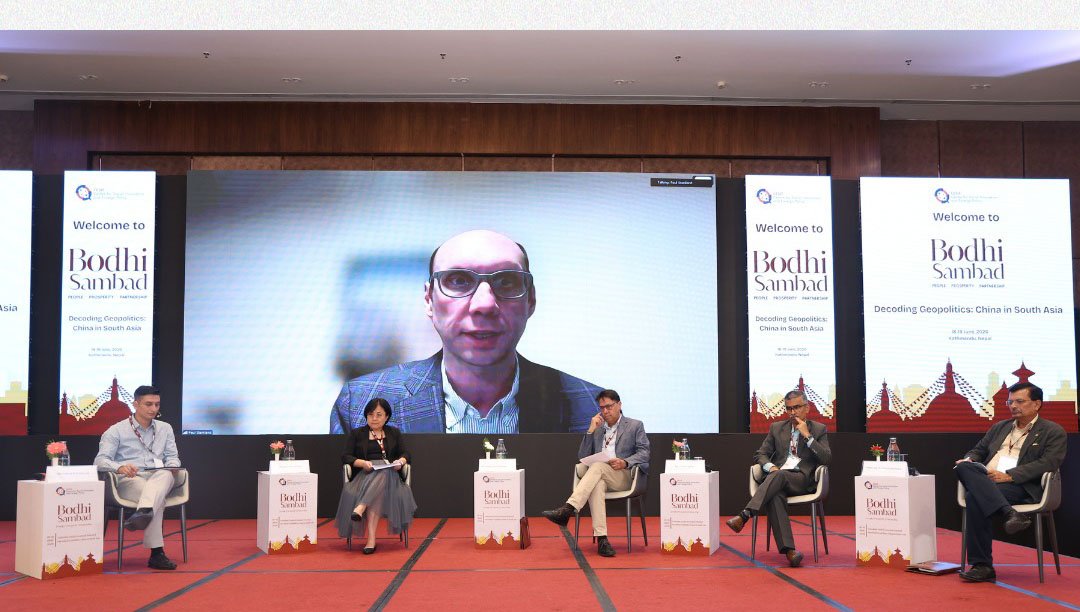
Kathmandu. Various international and domestic experts are discussing diplomacy, Buddhism, and Nepal's potential role on the world stage at the four-day 'Bodhi Dialogue 2026' organized by the Center for Social Innovation and Foreign Policy (CESIFP).
Speaking at the program, former US Assistant Secretary of State for Democracy and Human Rights, Tom Malinowski, stated that Nepal has made its identity through the role played by youth in the Gen Z movement.
He said, 'Not all countries can become military or economic superpowers, but with a little courage and the solidarity of youth, any country in the world can become a moral superpower or a superpower of values, which Nepal has demonstrated in a short time.'
Malinowski mentioned that the performance of youth in Nepal's Gen Z movement has given courage to youth worldwide to fight against corrupt elites, and if Nepal's new government adheres to those principles of the youth, Nepal can leave a much larger impact than its capacity.
Akhilesh Upadhyay, Senior Fellow at IIPS and an expert on Nepal, stated that Nepal is a special example of religious harmony. He said that in Nepal, Hinduism and Buddhism are not completely separate but are interconnected.
'Nepal is an example where both Hindus and Buddhists share common festivals, as well as ideas like karma and non-violence,' Upadhyay said. 'Nepalis consider Buddha as both a separate deity and an avatar of Vishnu. Therefore, here, 'Nepali' refers to both Hindus and Buddhists.'
Discussions were also held on the limitations of India and Buddhist diplomacy at the program. Dr. Jabin Jacob, Director of India's Center for Excellence for Himalayan Studies, commented that India's Buddhist diplomacy is mainly limited to Tibetan Buddhism and that Buddhists are ignored in this.
He accused India of essentially conducting Buddhist diplomacy with its hands tied behind its back. He claimed that Buddhism is subject to India's internal dynamics and that the world has higher expectations of India regarding Buddhism compared to China.
Similarly, Professor Dr. Ramesh Dhungel of Buddhist Studies and Himalayan Culture and Languages, recalling historical facts, reminded that in the past, Nepal supported India when it tried to spread religious culture to regions like China and Tibet. He mentioned that there was a great alliance between Nepali and Indian scholars at that time.
However, Dr. Mei-Chuan Wei, Associate Professor at Taiwan's National Chengchi University, offered a different perspective on the effectiveness of religion in contemporary society. She stated that as interest in religion among the youth in Asia and around the world is declining, the use of Buddhism as an effective tool of foreign policy faces challenges.
Pointing out the risk of cultural diplomacy becoming politicized, Dr. Wei said, 'Instead of culture being easily understood by everyone, if it is constructed in a specific way, it can also create division in society.'
This specific news has been automatically translated by AI. As a result, there may be some inaccuracies or language errors.