India Unilaterally Builds Higher Embankment on Nepal Border, Causing Flooding in Gaur

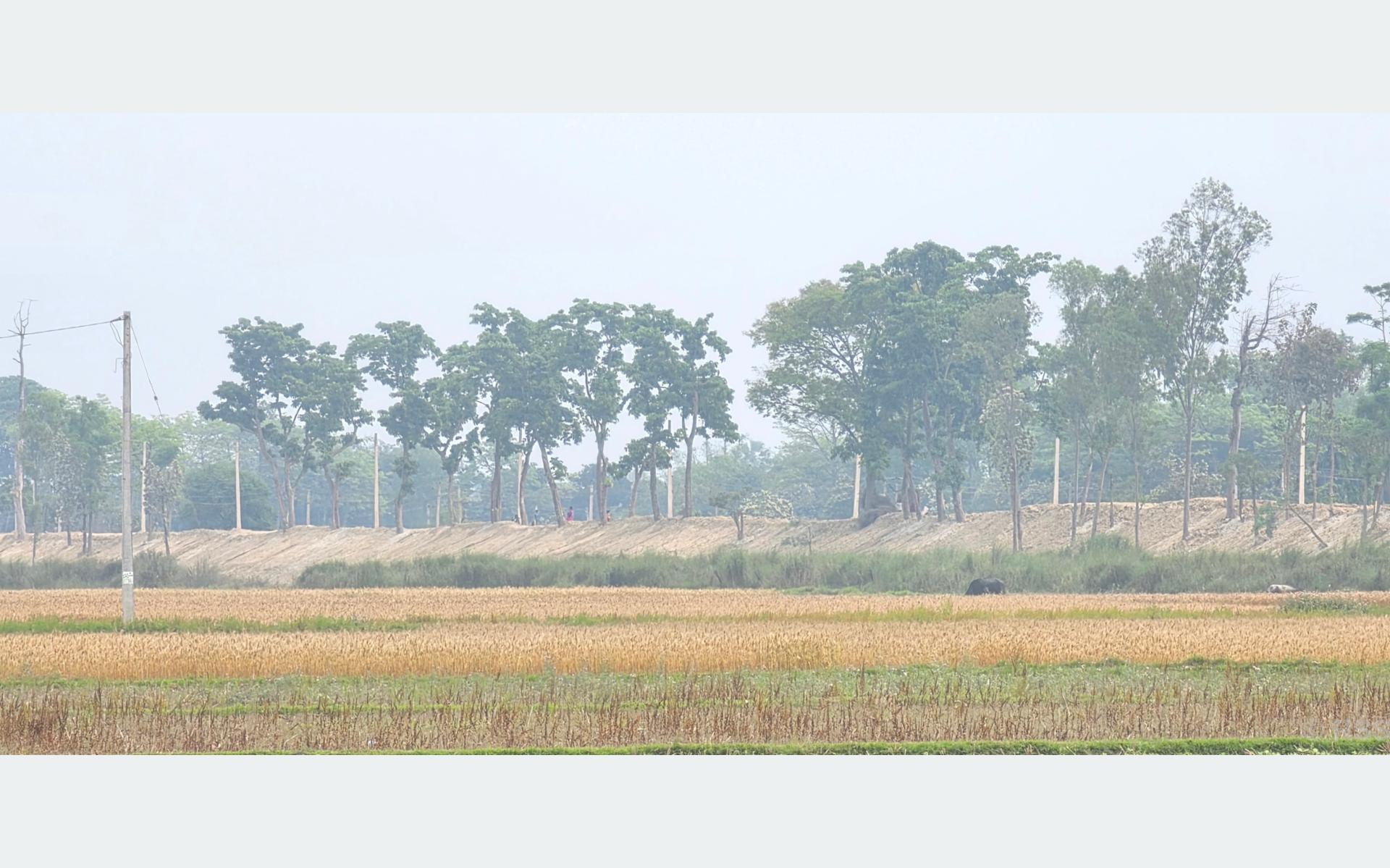
Rautahat. The Indian side has unilaterally made the embankment constructed in the border area between Gaur of Rautahat and Bairgania of India higher and stronger in the pretext of repair, violating international rules.
There is a rule that no physical structure can be constructed, expanded, or altered without the consent of both countries in the no-man's land or near it in the border area. However, the Indian side is ignoring this provision and increasing the height and width of the embankment by adding soil in the name of repair.
No country can build such a structure on its border to prevent flooding or other environmental damage to the territory of a neighboring country. Local Amit Keshari said that due to this very embankment in the Bairgania area, the natural flow of floods is blocked during the monsoon season, causing flooding in the district headquarters Gaur and dozens of Nepali villages.
Keshari stated that Nepal faces flooding because India built a 15-foot-high and five-kilometer-long embankment in the border area to save its cities like Bairgania and other cities in Bihar from flooding. The Indian side closes three gates (Sulisgate) of the embankment in the eastern part of Bairgania, causing the city of Gaur to be submerged every year. Keshari also informed that due to the fear of locals breaking the embankment and opening the Sulisgate after Gaur gets flooded, a team of Indian Border Security Force (SSB) remains deployed at the embankment 24 hours a day with weapons.
Due to the embankment being higher, the water from the Lalbakaiya and Bagmati rivers flowing from the Nepal side does not get an outlet, causing the water to 'back up' and enter Nepali settlements, informed Gautam Shrestha, secretary of the Federation of Nepali Journalists, Rautahat branch, and a resident of Gaur.
Shrestha said that adding soil to the ring embankment in the Bairgania area blocks the flow of floodwaters during the monsoon, causing the district headquarters Gaur and surrounding areas to be completely submerged. Since there is no place for floodwaters to drain in Gaur, significant loss of life and property occurs every year. A few years ago, during the tenure of the then Chief District Officer Kiran Thapa, when soil was being added in a similar manner, the work was stopped after the local administration and security agencies (Armed Police) from Nepal strongly objected.
Former Mayor of Gaur Municipality, Ajay Kumar Gupta, said that according to the agreement between Nepal and India, it is prohibited to build high structures like embankments or roads unilaterally within a certain distance from the border line. Gupta stated that India is arbitrarily adding soil and increasing the width of the embankment in the pretext of repairing the embankment built to protect its land.
He mentioned that due to the embankment constructed by India unilaterally for five kilometers from the Bagmati River in the east to the Banjara village across the Bakaiya River in the west, the city of Gaur gets submerged every year. Recalling that when he was the mayor in 2077 BS, the Indian side obstructed the construction of a protective embankment on the Bakaiya River in Mahadeopatti village of Gaur Municipality-2, former mayor Gupta said that currently, India is strengthening the embankment at its own will, and Gaur residents are facing more problems due to the closure of the Sulisgate below the embankment.
Regarding this issue, Rautahat's Chief District Officer Dinesh Sagar Bhusal said that he has drawn the attention of his Indian counterpart, the Chief District Officer (DM) of Sitamarhi district, Ruchi Pandey, about the soil being added to the embankment. According to CDO Bhusal, DM Pandey informed him that the repair work on the embankment was carried out by the Indian central government.
Since this is an issue related to the border between the two countries and international treaties, the central government needs to find a permanent solution by sending a diplomatic note, and former Chief Ministers of Madhesh Province have also been drawing the government's attention to this.
After India unilaterally built the embankment, the villages of Belbichhuwa, Brahmopuri Laxmipur in Rautahat's Rajdevi Municipality, all nine wards of the district headquarters Gaur, and Bairia, Auraiya, and Banjara villages in Ishnath Municipality have been getting submerged every year. Due to flooding in this area every year, there is a loss of crores of rupees in assets and crops.
This specific news has been automatically translated by AI. As a result, there may be some inaccuracies or language errors.



_cvUCBlwFTZ.jpg)