
National Assembly Members Criticize Budget for Disconnect with Policy and Burden on Citizens

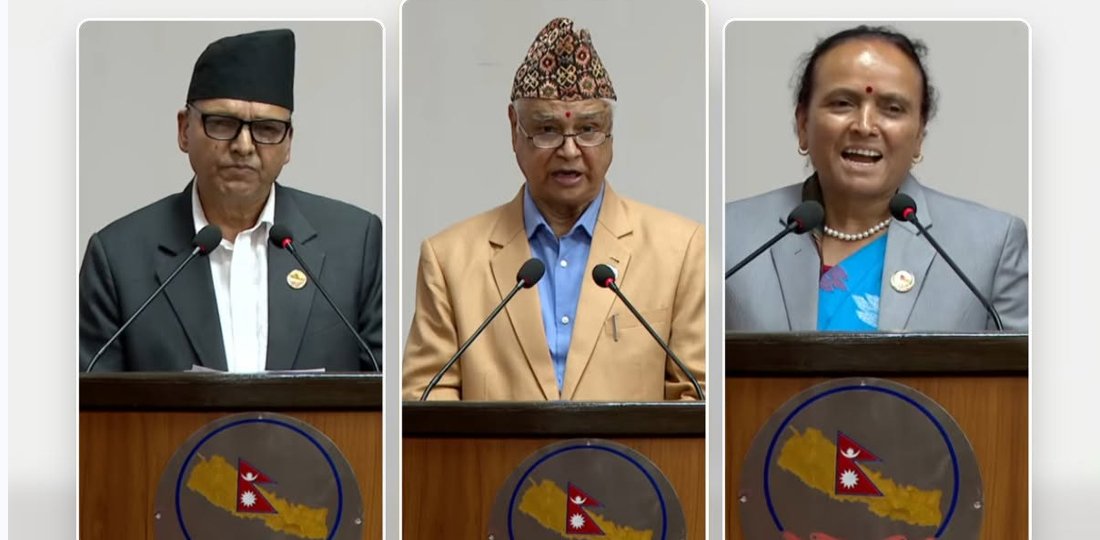
Kathmandu. Members of the National Assembly have strongly criticized the government, stating that there is a clear disconnect between the policy and program brought by the government itself and the budget allocation. Speaking in the National Assembly meeting on Friday, participating in the discussion on the annual estimate of revenue and expenditure for the upcoming fiscal year, the MPs expressed this view.
They argued that although Finance Minister Dr. Swarnim Wagle broke the traditional style of budget writing, he could not present a transformative budget. Nepali Congress MP Narayandatta Mishra said that although he was optimistic that a big transformation would come in the economy after the formation of the largest government in history, it did not happen. He criticized Finance Minister Wagle, stating that no transformative projects were included in the road, hydropower, irrigation, and education sectors. He commented that the government has increased the tax burden on low-income citizens by giving sweet-sounding names. He warned that if the people, fed up with the government's tax policy, take to the streets in protest, the country could face a serious economic deviation.
“Honorable Finance Minister has shown a new style by leaving the traditional style of budget writing. I thought that after the formation of the largest government in history, they would bring about a big transformation in the economy, but it is sad that no transformation is seen in road projects, rather the budget has decreased, there are no new and big projects in hydropower or irrigation, no transformative plan in education, and even the budget ratio has decreased,” said MP Mishra. “There are no attractive plans to bring foreign investment. After understanding, new taxes have been added with names that are difficult to understand and sweet to hear. Domestic production promotion and protection fee, skill promotion fee, clean infrastructure fee, education equity fee, and health promotion fee have been added.” He claimed that although the budget promised to provide relief to the middle class, indirect taxes have been excessively increased by providing relief in direct taxes. “Just as the country was devastated by the destruction on August 23 and 24, if the country's tax system is destroyed by the people raising the slogan of tax defiance, it cannot be said that the country will not go into a serious economic deviation again,” he said.
Jhakku Prasad Subedi, leader of the National Assembly parliamentary party of the Nepali Communist Party, said that the budget has failed to include ordinary people, farmers, laborers, and low-income groups and communities. He sarcastically commented that the government has increased the tax burden on citizens and that only a 'death tax' remains to be imposed. He also objected to the insufficient budget allocation for the industrial sector.
“What has this budget given to the poor, lower-middle class, farmers, laborers, Dalits, Madhesis, Muslims, and people from remote areas, who constitute the largest population of the country? As far as I understand, why has the electricity bill for 50 units of electricity used at home been increased by imposing 13 percent VAT? The Maoist government had provided 20 units free,” said MP Subedi, expressing his anger. “Now this government has imposed taxes on everything. Only one thing remains to be taxed, the death tax. Only the tax to be imposed after a person dies remains, taxes have been imposed on everything else.” He alleged that only 640 million rupees have been allocated for the country's industrial sector, and despite all indicators being met, Nepal is still being kept in the least developed country list for three more years. He questioned what the government intends to do by selling shares of Nepal Telecom, which is making a profit.
CPN (UML) MP Samjhana Devkota commented that the government does not seem serious about the socio-economic security of the citizens. Mentioning that taxes have been imposed on everything from household consumer goods to education and health, she questioned what impact this could have on the citizens. She stated that the government, formed on the foundation of the 'Gen Z' movement, has not brought any policy to provide labor to the country's youth. “How can the government afford to pay VAT on electricity used for domestic purposes? VAT on food, health, VAT on education, how can the public pay taxes on everything? What impact will this have on women, children, the elderly, and social security?” MP Devkota asked. “Where is the policy to provide labor to the country's youth? Where have the issues of the labor market and employment gone, government? The budget has not even touched small farmers and small businesses. Women cannot contribute to the country's GDP just by riding a blue bus. What other programs have you brought?” She complained that although the upcoming fiscal year's budget has provided tax exemptions to big businessmen, it has failed to address the low-income groups. In the discussion on the budget in the National Assembly, most MPs have accused the government of bringing policies that harm the poor and helpless people and benefit only the big and influential.
This specific news has been automatically translated by AI. As a result, there may be some inaccuracies or language errors.
_Z5wiZcZHg9.jpg)
_ZClym1j2cX.jpg)
-education-and-sport_c0BHyFjlfq.jpg)
_jngkj3r13m_7PHWnhfPpk.jpg)
