Government Introduces Minimum Support Price Directive for Agricultural Produce

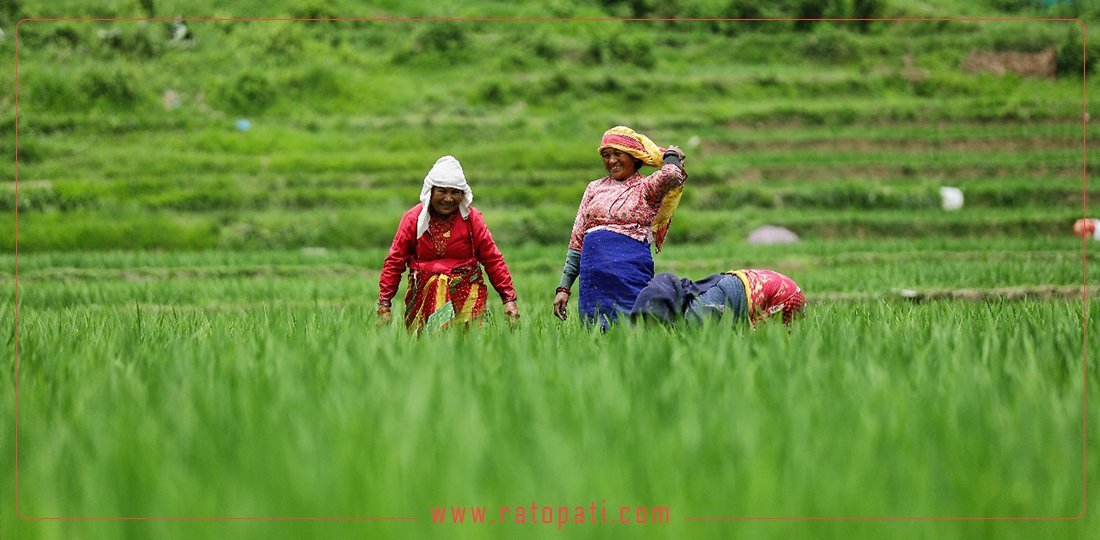
Kathmandu. The government has taken a historic step by addressing the long-standing demand of farmers. The government has issued the 'Minimum Support Price and Minimum Purchase Price Determination Directive, 2082'. With this new system, the price of major food grains and industrial crops will now be determined before planting or harvesting. This will ensure a minimum profit for farmers in a timely manner.
This directive, issued by the Ministry of Agriculture, Forests and Environment, provides for the determination of prices for major food grain crops (paddy, maize, wheat, millet) and industrial crops (sugarcane) by considering production costs, transportation expenses, and ensuring a minimum profit for farmers. The ministry claims that this will stabilize fluctuations in the market price of agricultural produce, protect farmers from market risks, and attract them to the farming profession.
Implementation Faces Challenges
Although the directive presents a new roadmap for ensuring the market for agricultural production, some challenges may arise in its successful implementation. Ministry officials say that the process of collecting data from various provinces and districts across the country to ascertain production costs, making the coordination between the technical committee and the recommendation committee effective, and finally getting the decision from the Council of Ministers in a timely manner can be complex. 'Considering the diversity of farmers and markets spread across the country, maintaining accuracy in data collection and analysis will be a major challenge,' says a joint secretary at the ministry.
He stated that balancing the encouragement of private buyers to purchase agricultural produce at this price and providing products to consumers at a fair price will be another challenge for the government.
For sugarcane farmers who have been struggling with price disputes and payment problems for a long time, special provisions have now been made in the 'Minimum Support Price and Minimum Purchase Price Determination Directive, 2082'. According to the directive, a system will be initiated where the minimum purchase price for industrial crops will be determined based on the recovery rate from sugarcane crops within the next three years.
Sugarcane-producing farmers will be encouraged to cultivate sugarcane varieties with high recovery rates. This provision will help improve the quality of sugarcane and ensure that farmers receive fair prices for their produce. It provides clear guidelines for the purchase and sale between sugarcane farmers and sugar mill owners and for resolving disputes, which will have a positive impact on the overall development of the sugarcane industry.
More Authority to Provinces and Local Levels
The new directive grants more authority to provincial governments and local levels in determining and implementing prices for agricultural produce. Provincial governments and local levels can purchase agricultural produce at the minimum support price and minimum purchase price determined by the government by making necessary legal arrangements. In addition, they have the authority to determine and implement minimum support prices and purchase prices for crops other than those specified by the government. The ministry claims that this arrangement will help manage agricultural prices according to local needs and circumstances and directly benefit farmers.
Price Determination Will Be on Schedule
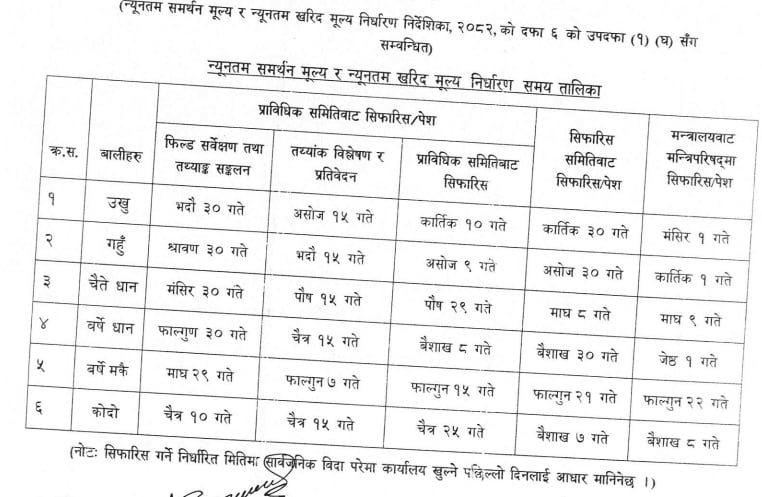
The government has released a new and detailed work schedule with the objective of bringing transparency and efficiency to the process of determining the minimum support price for agricultural production. This work schedule has systematized the process of setting the minimum support price and minimum purchase price for major crops including sugarcane, wheat, spring paddy, rainy season paddy, maize, and millet.
For sugarcane, field surveys will be completed by Bhadra 20, and prices will be determined by the Council of Ministers by Mangsir 1. Similarly, for wheat, field surveys will be completed by Shrawan 20, and prices will be determined by Kartik 1. The target is to determine prices for spring paddy by Magh 15, for rainy season paddy by Jestha 1, for maize by Falgun 22, and for millet by Baisakh 15.
This detailed work schedule sets clear deadlines for each crop, and it is expected that farmers will receive fair prices for their produce in a timely manner.
This specific news has been automatically translated by AI. As a result, there may be some inaccuracies or language errors.