Finance Minister Swornim Wagle Denies Corruption Allegations, Vows Resignation if Proven

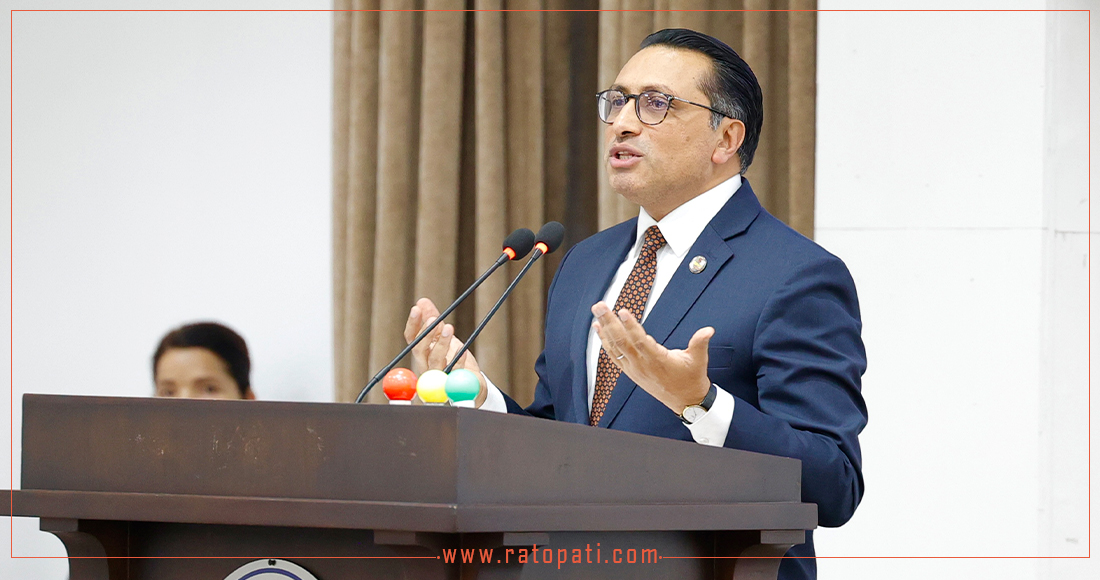
Kathmandu. Finance Minister Dr. Swornim Wagle has strongly refuted the corruption allegations against him, announcing his resignation if any irregularities are proven. Responding to questions raised by MPs in the House of Representatives meeting on Thursday, he warned that the old scandals of the leaders raising questions would also be exposed. He denied the accusation of favoring certain businessmen through tax rates while sitting in the Finance Ministry, claiming the suspicion of 2 billion is baseless. He mentioned refuting news against him in the Public Accounts Committee and pledged not to insult the mandate given by the people for good governance. He argued that he could not betray the public within two months of coming with a strict agenda of good governance and challenged those pointing fingers at him to maintain moral high ground. Targeting the MPs who raised questions about him, he said, 'The currently much-talked-about issue – that Swornim Wagle sat in the Finance Ministry and favored businessmen by manipulating tax rates – has also been heard. MPs must maintain their dignity. We should not engage in activities that diminish the prestige of this respected house. Can we betray the public within two months of advancing with a ruthless agenda of good governance, for which the public has given its approval? We cannot. I also said in the Public Accounts Committee today that one or two scraps wrote about suspicions of 2 billion, etc. But if there is any wrongdoing or dishonesty of even 2 rupees, not 2 billion, I will resign from the ministerial post. I am ready to even abandon public life. May those honorable members pointing fingers at me also possess this moral courage and moral high ground. We are not unaware of your scandals; those will also be revealed.' He also urged to be fact-based before making personal accusations. Similarly, Finance Minister Wagle claimed that the government has brought the budget for the upcoming fiscal year with equality at its center. Refuting the opposition parties' allegations that the budget has come against the spirit of the constitution, he clarified that equality and social justice have been made the center of the budget. He stated that the budget prioritizes the balance between economic growth and equality, aiming for equitable prosperity and development. He mentioned that although the word socialism is not explicitly mentioned in the budget, efforts have been made to practically implement the agenda of equality. He asserted that the government remains firm on its five-year commitment and the agenda approved by the public, claiming a high level of consistency between the policy, programs, and principles of the budget. Explaining the budget framework, he said, 'Complaining that the budget did not come in a language I understand or according to the agenda my party holds is one thing, but our focus for five years is the promise we made and the agenda approved by the public, and we have advanced programs with utmost loyalty to it. There is unprecedented consistency and coherence among 100 governance reforms, policy programs, budget principles and priorities, and the budget itself. Please view it from that perspective. Our politics for the past 30/40 years has been somewhat left-leaning, and it is ingrained in that narrative, from which we have also drawn inspiration. The claim that it is against the constitution is absolutely wrong; we have placed equality at the center. While talking about growth, we have talked about growth with equity. We have talked about equitable prosperity and development. Therefore, even if the word socialism is not exactly included, we have put forward the agenda of equality.' He also commented that the opposition parties are entitled to complain that the budget did not come as per their party's agenda. Meanwhile, Finance Minister Wagle clarified that poverty does not decrease merely by distributing cash. He informed that although the budget has not prioritized cash distribution, social security programs have not been cut and have even been expanded in some areas. He stated that the government's goal is to enable people to earn income rather than always being in a state of receiving aid. He mentioned that the most effective way to eradicate poverty is to create sustainable employment and income-generating opportunities, and the upcoming budget will empower agriculture, entrepreneurship, and the private sector. He explained that the government is advancing economic policy with a focus on collaboration with the private sector, clarifying that the old mindset of the state doing everything itself or viewing the private sector with suspicion has been abandoned. Speaking about the role of the market and the responsibility of the state, he said, 'We have abandoned the dual character in terms of policy. We have focused on strengthening regulatory bodies. We have moved away from the old mindset where the state does everything and views the private sector with suspicion. We are also far from the extremist thinking that the market solves everything. Our approach is based on cooperation between a capable state and a dynamic private sector. The market is not self-made; the state must make it. Markets are not self-regulating; the state must regulate them. Markets are not self-stabilizing; stable bodies of the state must stabilize them. Returns in the market are not self-legitimizing; the state must intervene to do so. This budget has been formed from that perspective. We have been practicing this with regulatory bodies, but it has become distorted.' Finance Minister Wagle expressed determination to move forward by ending such distortions in the coming days, stating that crony capitalism and economic capture have emerged due to the distortion of regulatory practices in the past. He added, 'Sometimes issues of crony capitalism arise, sometimes issues of capture arise. We must move forward by destroying them. For a competitive economy to bring about the results of equitable prosperity, the state must be strong. Another perspective on how to reduce poverty is a bit advanced; we have not cut any existing social security programs. Budgets brought by you in the name of welfare or poverty have not been cut; rather, we have added to them. But the budget accepts the reality that poverty does not decrease merely by distributing cash. We are in favor of enabling people to earn income, not keeping them in a state of always receiving aid.'
This specific news has been automatically translated by AI. As a result, there may be some inaccuracies or language errors.