IPPAN Senior Vice Chairman Candidate Uttam Bhilon Lama Proposes Collaboration for Energy Sector Crisis

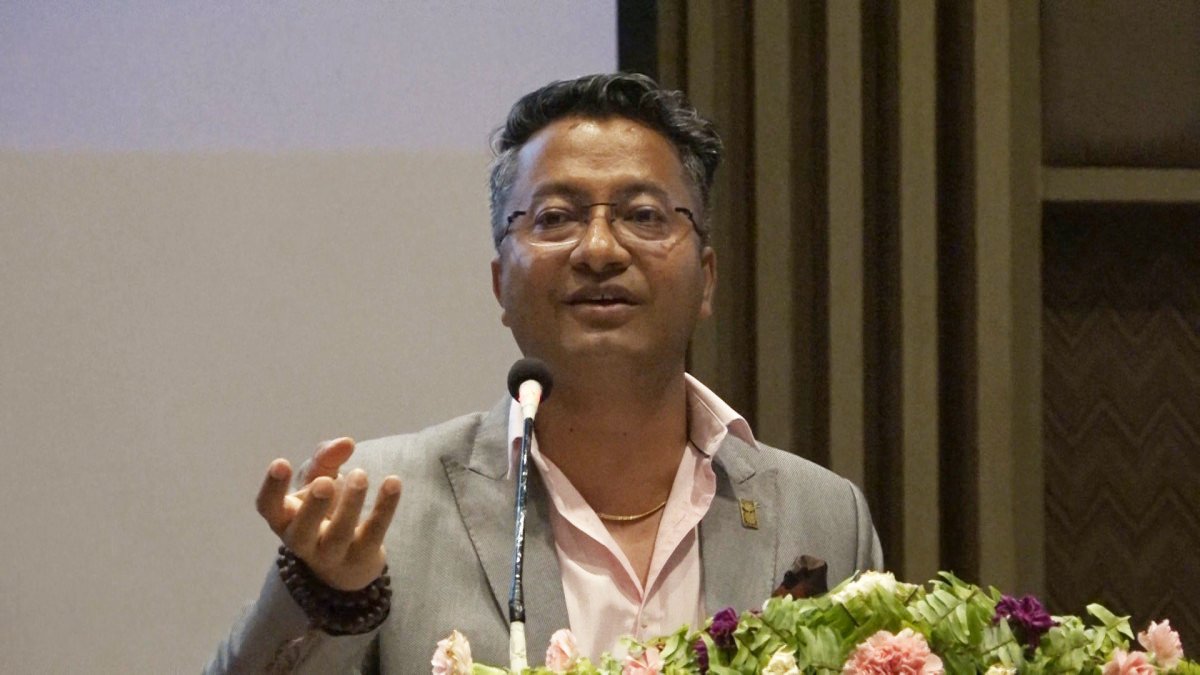
Kathmandu. Uttam Bhilon Lama, a candidate for Senior Vice Chairman of the Independent Power Producers' Association, Nepal (IPPAN), has stated that collaboration between the government, private sector, and consumers will be crucial to pull the energy sector out of its current crisis.
Presenting his election agendas at a special program organized in the capital, he recalled that the investment and risky efforts of energy entrepreneurs were important in ending the dire load shedding of up to 16 hours in the past.
Candidate Lama has put forward a new perspective to address the existing problems in the energy sector by classifying them into two parts. According to him, the state must immediately make decisions by clearly distinguishing between 'budgetary support' and 'non-budgetary' types of work for the development of the energy sector.
His demand is that the role of the private sector should be further expanded in this sector as a large investment is needed in the country's transmission and distribution infrastructure. He has made the full implementation of 'Open Access', a simple licensing process for cross-border electricity trade, harmonization of grid codes and guidelines, establishment of a dispute resolution mechanism, and simplification of the electricity purchase agreement (PPA) process his main election agendas.
Appreciating the contribution of energy entrepreneurs, he said at the program, 'The energy sector has now become a very important sector in Nepal. Significant progress has been achieved in this sector through the joint efforts of the Nepali people and energy entrepreneurs. Energy entrepreneurs have invested by risking their life's earnings. Earlier, it was like a river in a bag, but now it looks like a bag in a river, meaning possibilities have been created even in areas considered impossible. The joint effort of the government, the private sector, and all citizens was decisive in bringing the country out of the serious situation of load shedding for up to 16 hours. I personally consider this a magical achievement.'
Clarifying his election roadmap, Lama presented data showing that more than 200 billion rupees are needed in the country for transmission and distribution line construction alone. However, with the country's total development budget being around 400 billion and the Ministry of Energy's budget being only around 85 billion, his analysis is that meeting this requirement solely from the government budget will take a long time. For this reason, he said that the private sector should be given more responsibility and trust in the field of electricity production and transmission.
Lama claimed that the government should primarily focus its attention only on distribution and cross-border transmission lines, and if the remaining areas are left to the private sector, they are capable of working. He argued that for the non-budgetary sector, no large financial investment is needed, but these policy reforms are possible only with clear policies, efficient coordination, and strong collaboration between the government and the private sector. He clarified that the private sector's contribution to this historic journey continues to grow, as the country has now reached a strong position of over 3,600 megawatts of electricity production.
This specific news has been automatically translated by AI. As a result, there may be some inaccuracies or language errors.