Foundation Robotics Develops 'Phantom' Humanoid Robot for Military and Civilian Use
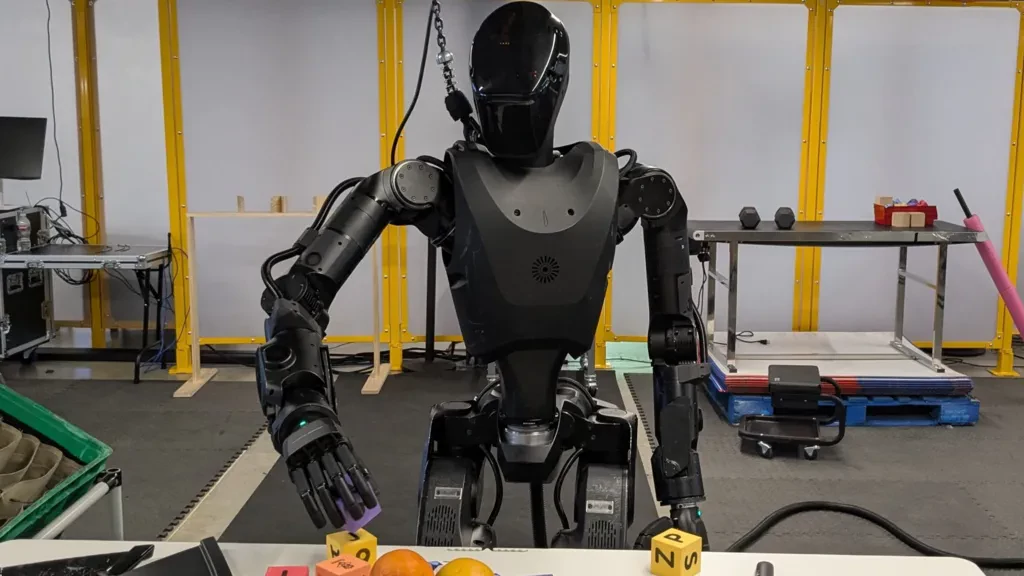
Upon arriving at Francisco's technology-focused area, I expected to see terrifying humanoid robot soldiers engaged in war-like activities. Perhaps a glimpse of future ground combat, but instead, a black, shiny, faceless robot named 'Phantom' was busy in its own world. It was manipulating colorful blocks that children play with.
'We need data on how it interacts with its surroundings... and this is today's menu,' explained Sanget Pathak, co-founder and CEO of 'Foundation Robotics,' which was launched two years ago. This company is developing Phantom for use in both military and civilian sectors.
He pushed the robot's 80 kg steel-covered body around the room to demonstrate its stability and how it walks. While many companies are building automated humanoid robots to work in factories, homes, or as companions, Foundation claims to be the only American company specifically developing such robots for extensive use in the defense sector. This includes support roles such as material transport, reconnaissance, rescue of equipment or the injured, and inspection of hazardous areas. However, more controversially, it also includes combat roles to confront and neutralize threats—what Pathak calls 'frontline weaponization.'
He argues that arming robots can keep human soldiers away from danger. They can enter and search buildings where narrow alleys could be deadly for humans. This can also reduce collateral damage in war. He suggests that ground-based automated systems may be more accurate than automatically attacking targets from the sky.
However, for Foundation's Phantom, all this is still in the womb of the future. The first-generation model I was shown was 'Phantom Mk-1.' It has no battery, is not dust or water-resistant, and cannot even get up if it falls. The dexterity of its hands is still a major challenge in the field of robotics. Its hands lack strength and dexterity, and it doesn't have a proper wrist yet. A second-generation model named 'Phantom Mk-2' with more features is under construction.
According to Pathak, Phantom Mk-2 will not only be dust and water-proof but also have a large battery that can run for about 6 hours, and it will be able to get up on its own if it falls and withstand more force. Having strong hands is extremely important for this. 'The fingers and wrists of the robot's hands will move in many ways, which will help it operate weapons,' says Pathak.
Foundation's goal is to produce at least 40,000 robots per year by the end of 2027, with a long-term cost of less than $20,000 per unit, Pathak added.
Sanget Pathak, wearing a blue t-shirt, stands next to the black Phantom robot. Pathak argues that China is rapidly advancing this technology and Western countries should not fall behind. He envisions armies of millions of AI-powered humanoid robots, similar to the increasing use of automated drones in the sky. 'Teams of humanoid robot soldiers can play a big role in deterring conflict,' he said.
The Foundation has a $24 million research contract with the US Army to test its technology. Additionally, two units are currently being tested by the Ukrainian army. 'The US Army's testing is limited to material transport rather than operating weapons,' Pathak said.
However, testing in Ukraine includes weaponization. The company attracted much attention earlier this year after Eric Trump, son of former US President Donald Trump, became an investor and advisor. For Pathak, Foundation is also an opportunity to prove himself. The financial services company 'Synapse,' where he was a co-founder and took leadership, went bankrupt in 2024. But are humanoid robot soldiers what the military needs? How difficult are they to build? And what ethical questions do they raise? Dean Frankhauser of the humanoid robotics consulting firm 'RoboJaps' says, 'The military is very interested in this.'
He pointed to a recent US Army competition where humanoid robots could assist soldiers in various tasks. Frankhauser argues that it is normal and inevitable for companies to see business opportunities in weaponizing this technology. Currently, simpler robots like drones and some ground-based robot systems are used to carry explosives, missiles, and other war materials. Their use in the battlefield, especially in Ukraine, is clearly visible. 'Some companies are also working on weaponizing four-legged robots that look like dogs. However, we haven't seen them much in active combat,' Frankhauser said.
But other companies with legged robots are opposing weaponization, citing potential harm and ethical issues. Pathak disagrees. He argues that it is dangerous for many companies not to follow Foundation's path. 'The reason humanoid robot soldiers are suitable is that this world was made for humans,' he argued.
Although Chinese robots have shown good performance, they are still some distance from the battlefield. However, not everyone is convinced that humanoid robots are the most effective means. Frankhauser of 'RoboJaps' says, 'Other robots like quadrupedal ones can travel faster and more effectively over difficult terrain.'
'There is no need to reinvent tools, from screwdrivers to weapons. The system must have a human process before using any lethal force, and it must be approved by humans,' Pathak said. However, he makes some exceptions where it may be necessary to operate weapons independently to avoid catastrophic consequences, and in such situations, the importance of human approval is reduced.
Perhaps the biggest challenge facing all companies building humanoid robots is developing artificial intelligence (AI) that can work in the real world and cope with unpredictable and complex situations. Phantom is guided by an AI system called 'Cortex,' and its new version is also under development. The concept is that Phantom is given a task, such as moving materials or mapping inside a building. It is specially trained for this task using video, images, and instructions. It can then see 360 degrees around using the cameras in its helmet. It moves accordingly. This helps its AI system evaluate its surroundings and adapt its movements.
According to Pathak, two types of AI models work together in Cortex. A 'reasoning model,' trained on examples of specific tasks, interprets its goals and creates a plan of action for Phantom. The other, a detailed 'world model,' is based on internet videos and data collected by the robot as it interacts with the physical world. Such data is obtained from activities like playing freely with blocks. It predicts how the environment will react, which helps Phantom move safely and execute its tasks.
Although Chinese robots have shown good performance, they are still some distance from the battlefield. However, not everyone is convinced that humanoid robots are the most effective means. Frankhauser of 'RoboJaps' says, 'Other robots like quadrupedal ones can travel faster and more effectively over difficult terrain.'
Based on what he has seen in the commercial sector, humanoid technology still has a long way to go. 'Today's commercial humanoid robots can barely handle warehouse packing, let alone open doors,' Frankhauser said. 'If war breaks out in Taiwan today, the possibility of China militarizing these humanoid robots and fighting effectively is just a fantasy.'
Although Chinese robots have shown some impressive performances, they have been in highly controlled or specific organized environments. This is contrary to the environment of real-world warfare. However, Frankhauser adds that the situation may be different in 5 or 10 years. Robert Griffin works on humanoid robots at the non-profit 'Florida Institute for Human and Machine Cognition.' It studies humanoid robot projects deployed in non-combat areas but dependent on military support. A company spun off from this was later acquired by Foundation for some of its key technologies.
Griffin sees the importance of humanoid robots in reducing the risk to human soldiers, but says that unpredictable environments are still a major obstacle.
'It is difficult to make a robot jump from a window of unknown height, land on uneven ground, and immediately advance into an unfamiliar interior. 'Seeing the human form gives you the impression of human-like capabilities... but we still don't know how they will handle sudden uncertainties,' Griffin said.
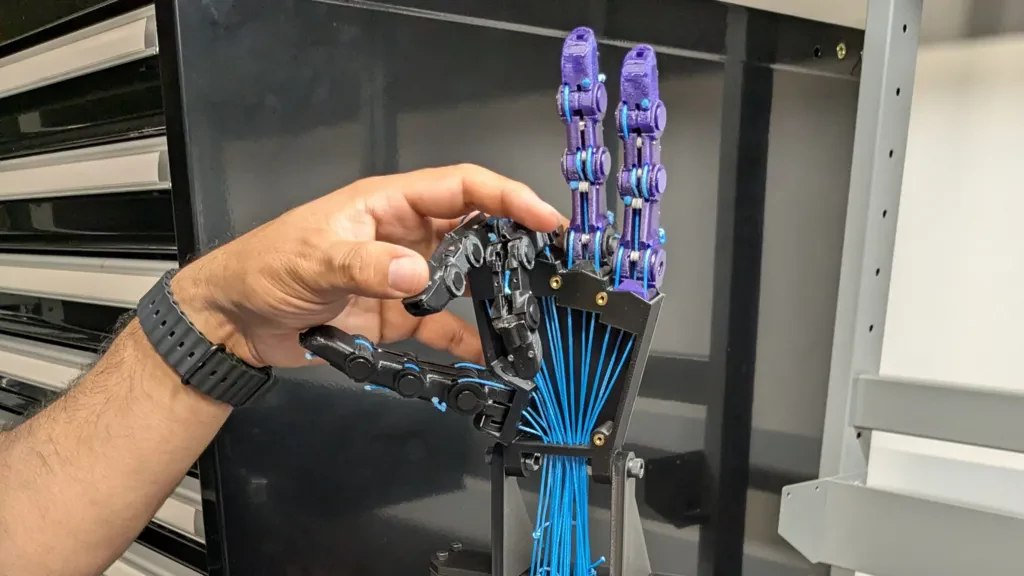
JE Corbin is manipulating a robot's hand placed on a bench with a human hand. JE Corbin Foundation is working on new hands for its robots. Meanwhile, ethical concerns are emerging significantly. Lethal autonomous weapons, in whatever form, lower the threshold for war, dehumanize conflict, and obscure accountability.
He stated that human soldiers can easily trick the robots' AI systems by performing unnatural actions like falling over or placing cartoon cans on their heads. Practical problems are also not easily solved. Operating time is also an issue plaguing humanoid robot companies. Griffin said, 'Moving around and operating joints are extremely energy-consuming tasks. Therefore, running for 6 hours is considered very effective.' Whether the Foundation company can build hands capable of operating weapons designed for humans remains to be seen.
'This company is setting extremely difficult challenges for its engineering team, either to complete or fail,' he said.
JE Corbin is manipulating a robot's hand placed on a bench with a human hand. JE Corbin Foundation is working on new hands for its robots. Meanwhile, ethical concerns are emerging significantly. Lethal autonomous weapons, in whatever form, lower the threshold for war, dehumanize conflict, and obscure accountability.
Nicole Van Roijen, executive director of the global non-governmental organization 'Stop Killer Robots,' considers humanoid robots 'more offensive.' As the civilian use of human-like machines increases, they may seem familiar and reliable. 'This increases the risk that people may not recognize the danger. The solution to the unhealthy competition in current technological weaponization is to create international rules to curb it as much as possible,' Roijen argues.
Joey Corbin is a technology correspondent in San Francisco.
This specific news has been automatically translated by AI. As a result, there may be some inaccuracies or language errors.