Dhaulagiri Basic School Faces Equal Number of Students and Staff

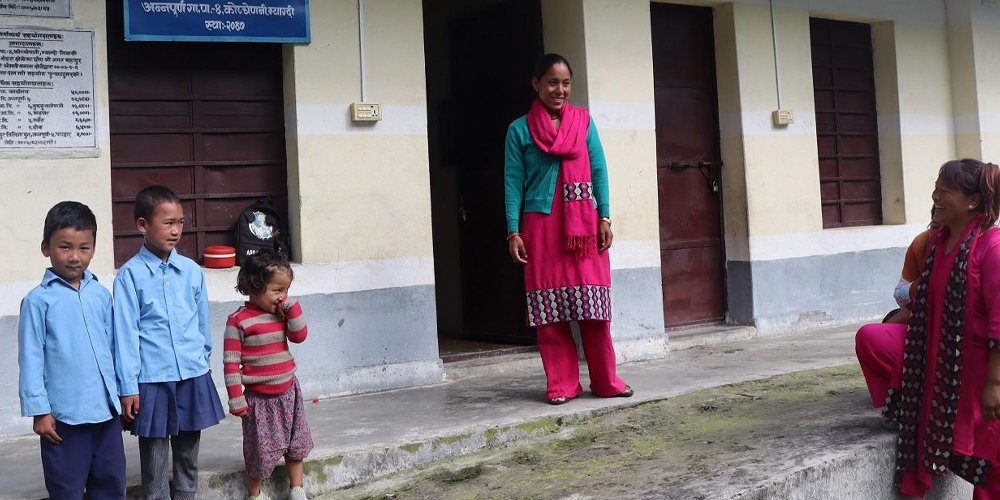
Myagdi. At Dhaulagiri Basic School in Bhalebas, Annapurna Rural Municipality-4, the number of students and teachers-employees is equal. The school, which offers education up to class 3, has zero students in classes 1 and 2. Established in 2040 BS, this school has one student in the pre-primary class and two students in class 3. The number of teachers-employees here is also three. Shanti Ramjali, a permanent cadre teacher, is the headmaster, Shikha Bohora Chhetri is the early childhood facilitator, and Surjana Rok is an assistant. Among the students here, Jessica Khadka enrolled in the pre-primary class this year, while Nelson Roka and Shrisha Khadka, having passed class 2, have enrolled in class 3. Headmaster Ramjali said that the impact on the school is due to increasing migration and decreasing birth rates. "There are 15 households living in Bhalebas and 10 in Kopchepani, which fall within the school's service area," he said. "Until 2072 BS, there were 15-20 students. This problem has occurred because the birth rate of new children has decreased and the rate of migration to other places has increased." Earlier, in 2075 BS, the school building in Kopchepani was washed away by a flood in Kaligandaki and was relocated to Bhalebas. Despite having a well-equipped building, toilets, and child-friendly classrooms, the school is deserted due to the low number of students. Due to the low student numbers, the rural municipality cut one teacher's position last year. Local resident Tularam Buda said that the number of students is decreasing because the village is emptying due to migration. "It takes about an hour's walk for children to reach Gadpar and Kavre, neighboring villages of Bhalebas and Kopchepani," he said. "There is a compulsion to operate the school even with a small number of students so that the children in the village are not deprived of their right to education." Basic schools in Thada, Kindu, Swat, Gharap, and Chitre under Annapurna Rural Municipality also have a low number of students. The rural municipality chairman Bharat Kumar Pun said that the rural municipality has adopted a policy of reducing classes and managing staffing positions due to the low number of students in schools located in geographically remote and scattered settlements.
This specific news has been automatically translated by AI. As a result, there may be some inaccuracies or language errors.
_iL3K2wYemS.jpg)