Good Governance and Prosperity: Pillars of Modern Nepali Democratic State

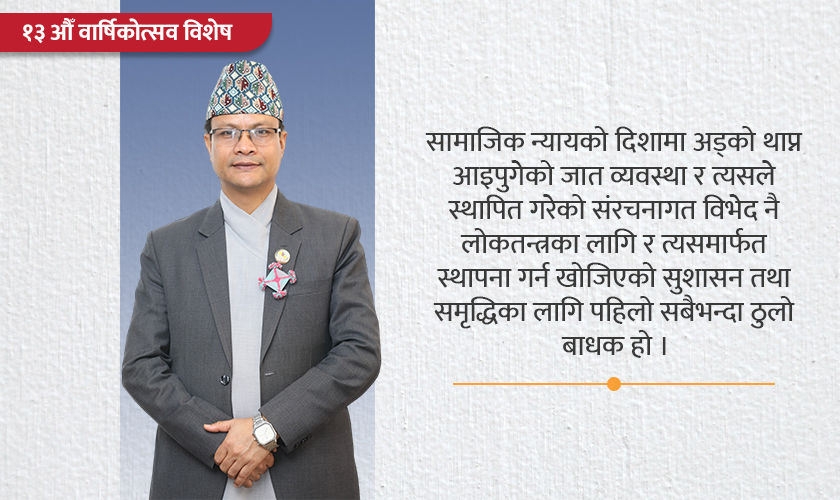
As I write about the main pillars of good governance and prosperity in a modern state on the occasion of Ratopati's 13th anniversary, I first wish to extend my heartfelt congratulations to the entire Ratopati family.
We are now standing in a new political environment, having gone through the Gen Z revolution. A new government has been formed after elections held on the foundation of the Gen Z revolution. The party running the government is new. And, there are thousands upon thousands of young people from the new generation on the political base. In other words, the new generation of youth have taken the responsibility of building a new Nepal on their shoulders and are moving forward accordingly.
Certainly, there are many definitions of democracy in the world. However, there are minimal similarities in the conception, practice, and experimentation of countries that have adopted a democratic state system.
No country that claims to be a 'democratic' nation can trample upon the fundamental tenets of democratic values. As a country, we too cannot trample upon those values and standards.
Just as every person has their own history and life's ups and downs, so does a country have its own history and the ups and downs of its democratic practice. In Nepal's political history, the People's Movement of 2062/063 is the latest significant milestone, from which we were able to institutionalize the Federal Democratic Republic.
In the context of Nepal, democracy is not just a political system; it is the collective result of decades of blood, sweat, sacrifice, and martyrdom. The background to how easily we utter the word 'democracy' today is as complex and arduous as it is.
It is impossible to completely forget the phased movements, people's movements, sacrifices, and in some instances, even the vicious cycle of exile that occurred to establish this democratic system, and then to chart a course towards good governance and prosperity by standing on the shoulders of this democratic system.
Therefore, in this article, I will briefly discuss what the fundamental pillars of good governance and prosperity, considered essential in the process of building a modern Nepali democratic state, are.
- From Heinous Discrimination Towards Social Justice
Observing Nepal's modern democratic practice closely, its main obstacle is the 104-year Rana regime. For Nepali citizens, that time was no less than a dark dungeon. The common Nepali had to wait until 2007 BS to break free from it.
However, the Rana regime was not just political dictatorship; it was a factory of heinous social division sustained by religious authority. The religious authority, which had taken root more strongly than political power, divided society on the basis of caste, class, gender, and geography to such an extent that its repercussions are still felt in the democracy of the 21st century.
We are currently talking about democracy, social justice, and inclusion, taking the 2072 BS constitution as a mirror. However, to understand the spirit of the current constitution, we must trace the roots of the Muluki Ain of 1910 BS. Although the common people talk about Prithvi Narayan Shah's 'four varnas, 36 castes,' if we trace its inner arteries, the division of Nepali society into 'human' and 'inhuman' categories was done at that time.
The caste system, which has hindered the direction of social justice, and the structural discrimination it established, is the first and biggest obstacle to democracy and the good governance and prosperity sought to be established through it. Until the Nepali society itself removes this obstacle, the journey of Nepali society towards its envisioned destination will always remain obstructed.
To such an extent that in the Kathmandu Valley alone, it has drawn more than 200 lines of division within the Newar community. It has established a hierarchy of division even within indigenous communities.
On the basis of such a hierarchy, what kind of society will we build? Imagine a picture of future Nepal in your mind. It will surely look ugly.
The courts and justices here have issued many significant orders to end caste oppression. However, they have not been able to provide justice to the communities trapped in the web of discrimination. This is because its origin lies in that very ancient religious authority, which the courts found impossible to break.
The discrimination faced by a student coming to Kathmandu to study from Karnali even today, being unable to find a room, is a heinous indicator of that. And its root cause is historical discrimination. We cannot move forward without addressing this while talking about democracy, good governance, and prosperity.
- Development and Prosperity for Whom?
Call it the spread of democracy or talk of advanced democracy, what comes linked with it is development and prosperity. However, we must not forget again: for whom is that 'development' and 'prosperity'? Is 'development' and 'prosperity' meant for the state-protected citizens living in Durbar Marg, Kathmandu, or is it for the citizens living below the poverty line in Namche and Safoksundo? Is 'development' and 'prosperity' spoken of to uplift citizens entangled in historical discrimination and geographical complexities, or is it for the happiness of a limited class?
Therefore, it is not enough to just talk about 'development' and 'prosperity.' What we must be clear about is that such development must be equitable. Such prosperity must be egalitarian. This can be simply termed as equitable development and egalitarian prosperity. When talking about good governance, it must be good governance with social justice. The main leadership of the Rastriya Swatantra Party (RSP) is clear on this. Therefore, as long as we cannot advance the discourse of equitable development, egalitarian prosperity, and good governance with social justice, Nepal's democracy cannot establish its roots deeply.
This is essential for democracy to flourish in public institutions and various government bodies. Only then can all citizens proudly move forward in nation-building under the umbrella of the Federal Democratic Republic.
To strengthen democracy, I have been advocating the concept of '5-D' in the party and in various discussions. The first 'D' is Democracy. The second, Development. The third, Dignity. The fourth, Diversity. And the fifth, Delivery.
In a democracy, as long as a person does not feel the full assurance of their dignity and self-respect, no system can find an environment to flourish. When people like Navraj BK, Ajit Mijar, Shambhu Sada, and Angira Passi are killed, it not only mocks our society but also exposes the character of our paper democracy.
Recently, a new force has emerged in politics. The Rastriya Swatantra Party (RSP), in a short period since its establishment, has instilled hope in everyone by including democratic republic and social justice in its core document and declaring its commitment to them. However, challenges still remain.
Because democracy is tested in practice, not on paper. It must be felt in life, not in speeches.
Finally, to make democracy a vibrant system, we must address the roots of historical discrimination and move forward by addressing them. The government led by RSP has recently formally apologized to the Dalit community of Nepal. This is a great achievement. Because the construction of a new Nepal is impossible without addressing the 'baggage' of discrimination marked by the Rana regime, Panchayat, and Muluki Ain.
Our journey ahead should not only be of good governance and prosperity but also of human dignity with social justice. As long as the person at the bottom of society does not feel 'this state is also mine and it has given me the status of a human being,' our talk of roads and trains alone cannot make democracy flourish.
Under the umbrella of democracy, first of all, those individuals must be included who stood as shields for centuries, enduring sun and rain, to bring about this system.
On the occasion of the 13th anniversary, I wish further success to the future endeavors of the mainstream media Ratopati once again!
(The author is the Chief Whip of the Rastriya Swatantra Party Parliamentary Party.)
This specific news has been automatically translated by AI. As a result, there may be some inaccuracies or language errors.