Chinese President Xi Jinping Visits Pyongyang After Seven Years, Meets Kim Jong Un

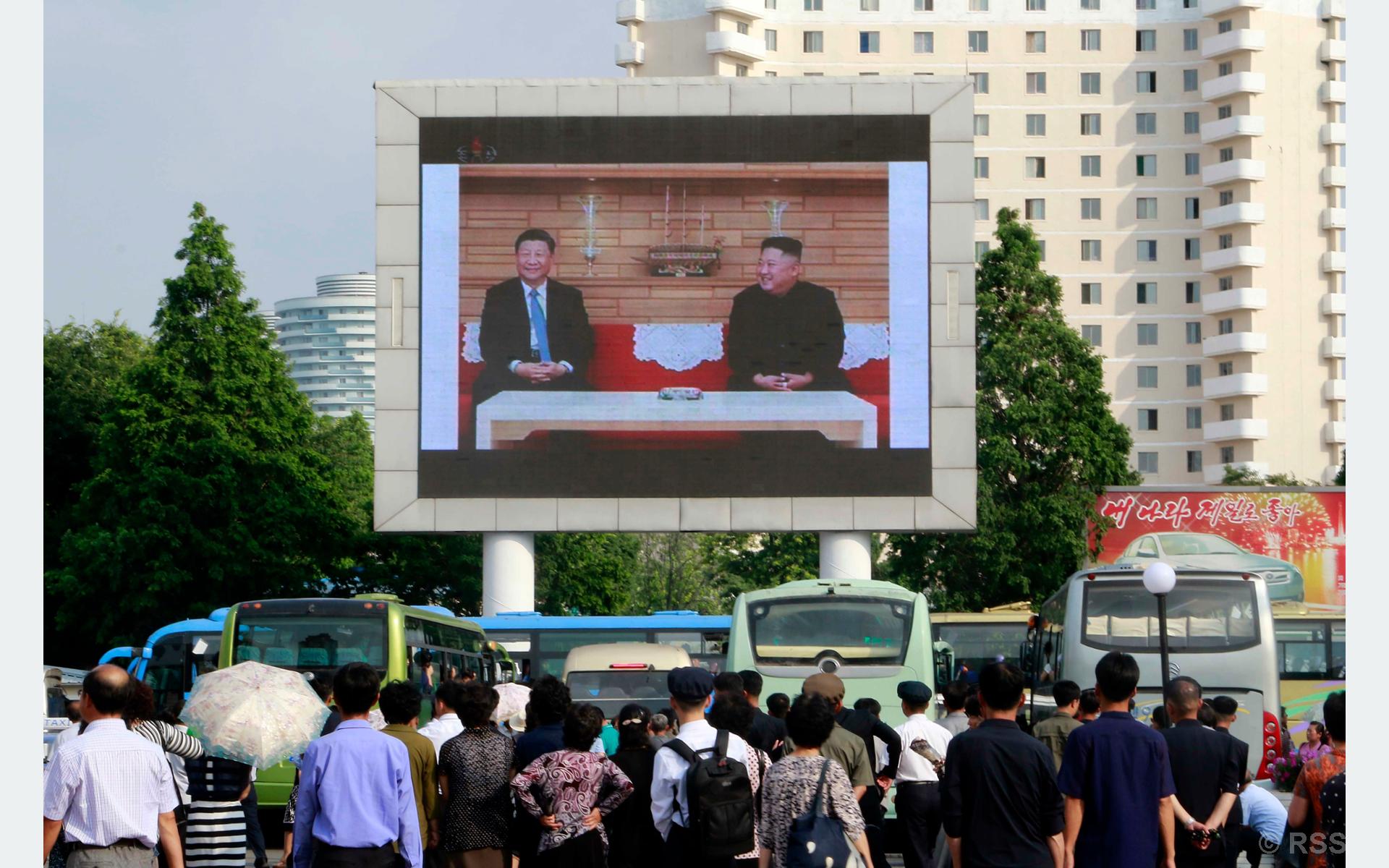
Pyongyang. Chinese President Xi Jinping has reached Pyongyang, the capital of North Korea, for the first time in seven years. During his two-day state visit, he is scheduled to hold high-level talks with North Korean leader Kim Jong Un to discuss bilateral relations, economic cooperation, and regional security. Analysts believe this visit is expected to strengthen China's influence in North Korea and further clarify Beijing's role in the changing global power balance.
According to China's state news agency Xinhua, Xi was accompanied by his wife Peng Liyuan, Foreign Minister Wang Yi, and senior officials of the Chinese Communist Party. This is the first official summit meeting between Xi and Kim since their meeting in Beijing last year. Although the detailed agenda of the visit has not been made public, sources indicate that the focus of the talks will be on strengthening China-North Korea relations, expanding economic cooperation, and the regional security situation. Both countries are seeking to reactivate their old strategic partnership at a time when they have been facing separate tensions with the United States in recent years.
This visit comes after Xi Jinping's summit meetings with US President Donald Trump and Russian President Vladimir Putin last month. Further meetings between Xi and Trump are also expected in the coming months. Analysts suggest that demonstrating influence over North Korea could be a significant factor for China in its diplomatic competition with the United States.
China has long been North Korea's main economic partner and diplomatic supporter. Despite international sanctions, Beijing has maintained its economic ties with Pyongyang. This year marks the 65th anniversary of the mutual defense treaty between the two countries. However, questions about the state of China-North Korea relations began to arise in recent years as North Korea rapidly expanded its relations with Russia. Reports have emerged of North Korea providing military aid to Russia during the Ukraine war in exchange for economic and military assistance. In this context, Xi's visit is seen as an indication of China's attempt to reassert its traditional influence.
In an article published in North Korea's state newspaper Rodong Sinmun, Xi stated that China and North Korea should strengthen their strategic cooperation and jointly stand against 'hegemonism' and 'power politics.' He also emphasized the need for cooperation between the two countries to build a multi-polar world order.
According to analysts, China may propose resuming group tourist visits to North Korea, increasing food and fertilizer supplies, and expanding joint economic projects. North Korea is said to feel the need to prioritize its relationship with China equally, as it cannot solely rely on Russia. Another significant aspect of the visit is North Korea's nuclear program. Experts suggest that Xi may focus on conveying a message of peace and stability on the Korean Peninsula rather than directly pressuring Kim for nuclear disarmament. Kim, on the other hand, appears focused on seeking international recognition for North Korea as a nuclear-armed state.
Last month, after the meeting between Trump and Xi, the US side reiterated that the denuclearization of North Korea is a common goal. However, China only mentioned that the nuclear issue of the Korean Peninsula was discussed. On Sunday, Kim Yo Jong, sister of Kim Jong Un and a senior official, dismissed the US interpretation as 'misleading.' Meanwhile, Kim Jong Un recently inspected a new nuclear material production facility, reiterating his commitment to rapidly expand the country's nuclear capabilities. He also oversaw the sea trials of a new warship, ordering an acceleration in the construction of a nuclear-armed naval force.
North Korea, which has been rejecting proposals for talks from the US and South Korea, has prioritized the expansion of its nuclear program. Therefore, Xi Jinping's visit is not merely seen as a regular diplomatic meeting between the two countries but as a significant event that will influence the changing power dynamics in Northeast Asia.
This specific news has been automatically translated by AI. As a result, there may be some inaccuracies or language errors.