Majority of Doctors Educated Abroad Fail Nepal Medical Council License Exam
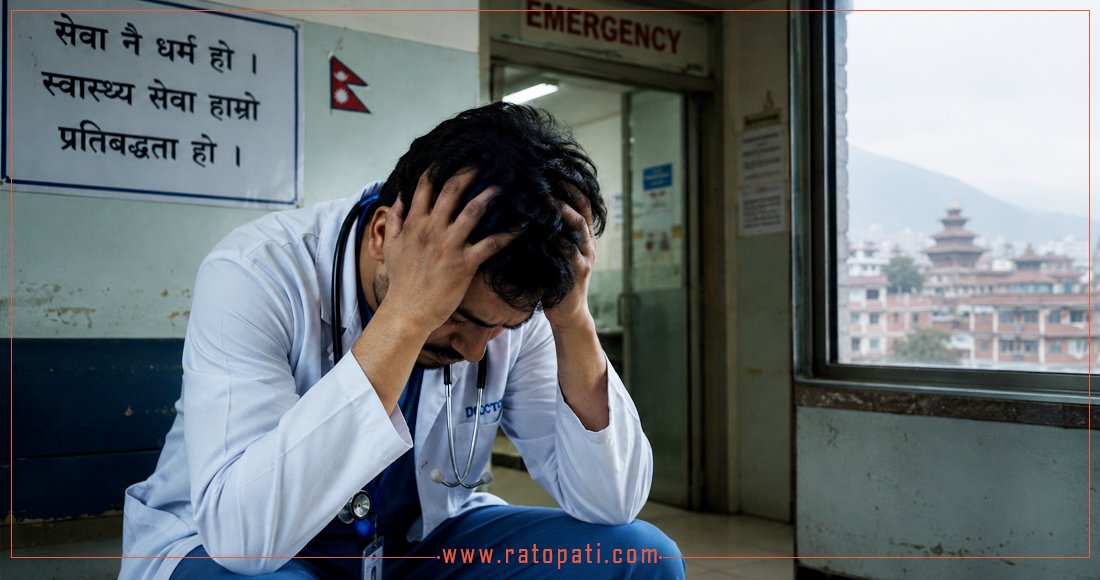
Kathmandu. Most doctors who studied abroad have failed the license examination conducted by the Nepal Medical Council. In the license examination conducted by the Council from Jestha 12 to 15, the number of those who failed among those who studied medicine (doctor) abroad was higher compared to private colleges in Nepal.
The Nepal Medical Council has published the results of the license examination by country and college. The Council has published the results of students who have completed their studies in various educational institutions in Nepal and abroad and participated in the examination by issuing a notice. According to the published results, 63.5 percent of students passed overall in MBBS and 81.52 percent in BDS.
Looking at the country-wise results of MBBS, the pass percentage of students who studied in Nepal is high. Out of a total of 1,254 students who participated in the examination from Nepal, 963 or 76.7 percent passed, while 287 failed. Similarly, among students who studied abroad, 151 out of 367 participants from Bangladesh passed (41.14 percent) and 11 out of 26 participants from India passed (42.31 percent). The Council's data shows that only 2 out of 133 students who took the exam from China passed, excluding those who were put on hold.
Analyzing the college-wise results of various medical colleges and institutions within Nepal, Chitwan Medical College and B.P. Koirala Institute of Health Sciences have excellent results. Out of 58 students who appeared for the examination from Chitwan Medical College, 54 passed, and out of 77 students from B.P. Koirala Institute of Health Sciences, 71 passed. Similarly, 47 out of 56 students from Maharajgunj Medical Campus under Tribhuvan University passed, while Nobel Medical College Teaching Hospital has the lowest pass percentage of only 54.84 percent.
Dr. Dipendra Pandey, Acting Registrar of the Nepal Medical Council, stated that the Council has made the college-wise and country-wise results of the license examination public not to show anyone as a failure, but to bring out a crystal clear 'reality check' of medical education. Dr. Pandey said, 'The general public and the state have the right to know what kind of doctors are graduating from which college and from which country by spending lakhs of rupees. Ensuring administrative transparency and the right to information is the legal responsibility of the Council. This data is not just for discussion; it has been officially sent to the Medical Education Commission for action in determining college seats and monitoring affiliations.'
Dr. Basnet said that the low pass percentage in the results published by the Council includes a large number of old students who have failed many times, which is why the overall pass percentage appears much lower than the actual results of new graduates taking the exam for the first time.
He stated that the Council is determined to admit only 100 percent competent doctors, not 'borderline' products in the health sector.
Dr. Rabin Basnet, a member of the Nepal Medical Council, says that the failure of Nepali doctors returning after studying medicine from foreign universities in the Nepal Medical Council examination, despite their hard work, is due to not only individual weaknesses but also many systemic and structural reasons.
Dr. Basnet said, 'One reason is the lack of clinical exposure and practical training. Most students studying abroad cannot directly interact with patients and participate sufficiently in the treatment process due to language barriers. Although they have good theoretical knowledge, they have less experience with the patient load and practical practice seen in Nepali hospitals.'
Language difficulty is the second reason, he said. Dr. Basnet said, 'Studying medicine in countries where the medium of instruction is other than English (such as Russian or Chinese) puts additional mental pressure on understanding medical concepts and then adapting them to the English or Nepali clinical perspective upon returning to Nepal to take the exam.'
He also mentioned that the format of the examination is an important factor. He said, 'Some foreign colleges have oral or descriptive examination systems, whereas the Nepal Medical Council conducts the examination entirely in a multiple-choice question format, which requires quick and accurate decision-making. This requires a separate examination strategy and practice.'
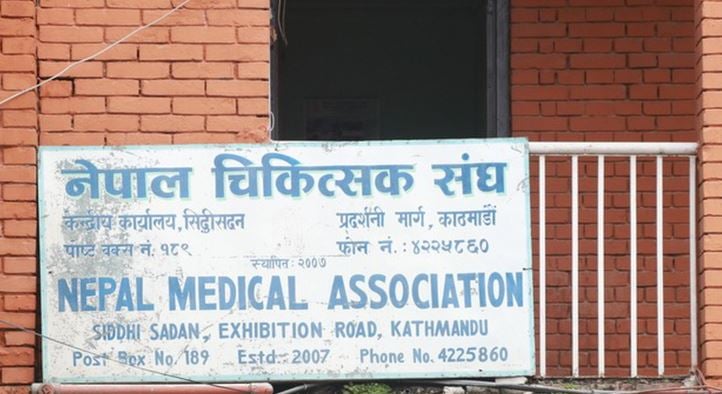
Dr. Sanjeev Tiwari, General Secretary of the Nepal Medical Association, said that rather than pass-fail, the focus should be on believing in quality education in medical education.
Dr. Basnet said that the low pass percentage in the results published by the Council includes a large number of old students who have failed many times, which is why the overall pass percentage appears much lower than the actual results of new graduates taking the exam for the first time.
He said, 'There is no official transitional program at the state or institutional level to help doctors returning from abroad integrate with Nepal's health system, here's guidelines, and clinical environment. Students are forced to rely only on private coaching centers or self-study.'
Dr. Kalusingh Khatri, a former member of the Nepal Medical Council, said that the trend of going abroad after the selection process in Nepal is common. He said, 'Only students who rank low go abroad. Suppose up to 1400th rank is acceptable to study in Nepal, but is it necessary to send someone with a 1401st rank to Bangladesh or any other country? It is not appropriate to send students to study medicine abroad by paying money, except for scholarships.'
Dr. Sanjeev Tiwari, Senior Vice-President of the Nepal Medical Association, said that rather than pass-fail, the focus should be on believing in quality education in medical education. He said, 'Since Nepal's curriculum is based on examination, Nepali students benefit. It is not that studying in Nepal is good and studying abroad is bad by putting them in the same basket. It seems that the Medical Education Commission should monitor this matter.'
This specific news has been automatically translated by AI. As a result, there may be some inaccuracies or language errors.