Star Actors Increasingly Drawn to Theater
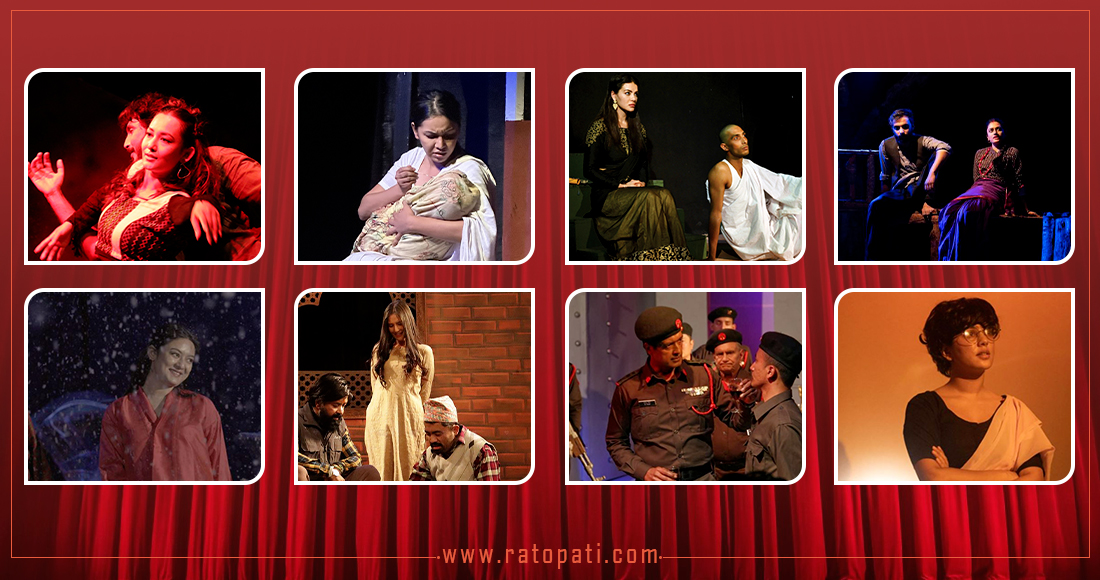
Kathmandu. There are many actors who enter the film sector after acting in the theater. This is considered a natural cycle in the art sector. However, actors who are known as 'stars' in the film industry rarely go to the theater. This scenario, which is considered rare, has been seen frequently in the Nepali art sector recently. There are many examples of Nepali actors who have established themselves in films being attracted to theater. Rajesh Hamal, who entered the film world with the movie 'Yug Dekhi Yug Samma' directed by the late Deepak Rayamajhi, is a successful actor in the Nepali film industry. Hamal, who has acted in more than two hundred films, stepped into theater in 2070 BS. He appeared in a play for the first time through the drama 'Court Martial' directed by Anup Baral. Rekha Thapa, who debuted as an actress with the film 'Hero', is an established star of the Nepali film industry. Rekha, who has acted in more than two hundred films, has also made a name for herself as a producer and director. Many actors of the new generation consider her their ideal. Rekha debuted in theater last year with the drama 'Mira'. In the drama directed by Sundar Dhital, she played the main character 'Mira'. Keki Adhikari, who started her journey as an actress with the 2010 film 'Swar', has also acted in many films and produced films. Keki entered theater a few years ago through the drama 'Charumati'. These are just a few examples. Actors like Benisha Hamal, Surakshya Panta, and even new generation actress Sanisha Bhattarai, who have made a name for themselves in the film industry, have entered theater. The trend of film actors coming to theater has been increasing recently. While actors like Saugat Malla, Dayahang Rai, and Bipin Karki, who came from a theater background, are enjoying themselves in films, old and new stars from the film industry are increasingly being attracted to theater. Why has the attraction of filmmakers towards theater increased? Senior theater artist Nisha Sharma sees this trend positively and believes it should be viewed in connection with the practices of neighboring countries. 'In foreign countries or neighboring India, established film stars like Naseeruddin Shah, Farooq Sheikh, and Shabana Azmi used to perform in plays occasionally. Now, a similar trend seems to have entered our country,' she said. While many say that acting in plays is difficult and acting in films is easy, she believes that some actors may have come from the film sector to theater to prove themselves and accept that challenge. Sharma says that theater helps to further refine acting and gain more experience, which might be why established film actors are attracted to theater. 'I view the attraction of filmmakers towards theater positively. The seriousness that is present in theater is now being reflected in film production,' she said. 'Now, there is a trend of conducting workshops, rehearsals, and in-depth discussions on characters before filming, which was not the case before.' She mentioned that in their time, there was no such practice of pre-rehearsing characters. She believes that live stage performance increases an actor's confidence and inspires the new generation. Senior actor Rabindra Khadka says that the importance of theater and the understanding of it have now changed. 'In our early days, not many films were made, so we were more focused on theater,' he said. 'Although more films are being made now compared to then, the audience for theater has also increased significantly. The understanding that theater actors are very polished in their acting has been established.' Khadka believes that many actors are attracted to theater to learn acting because film producers and directors have started choosing actors who can deliver powerful performances. Khadka clarified that the success of established actors from theater has guided the new generation and reminded the old ones of their roots. He said, 'Established actors like Dayahang Rai, Saugat Malla, and Bipin Karki have all come from theater. This shows the new generation that if they start their journey from theater, they can get good opportunities in films.' Khadka also says that the immediate feedback received from theater attracts film actors. Raj Shah of Sarwanam Theater also agrees with the views of Khadka and Sharma. He sees the entry of established film actors into theater as a positive aspect. 'In the past, we struggled to enter films from theater, but now it is a good thing that established film actors are attracted to theater,' Shah said. 'Filmmakers themselves have the experience that the scope for proving oneself in films is limited. Theater is always a medium for actors. Therefore, they may have come to hone themselves and prove themselves further.' Shah believes that when established actors come to theater, it not only shows respect for theater but also provides great motivation to other struggling artists here. 'Who entered theater?' The trend of film actors entering theater has increased significantly in the last decade. Rajesh Hamal entered theater in 2070 BS through the drama 'Court Martial' directed by Anup Baral. Actress Keki Adhikari also appeared in the drama 'Charumati' around the same time. Many dignitaries, including the then President Ram Baran Yadav, the then Indian Ambassador Ranjit Ray, and leaders Jhala Nath Khanal, Surya Bahadur Thapa, and Pashupati Shamsher Rana, attended the theater to watch this drama, which carries the historical aspect of Nepal-India relations. In 2080 BS, Malika Mahat debuted in theater at Mandala Theater with the drama 'Pagala Ghoda', based on the story of Indian playwright Badal Sarkar. Namrata Shrestha debuted in theater with the drama 'Yarma' directed by Bimal Subedi, and Srishti Shrestha debuted with 'Hamlet'. Arpan Thapa was paired with Srishti in William Shakespeare's 'Hamlet', staged in Bhaktapur Durbar Square. Around 2075 BS, senior actor Neer Shah returned to theater after 32 years through the drama 'Bathtub'. In 2077 BS, Swastima Khadka had rehearsed for the drama 'Pulpasa Cafe', based on Narayan Wagle's famous novel, but the drama could not be staged due to the second wave of the Corona pandemic. In 2081 BS, Varsha Raut debuted in theater with the drama 'Hitler Aaudai Chha', staged at the Civic Theater in Ohio, USA. Varsha played the lead role in this drama, jointly written by Bimal Subedi and Joyesh Pandey, and directed by Bimal Subedi. In 2080 BS, Shilpa Maskey debuted in theater with the drama 'Transit', directed by Ghimire Yuvaraj and written by Kumar Nagarkoti. Actress Surakshya Panta first entered theater in 2080 BS with the drama 'Klesha'. This drama, which also participated in the India Rang Mahotsav, featured Vijay Baral alongside Surakshya in the lead role. Rekha Thapa debuted in theater last year with the drama 'Mira', produced by Kantipur Theater and based on Deepak Sinjali's novel. Sundar Dhital directed this drama, which tells the story of a woman's family and social rebellion. Similarly, Benisha Hamal entered theater by playing the role of the main character 'Tara' in the drama 'Seto Dharti', staged by Kantipur Film Academy. Sanisha Bhattarai also entered theater last year with a drama based on the famous novel 'Shirish ko Phool' by litterateur Parijat. 'Journey Towards Theater: Desire or Compulsion?' The entry of established film actors into theater is seen by some as a desire and by others as a demand of the times or a compulsion. The journey of actors like Rajesh Hamal and Rekha Thapa, who choose theater to fill the void of not having theater experience despite achieving fame, wealth, recognition, and success in films, can be called 'desire' or wish. Actress Rekha Thapa has stated that she acted in the play to gain theater experience. Rekha, who has spent more than two decades in films, believes that the self-satisfaction gained from theater acting cannot be found anywhere else. However, for some, entering theater has become like a compulsion. Recently, the selection of actors in Nepali films has started to be based on acting ability rather than just physical beauty. Directors and producers have started looking at the depth of an actor's performance and their theater background. For this reason, many film actors are compelled to come to theater to refine their acting and strengthen their profile. Film writer and critic Samipya Raj Timalsina views this attraction from a different angle. He says that compared to the past, film news has become ordinary nowadays, and audiences no longer take film news as seriously as before. 'In such a situation, doing theater brings a new kind of discussion among the media and the audience,' Timalsina said. 'Most film actors have not come here solely out of immense love for theater. Since they are not getting the expected fame from films, theater is being used as a medium for testing and attracting market attention.' He claims that it is a misconception to say that established stars have come to act in plays. Actress and theater artist Laxmi Bardewa considers the attraction of film actors towards theater natural. She believes that actors always have a hunger to do well, which is why they are drawn to this field. Bardewa said, 'Just standing on stage and acting or rehearsing for a month and performing shows does not make anyone an excellent actor. Judging and praising someone solely based on their theater background is detrimental to theater itself.' 'Continuity is Zero' While actors from theater backgrounds like Dayahang Rai, Saugat Malla, and Bipin Karki are very busy in films, they occasionally return to theater to perform plays. However, most actors who entered theater from films are limited to their first play. Rajesh Hamal has not done another play after 'Court Martial', Keki Adhikari after 'Charumati', and Malika Mahat after 'Pagala Ghoda'. The journey seems to have stopped at the first play for Namrata Shrestha, Srishti Shrestha, Varsha Raut, Shilpa Maskey, Surakshya Panta, Rekha Thapa, Benisha Hamal, and Sanisha Bhattarai as well. Why did the theater journey of film actors end? Raj Shah of Sarwanam Theater says that theater itself is a very serious, difficult, and practice-requiring medium. 'The financial return here is low, but the investment of time and effort is very high. It takes at least one to two months to prepare a play continuously,' Shah said. 'This makes it difficult for busy actors in films to maintain continuity.' Actress Benisha Hamal also agrees with Shah's view. She says that for many actors, theater is like a school, and they have a desire to experience it at least once in their lives. 'In films, shooting usually takes about a month, and there can be some flexibility or breaks, but in theater, strict discipline and commitment are required,' Benisha said. 'Here, a full commitment of at least two months is needed, with one month for rehearsal and another month for performance.' She shares that time management is the most challenging aspect for actors with busy schedules in films. 'The mental satisfaction that theater provides is incomparable,' she said. 'How easy is it to make film stars act in plays?' It is both easy and challenging for directors to guide actors who are accustomed to the glitz, millions in remuneration, and widespread fame of films, within the limited resources and strict discipline of theater. According to Raj Shah of Sarwanam Theater, theater has its own set of rules and deep discipline, so artists do not receive special treatment (VIP treatment) like in films. 'In theater, no one is small or big. We eat together, get up together, and work together,' he said. His experience is that some filmmakers hesitate to act in plays after realizing the rigorous process and significant time investment of theater. However, Prakash Puri, CEO of Kantipur Theater, has a different experience than Shah. He says it is easy to make film actors act in plays. He has made actors like Rekha Thapa, Benisha Hamal, Sanisha Bhattarai, and Jeevan Luintel act in plays for the past few years. Puri, who has been teaching films for the last 11-12 years, says that big stars come to theater leaving their stardom outside. 'We have worked with Rekha Thapa, Jeevan Luintel, Benisha Hamal, and others. We never felt the arrogance of a star while working with them,' Puri said. 'They came as simple and very hardworking actors.' Puri clarifies that there has never been any misunderstanding regarding remuneration when film actors come to theater, even though they charge millions in films. He says, 'They are clear about coming to us beforehand. We have no experience of work being stopped due to budget.' He has also experienced some people contributing by spending their own money on theater.
This specific news has been automatically translated by AI. As a result, there may be some inaccuracies or language errors.