Gandaki Province Presents Policy and Program Reflecting Youth Uprising Demands
Pokhara. A major uprising took place on Bhadra 23 and 24, called by youth demanding good governance and an end to corruption in the country. The election following that movement has brought an unexpected change in the size of Nepal's political parties.
The National Independent Party (Rastriya Swatantra Party), which emerged from the election held on Falgun 21, is currently leading the government with nearly a two-thirds majority mandate. Although the Jenji uprising affected the physical structures of provinces and local levels, it did not bring about political change in them. The old governments continue to run in the provinces and local levels.
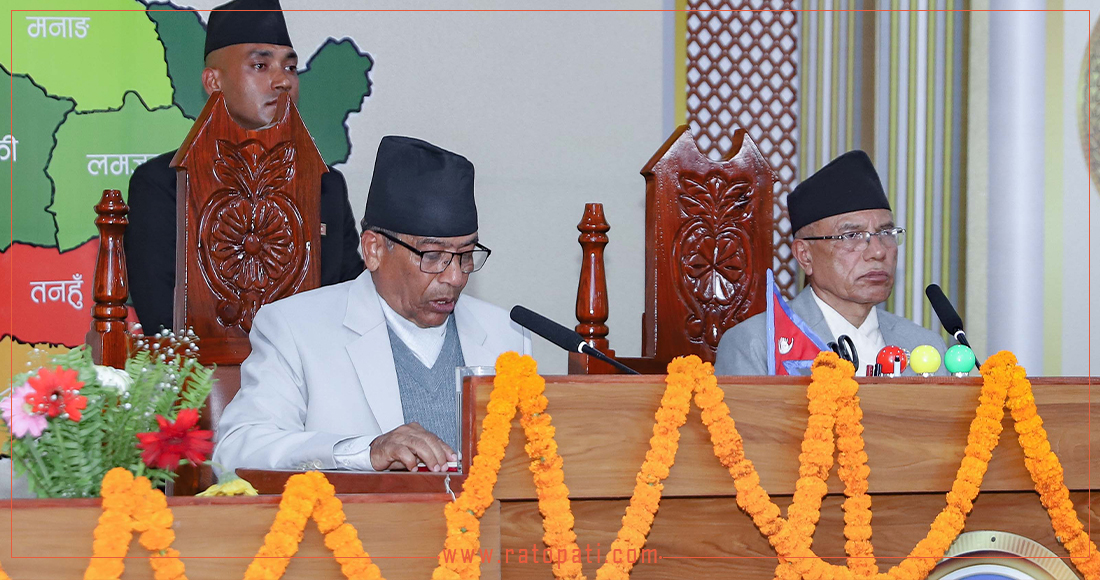
The Gandaki government has presented its policy and program for the first time after the Jenji uprising. The policy and program presented by Province Chief Dilliraj Bhatta in the parliament on Tuesday attempts to incorporate some of the spirit of the previous uprising. Most programs are old, with some efforts made for improvement.
Looking at the policy and program for the current fiscal year (2082/083) and the upcoming fiscal year (2083/084), some subjects including roads, drinking water, and agricultural modernization have been continued. Commitments to complete old infrastructure construction projects and social security programs are similar for both years.
However, this time's policy and program attempts to incorporate the spirit of the Jenji uprising. Zero tolerance against corruption and pressure for results have been included in the policy and program. The Gandaki government is trying to make project chiefs responsible for results in the upcoming policy and program.
Similarly, following the concept of the Digital Nepal Framework, the province has emphasized the use of AI and blockchain technology. The provincial government has put forward a policy to take the entire payment system online to end the role of middlemen in government services. Technology is being introduced into services as per the demand of the Jenji generation.
Gandaki has put forward the program 'My Province: My Responsibility'. The government has announced to provide concessional loans to youth returning from abroad and to establish industries based on local raw materials.
The provincial government has announced the 'Return to Village' campaign to bring youth back to villages and involve them in agricultural entrepreneurship. Those returning from abroad and those wishing to return from urban areas to the village to engage in agricultural entrepreneurship will receive agricultural grants at concessional interest rates. Similarly, the policy and program also include a declaration to provide work based on merit and pay based on work to the youth.
Gandaki envisions the prosperity of the province through agriculture and tourism. Projects such as the selfie bridge at Phewa Lake and the construction of a glass bridge at Rupa Lake have been put forward.
The province has announced to operate the Gorakhkali Rubber Industry and Bhrikuti Paper Factory in coordination with the federal government. Similarly, priority has been given to the construction and operation of provincial-level industrial zones at Lokahkhola in Nawalpur and Paunditar in Kaski. The government expects thousands to get employment from this. Gandaki has envisioned the formation of a Revenue Board to increase the province's internal revenue by reforming federal laws.
Gandaki's main source of income is energy. In the upcoming year, the government will grant permits for construction of projects within its jurisdiction and guarantee local employment and share investment in projects, according to the policy and program. The policy and program states that the government will grant permits for construction of projects within its jurisdiction and guarantee local employment and share investment in projects.
The plan to brand cannabis cultivation and local liquor, which has been discussed for a long time and is in the process, is said to be implemented from next year. Laws for both have already been made. The government has announced the implementation of these laws through the policy and program. Gandaki, which set an example by undertaking administrative restructuring for the first time in the country, will undertake further restructuring.
The policy and program includes a point on administrative rightsizing. Previously, 32 offices were merged to create 19 offices. The Chief Minister's Office claims that this reduced the number of employees by over 300 and saved 500 million annually. It is mentioned that the remaining offices will also be merged or integrated.
Most of the other policies and programs are repeated. The road network to Narpa Bhumi and Chumanubri, a plan that has been included in every budget and policy and program but has not been addressed, is also included for the upcoming year. The operation of industrial zones is also a frequently repeated plan. The plan to utilize barren land is addressed every year with different slogans, but there are implementation problems. Chief Minister Surendra Raj Pandey said that the policy and program has been organized based on the demands of the youth and the budget for the upcoming year will be managed accordingly. "Gandaki government is committed to good governance. We did not say this after the movement; we were already heading in that direction," he said. "Gandaki undertook administrative restructuring before the movement. The use of technology in government work has been further emphasized."
This specific news has been automatically translated by AI. As a result, there may be some inaccuracies or language errors.
-1780761623189_v_HD5Pdcbrzy.webp)