Nepal Faces Pressure to Exit FATF Grey List Amidst Misuse of Anti-Money Laundering Laws
Kathmandu. The Financial Action Task Force (FATF), an international umbrella organization for anti-money laundering, has placed Nepal on the 'Grey List', creating pressure for Nepal to exit the list. Experts say that after being placed on the 'Grey List' (list of high-risk countries), Nepal is facing multifaceted risks.
For Nepal, which is heavily dependent on imports, being listed for a long time is highly unfavorable. Therefore, Nepal is under pressure to implement various reforms to get out of this list.
Accordingly, Nepal needs to improve its understanding of money laundering and terrorist financing, identify and ban services like Hundi that transfer illicit funds and value without affecting financial access, and enhance the competitive capacity and coordination of administrative bodies for money laundering investigations.
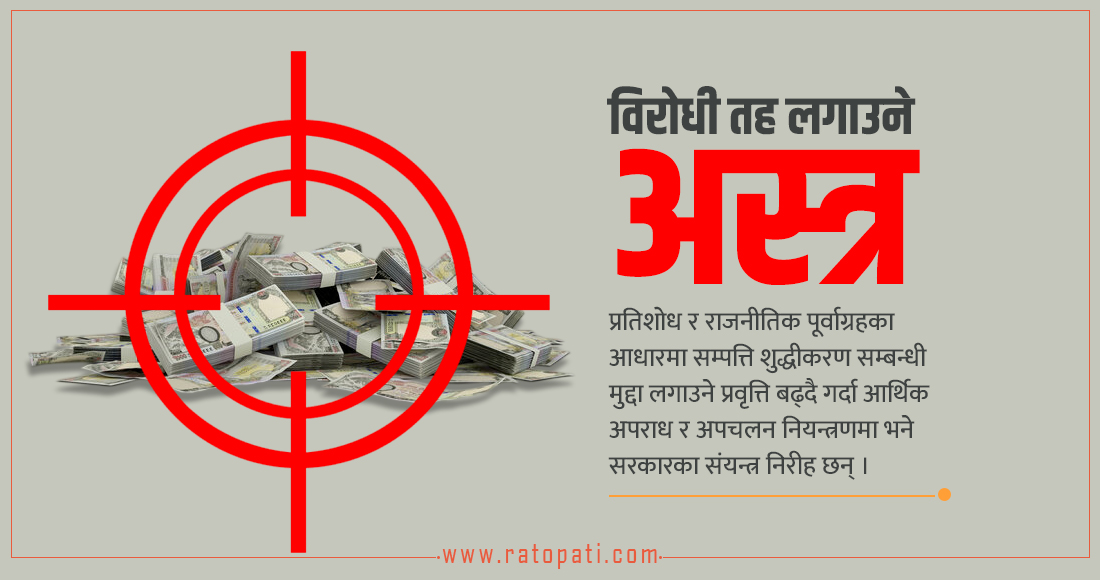
Amidst this pressure, political parties in power or their leaders have started patronizing activities such as filing money laundering cases based on political interests or withdrawing prosecution by amending it. It is indicated by various developments that not just a particular government, but those who have come to state power recently have increasingly resorted to selectively filing money laundering cases against opponents or rivals, or granting immunity to their own supporters.
Following the formation of the Council of Ministers led by Balen Shah according to the new public mandate, middlemen and businessmen who enjoyed power in the old regime are being arrested one after another.
_qAMOjaaVsf.jpg)
Sudhan Gurung, a leader of the Gen Z movement, even started a 'countdown' for the arrest of some 'high-profile' individuals a few days after assuming leadership of the Home Ministry on Chaitra 13, 2082 BS.
The third 'countdown' character was Congress leader and former minister Deepak Khadka, who was accused of money laundering.
On Chaitra 15, 2082 BS, he was arrested by the Central Investigation Bureau (CIB) of the police. The Bureau handed over Khadka to the Department of Money Laundering Investigation for investigation into the money laundering case.
_bthdthocjx_Qilrlx9nFu.jpg)
However, Khadka was released from custody on Baishakh 3 BS by order of the Supreme Court. He was known as a powerful figure in the political arena before the Gen Z movement. Challenging the money laundering charges against him, Khadka said, 'I don't just do politics; I have been in business since before entering politics, and I still am. I have paid all my taxes to the state, including audits.'
Publicly, Khadka has stated that he will always cooperate with investigations by all state agencies. He questions, 'If they found any fault or weakness in me, would they have let me go?'
The Department of Money Laundering Investigation is also investigating Sulav Agrawal and Shankar Agrawal, directors of the business conglomerate Shankar Group.

Another high-profile figure under money laundering investigation is businessman Deepak Bhatt. It is alleged that Bhatt held absolute sway in the previous regime. Bhatt was the most powerful center for major appointments, contracts, and promotions. It is in connection with Bhatt that the Agrawal father and son are currently under investigation for money laundering by misappropriating funds through Himalayan Reinsurance.
The Prevention of Money Laundering Act, 2064 BS, defines money laundering as the act of concealing the source, changing the nature, or evading transactions of property acquired through illegal activities to make it appear legitimate. To investigate someone for money laundering, they must have acquired property through crime. For example, it must be shown that property was earned through predicate offenses such as corruption, tax evasion, human trafficking, arms dealing, and drug trafficking.
Despite being labeled 'big fish', as the cases appeared weak, the Council of Ministers led by Balen Shah recommended an ordinance to amend the Prevention of Money Laundering Act, 2064 BS. The President issued the Prevention of Money Laundering Ordinance on Baishakh 18 BS.
The ordinance has expanded the scope of investigation by the department to include predicate offenses related to smuggling, tax evasion, market manipulation or insider trading in the securities or commodities market, foreign exchange, banking, negotiable instruments, and insurance.
With the ordinance in place, insurance-related offenses have been established as 'predicate offenses' against Bhatt and the Agrawal father and son. The department's investigation concludes that they laundered money by misappropriating funds through Himalayan Reinsurance.
The ordinance introduced a provision to file cases in the Special Court after investigation by the Department of Money Laundering Investigation, even in the absence of predicate offenses. By amending the Prevention of Money Laundering Act-2064 BS, the police and other prosecuting agencies were given the authority to file money laundering cases on Chaitra 30, 2080 BS. It is stipulated that 32 types of offenses are considered predicate offenses, allowing all agencies that file cases to also investigate money laundering.
Many have criticized the Department of Money Laundering Investigation for arresting accused individuals in money laundering cases, unlike in other criminal cases. Former SSP Rabindra Regmi stated that in money laundering offenses, it is possible to file a charge sheet directly without arresting the accused.
Regmi, who worked in the Department of Money Laundering Investigation for a long time, said, 'In money laundering offenses, there is usually no immediate risk of evidence being destroyed. Therefore, a policy of hearing first and then detaining should be implemented.'
- First Rabi-Chhabilal, Now Oli-Deuba
Ravi Lamichhane, chairman of the Rastriya Swatantra Party (RSP), and former DIG Chhabilal Joshi were also charged with money laundering in connection with the misappropriation of funds from five cooperatives, including Swarnalaxmi and Suryadarshan. When the case was filed against them in Poush 2081 BS, KP Sharma Oli, chairman of the CPN (UML), was the Prime Minister. At that time, Oli was criticized for filing the case against them with prejudice.

Currently, Oli, the UML chairman, is out of power. With Lamichhane's Rastriya Swatantra Party taking the reins of power, investigations into money laundering are underway against former Prime Minister Oli, Sher Bahadur Deuba, and Pushpa Kamal Dahal 'Prachanda'.
The Central Investigation Bureau of the police and the Department of Money Laundering Investigation are investigating them.
The Department had obtained an arrest warrant from the Kathmandu District Court against the Deuba couple, who are currently abroad, and had corresponded with Interpol through the Nepal Police for a red notice. However, the Supreme Court, hearing a writ petition filed on behalf of the Deuba couple, clarified that the district court cannot issue an arrest warrant as the money laundering case falls under the jurisdiction of the Special Court.
-_nXh2h5Wooj.jpg)
Former Attorney General Raman Kumar Shrestha argues that everyone who comes to power starts misusing the law for revenge or prejudice. 'The cooperative fraud case against Ravi Lamichhane was linked to organized crime and money laundering with prejudice,' he said, 'Now, an attempt is being made to do the same with Sher Bahadur and his wife out of prejudice.'
Indeed, with the change in government, the Kaski District Court, upon the recommendation of the Attorney General, has allowed the amendment of the charges related to the money laundering case previously filed against Rabi and Chhabilal. As per the district court's order, Rabi and Chhabilal have recently been acquitted of the money laundering and organized crime charges filed by the previous government. Rabi is currently the chairman of the ruling party.
Even when the case was filed against Rabi, legal practitioners criticized the misuse of the Prevention of Money Laundering Act. Now, concerns are growing that the government may be trying to grant immunity to those in power and selectively file cases against the opposition.
As the practice of filing money laundering cases based on revenge and political prejudice increases, the government's mechanisms for controlling economic crimes and corruption remain helpless.
According to the Financial Action Task Force report, effective action in controlling economic crimes and corruption is not being seen. Former Attorney General Shrestha argues that the trend of filing more money laundering cases in Nepal is increasing due to pressure from the Asia/Pacific Group on Money Laundering (APG) because the country is on the 'Grey List'.
Those who are unfavorable to those in state power and those who worked closely with the old regime tend to become targets. Instead of proper investigation, there is a growing tendency to harass those targeted by the state rulers by taking advantage of the legal provision that allows them to be detained for up to 90 days in the name of investigation.
Former Attorney General Dr. Dinmani Pokharel states that money laundering offenses are not of a nature that requires arresting and detaining people. 'The offense is sensitive,' he said, 'Sensitive cases should not be used for revenge.'
For those close to centers of power, money laundering cases are becoming 'optional'. Experts say that the misuse of money laundering laws has increased since the police and all other agencies began investigations on Chaitra 30, 2080 BS.
The Prevention of Money Laundering Act mandates the use of special investigative methods when investigating, but investigative agencies are only adopting the traditional method of requesting bank account details to prepare files.
Due to weak investigations, only 10 percent of such cases are successful in court, according to officials. The law gives investigative agencies the right to prosecute when linked to predicate offenses, but experts say that this right is being exercised at the discretion of centers of power.
This specific news has been automatically translated by AI. As a result, there may be some inaccuracies or language errors.
-1780761623189_v_HD5Pdcbrzy.webp)