Government Focuses on Expanding Middle Class in New Budget

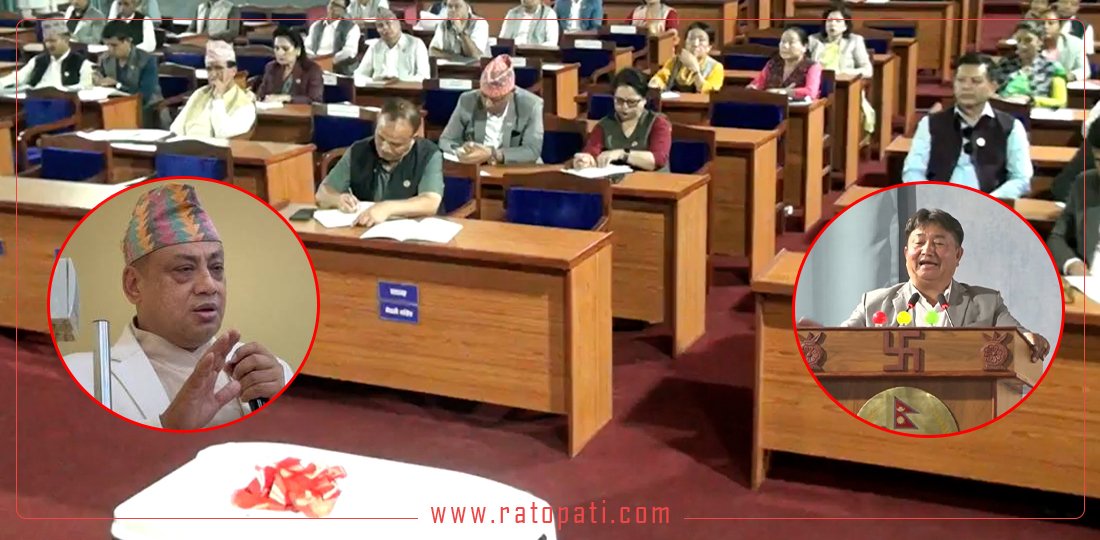
Kathmandu. A phrase has been prominently mentioned in the policy and program brought by the government and the pre-budget discussion - the expansion of the middle class.
In point number 2 of the principles and priorities of the Appropriation Bill, known as the pre-budget, it is stated - 'We will develop capable human capital by ensuring equal access to quality education, health, nutrition, and skills. We will build a reliable foundation of social security for those who need state protection. We will expand the middle class by guaranteeing economic mobility and social security.'
Nepal gets policy and program and budget every year. There is also a discussion on its principles and priorities before the budget. However, this issue has not been raised in this way before. This phrase, raised for the first time, has increased interest in what kind of budget the government will bring and how it can change the government's programs, appropriations, and tax-related arrangements.
- Who is the middle class?
Generally, the world's population is divided into three classes - lower class, middle class, and upper class. As emerging economies grow worldwide, this class is also divided into two parts: lower-middle and upper-middle.
The middle class is one whose basic needs are met and aspires to consume luxury goods, which creates new demand in the market.
However, there is no concrete basis for this division. Some look at it economically, some socially and culturally, and some politically. However, many also interpret it based on property rights and access, and consumption capacity.
A World Bank report titled 'The Concept of Risk in the Definition of the Middle Class' seems to focus on the economic resilience of any individual, the risk of falling back into poverty, and the state of long-term economic stability.
Similarly, an OECD report has given a more concrete definition. The report states that a person with an income between 67 percent and 200 percent of the national median income can be considered middle class.
_OQButqTbfE.jpg)
Overall, the middle class refers to an economic or social class that has access to and assurance of basic rights and consumption, but does not have the potential to hold excessive wealth. Economically, it can be seen in terms of property and income, while politically, representation and access to state bodies, and socially, issues of social identity and respect are also linked.
- Government's Desired Expansion
Although the scope of the definition of the middle class is quite broad, the definition mentioned in the government's policy and program is limited to the economic scope. It only incorporates the aspects of consumption and social security. Only issues of education, health, nutrition, skills, and social security are raised here.
Associate Professor of Economics at Tribhuvan University, Dr. Resham Thapa, calls the expansion of the middle class mentioned in the document a 'wordplay'. He says that the subject of reducing poverty, which previous governments have been talking about, has been presented in a new way.
'The expansion of the middle class happens in two ways - first by lifting the lower class, i.e., the poor, upwards, and second by bringing down the upper class, i.e., the very rich,' says Dr. Thapa, 'The government is certainly not saying it will make the very rich less rich; this means lifting the poor upwards. It's just a difference in words.'
According to experts, increasing only the demand and consumption of the middle class without increasing domestic production carries the risk of increasing imports and putting further pressure on foreign exchange reserves.
However, government officials have a different view. An official involved in budget writing says that the concept of expanding the middle class does not aim only to increase its numbers. Rather, the government's goal is to expand the economic and consumption capacity of everyone within the middle class, he says.
'Expansion of the middle class does not just mean making the poor rich; it also means creating an environment where those who are already in the middle class do not fall out of this class. It also means fulfilling other needs of people in that class,' the official says, 'Policy stability, investment security, employment guarantees, skill development, financial service expansion, and social security arrangements ensure this.'
He says that the expansion of the middle class is related not only to increasing income but also to expanding consumption. Giving an example, he says, 'A person who rides a motorcycle wants to ride a car, but cannot because of lack of loans; if they can get loans easily, they can fulfill this need. Their income has not increased, but the government's policy can increase consumption capacity.'
- Why is the middle class prioritized?
There are both political and economic reasons for the government to prioritize the middle class.

The political reason is the population that falls into this class. Not only in Nepal but worldwide, the middle-class population is dominant. Prioritizing this class can gain high public support for the government. In a democratic country like Nepal, this is also a major basis for political gain.
Economically, the government appears to be motivated by creating demand through the expansion of the middle class.
The upper class has already fulfilled most of its needs, so increasing income does not increase its consumption. Conversely, the lower class struggles to meet basic needs, so it does not significantly increase demand either.
However, the middle class is a group whose basic needs are not only met but also has an equal aspiration to demand luxury goods. But, due to lack of capacity, they cannot consume such goods. In this situation, expanding the capacity of this group will create demand for high-value goods in the market, making the market dynamic and facilitating the expansion of government treasury. This understanding also seems to be the government's.
In a situation where the economy has been sluggish due to low demand for some time in Nepal, effective intervention as the government intends can help improve the economy. However, experts say that this path is not very suitable in the long run.
A large portion of consumption in Nepal is based on imports. Not only industrial production but also daily consumer agricultural products depend on imports in Nepal. In this situation, increasing the demand of the middle class carries the risk of only expanding imports and putting pressure on foreign exchange reserves, says Associate Professor Thapa. He says that this can only be effective if Nepal produces highly consumed goods domestically.
'Looking at the current demand situation in Nepal, at least induction stoves should be produced in Nepal, motorcycles should be assembled in Nepal, and there should be an environment within the country for a stage of processing agricultural products, then the justification for increasing demand would be proven,' says Dr. Thapa, 'But the government has turned towards remittances and the service sector; this is not the right path.'
Looking at the history of emerging countries worldwide, it is seen that those countries have risen through the stage of industrialization at some point. Neighboring countries like India and China, as well as emerging economies, and countries known as 'Asian Tigers' like South Korea, Singapore, and Thailand, have also followed this path. Experts say that Nepal choosing the path of economic prosperity by expanding the service sector instead of industrialization is less risky.
This specific news has been automatically translated by AI. As a result, there may be some inaccuracies or language errors.