Tarkeshwor Municipality Recovers Public Land


Kathmandu. Currently, an campaign to reclaim public land is underway across the country. After the eviction of informal settlements within the Kathmandu Metropolitan City area, local levels across the country have been carrying out this campaign.
One local level that is intensifying this campaign in the Kathmandu district is Tarkeshwor Municipality. Through the Judicial Committee and the Public Land Protection Committee, the municipality is identifying encroached land, measuring it, and bulldozing such structures. However, the municipality claims to be a pioneer in clearing encroached land.
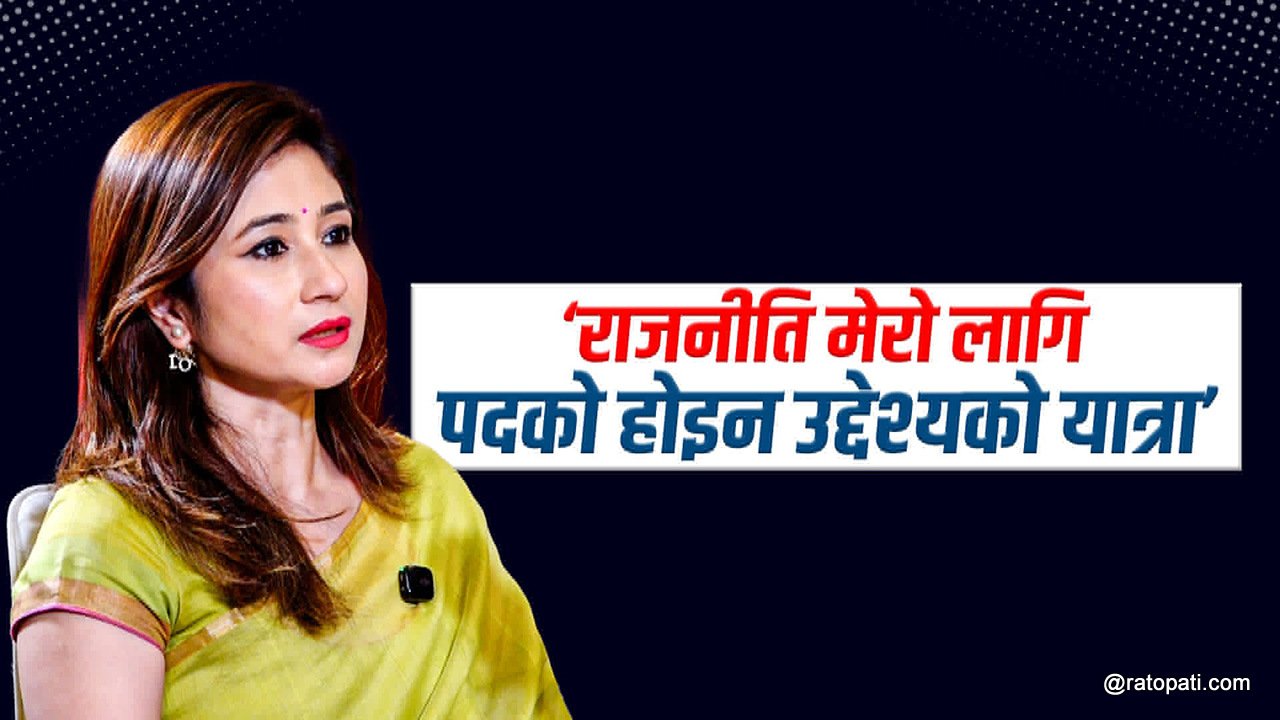
Edited excerpts of the conversation with Sirjana Burlakoti, Deputy Mayor of Tarkeshwor Municipality and Coordinator of the Public Land Protection Committee, focusing on these contemporary issues:
- Recently, after the Kathmandu Metropolitan City cleared informal settlements and riverbanks, other local levels have also been running this campaign. Tarkeshwor Municipality is also clearing encroached land; where has this campaign reached?
Compared to the Kathmandu Metropolitan City, our Tarkeshwor Municipality does not have as many informal settlements. The problem of encroachment on riverbanks and corridors is also not as severe as in the metropolis. As our municipality is located in the upper hilly region and the outer plains, people tend to concentrate more in the main urban areas when settling.
However, there were some encroachment problems in our area as well. In a place called Lambagar, on the way from Sheshmati Bridge towards the municipality office, about 25/30 households of informal settlers had occupied the river corridor.
This case was filed in the judicial committee before 2079 BS, i.e., before we were elected. However, it could not be implemented. After we were elected, the judicial committee ruled to remove the informal settlement in 2079 BS.
After that, we issued notices repeatedly and sent the municipal police. But it was very difficult to remove them. Finally, after 9/10 months, we took action. They came to the municipality office with a delegation. But upon investigation, it was found that instead of actual landless people, individuals from outside the district had occupied the land, built temporary structures, trusts, and rented out shacks for a living.
There, it was observed that the dominance was by people with a 'hukumbasi' (arrogant) tendency, who believed they were influential and untouchable, rather than genuine landless people. They were occupying state property and collecting rent.
Under this campaign, which began at the end of 2079 BS, we completed the removal of that settlement and expansion of the corridor in 2080 BS. Similarly, we removed temporary structures built in various parts of Goldhunga. Just recently, on Baishakh 16, we reclaimed over 3 ropanis of land belonging to the Government of Nepal near Thapapul in Phutung. There were no landless people there either; one person had built a shack and rented it out for business. After measuring and repeatedly requesting them, we bulldozed the structures when they did not comply.
Not only that, just last Friday, we completed the measurement of approximately 26 ropanis of public land in Tinpipla Chowk, Ward No. 3, Jhitpurphedi. Local individuals had encroached upon that land for shops and rent collection. We are demolishing those structures with bulldozers on Baishakh 7. Currently, counseling and monitoring are underway as a preparatory step.
- When and how did you start this campaign for the protection of public land?
If we talk about overall protection, Tarkeshwor Municipality had started the work of protecting barren and public land long before the Kathmandu Metropolitan City began removing informal settlements. I want to clarify this. So far, we have protected 20 to 25 ropanis of land with the principle that 'land belonging to the Government of Nepal must be returned to the government'.
Within Tarkeshwor Municipality, there are still more than 10,000 ropanis of public, barren, government, and forest-related land. We are making efforts to reclaim all of them gradually. Initially, it was a bit difficult to work because the 'Public Land Protection Committee' had not been formed. Due to the lack of clear responsibilities, there was confusion about who would do the work. However, a committee has now been formed under my coordination. It includes representatives from various political parties and social workers, and work is progressing rapidly according to the committee's plan.
- How do you identify which land within the municipality is public and which belongs to an individual? What is the technical process?
We do not go anywhere without proper basis. First, we request all land details from the concerned Survey Office and Land Revenue Office. They verify the records and registers. Only after the Survey and Land Revenue offices confirm with official maps and evidence that this land is public, barren, or government land do we take action. Tarkeshwor Municipality does not bulldoze anyone's house or shack without legal and technical clarity and evidence.
- How much more land is encroached upon and needs to be cleared within the municipality?
There is still a lot of such land. In some places, permanent structures have been built by encroaching on public land. For example, in Dhakalchaur, above Kunchipaukal in our Ward No. 1, we found many permanent houses built on public land during our inspection.
Some may have built them unknowingly or by being misled. But most have built them with the mentality, 'It's government land, what difference does it make if we occupy it? Who can demolish it?'
Through your media, I would like to humbly request all respected residents of Tarkeshwor – barren, public, government, and forest-related lands in the name of the Government of Nepal are state property. If anyone is occupying such land, please voluntarily give it up with the positive thought that I must return state property to the state. No one becomes small by returning state land. There are still many such encroached lands within the municipality, which we will gradually clear.
- There is also a common understanding in the market that 'barren land' and 'unregistered land' are the same. How are you looking at the issue of unregistered land? What happens to those living there?
The technical classification in the language of survey and land revenue seems to be a bit different. Sometimes it is mentioned as 'barren', and within that, there is a distinction between barren land that can be registered and barren land that cannot be registered. I do not know the very deep technical details, but we work based on the technical advice of the survey office and the official details they provide.
- There is data of about 1.2 million families living on unregistered land registered with the Land Commission across the country. If unregistered land is cleared, they will be displaced. Is there such a situation in Tarkeshwor?
I do not think there are families in our Tarkeshwor Municipality who have been solely dependent on unregistered land for years. If such a situation exists, the state will bring policies for their management. Local governments will also adopt and move forward with the policies and laws brought by the federal government.
However, in my work at the judicial committee and as the coordinator of the public land protection committee, when I went to the field, I did not find any genuine 'landless' people in our municipality. There are almost no landless families in our area who have no land, no shelter, and no proof or evidence. If any citizen in such a situation is found, the local government will manage them appropriately.
- The Kathmandu Metropolitan City even set up a camp to identify landless people while clearing public land. How are you identifying whether those being displaced are genuine landless people while clearing land?
We do not have the large crowds or the need to set up separate camps like the metropolis. We are local citizens and representatives here. We often know many things at the local level. When we go for measurement, the neighbors and local residents provide us with a lot of information and data.
Besides that, we consider the data from the Land Services Center as the main basis. If a person claims to be landless, and their name, father's name, or grandfather's name is entered into the software, and if they have land somewhere in Nepal, the system will show it. The server is the same. We ascertain the facts using this technology.
So far, in all the land we have cleared, we have not found any genuinely landless people. They were all individuals who owned land elsewhere but were eager to enjoy state property.
- If, in the future, you find someone who is genuinely landless as you say, how will you manage them?
The state has already made laws and procedures for landless squatters, which include provisions for issuing them 'nissa' (proof of entitlement). I do not need to explain this further. As for immediate management, Tarkeshwor Municipality is an empowered local government.
Local governments have full authority to take guardianship of their citizens. If a truly landless person is found who has absolutely nothing and no place to live, the municipality will definitely manage them somewhere. I don't think anyone needs to worry about this.
- When will all the encroached public lands within your municipality be completely cleared? The Kathmandu Metropolitan City cleared a large portion in a week or ten days; how long will it take you?
It will definitely take us some time. There are some practical reasons for this. Firstly, we do not have as large a workforce as the Kathmandu Metropolitan City. Secondly, when we go to clear land, we have to face the natural human tendency of the occupants to get angry, upset, and view us negatively. Who would willingly give up land they have occupied for years for free and are collecting rent from?
Moreover, we are a small municipality in terms of budget. We are carrying out public land protection work with a small budget allocated to the land branch. We do not have any special coordination or support from the provincial and federal governments. From a security perspective, we have to request security personnel by corresponding with the Chief District Officer's office and Balaju police station. However, they are cooperating by sending security personnel, which makes the work easier.
The metropolis mainly removed settlements along corridors and riverbanks, which are clearly visible and straight. But our geography is different. In our area, a small plot of barren land is hidden amidst dense settlements. It takes time technically to confirm such land through survey, demarcate it, and place a board. Therefore, it cannot be said that everything will be finished overnight, but our campaign will continue uninterrupted.
- A question that arises in many places is that municipalities bulldoze land but have no long-term plan for its utilization. Does Tarkeshwor Municipality have any plans for the proper use of cleared land?
This is a very important question, and it is directly linked to financial resources. The total annual budget of our municipality is about 2 billion rupees. However, our geography is very large and spread out. Our municipality extends from Nepal Tar in the south to Kunchipaukal in Ward No. 1, Khyalbuchha in Ward No. 3, and Bhuvan Bhanjyang in Tinpipla in the north.
Even if we were to spend the entire budget of a year on a single ward, that ward would not be fully developed. But we are compelled to manage our limited budget across all areas. Just because there is a lack of budget does not mean we will leave the cleared land in a chaotic state.
For example, the 26 ropanis of land we demarcated in Tinpipla today is the central point of the road coming from Nuwakot, Kakani, and Dhading. Legend has it that its name Tinpipla comes from three peepal trees that were there historically, and peepal trees still exist there today. On that 26 ropani land, we have the potential to build a well-organized and large bus park.
Large projects like these require a lot of budget, for which we will also pursue initiatives with the federal and provincial governments. But I want to clarify, Tarkeshwor Municipality will not leave the land demolished and in a chaotic, abandoned state. We will ensure its proper development and utilization within our capacity and area.
- A few days ago, the chairman of the Rastriya Swatantra Party (RSP) stated that local levels are clearing public land by putting a gun to their shoulders, following the directive of the federal government. As the deputy mayor of a municipality and coordinator of the land protection committee, you are clearing land; are you truly putting a gun to the RSP's shoulder?
That is their perspective and understanding. What anyone says does not affect the work of Tarkeshwor Municipality. As I clarified at the beginning, Tarkeshwor Municipality did not start this work based on anyone else's imitation or directive, but through a judicial committee's decision in 2079 BS to expand the corridor and remove informal settlements.
In 2080 BS, we had already removed the settlement in Lambagar. You can go and see for yourselves; the corridor has been built after removing the settlement in front of CN Mart near the Navadurga Temple, and afforestation has been done on the remaining land.
We are not working with a gun to someone else's shoulder, but by considering our own responsibility. We believe in how we have served the public and protected state property, rather than what anyone says. Long before the federal government or the Ministry of Home Affairs issued notices, and even before the Kathmandu Metropolitan City started its campaign, we had initiated this work. I want to inform him and everyone about this fact.
This specific news has been automatically translated by AI. As a result, there may be some inaccuracies or language errors.