Petroleum Product Consumption Decreases in Nepal Amidst Price Hikes and Reduced Holidays

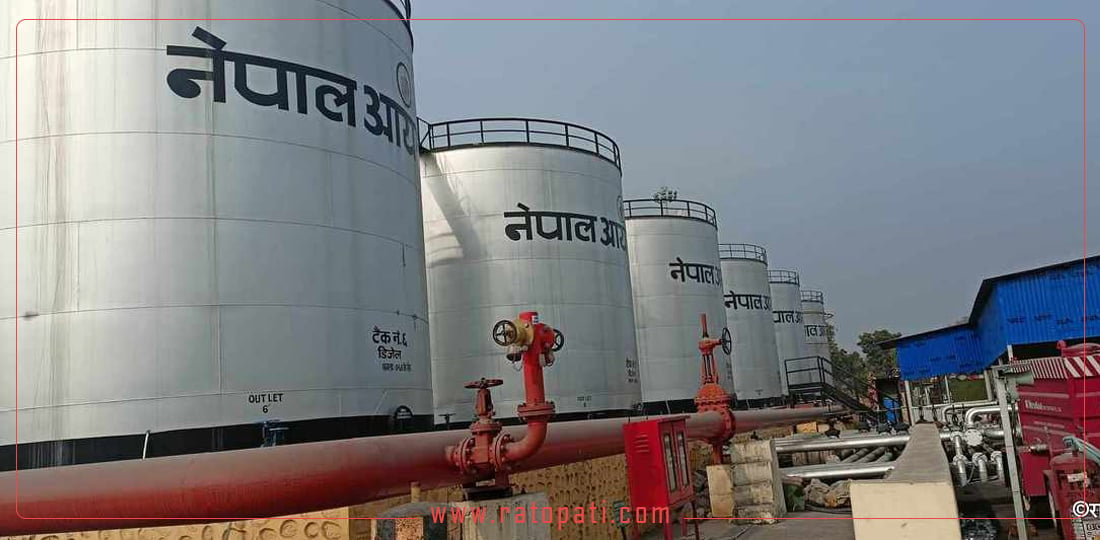
Biratnagar. Statistics show that the consumption of most petroleum products in Nepal has decreased in the month of Baishakh compared to the month of Chaitra.
Amidst the tension in West Asia and a significant increase in the price of petroleum products, the government had decided to give two public holidays starting March 21 to reduce consumption. The impact of that decision and the slowdown in the construction sector have led to a decrease in the consumption of petroleum products.
According to the latest report, the consumption of petrol, diesel, kerosene, and cooking gas has decreased, while the consumption of aviation fuel has increased slightly. The statistics show the biggest drop in diesel consumption. While 140,029 kg of diesel was consumed in Chaitra, it decreased to 102,071 kg in Baishakh. This is a decrease of about 37,000 kg.
Similarly, there has been a slight decrease in petrol consumption. In Chaitra, 59,938 kg of petrol was consumed, which decreased to 58,680 kg in Baishakh.
There has been a significant decrease in kerosene consumption. While 1,283 kg of kerosene was used in Chaitra, only 248 kg was consumed in Baishakh.
The consumption of LP gas for cooking has also decreased. While 38,799 metric tons of gas was consumed in Chaitra, it decreased to 32,056 metric tons in Baishakh.
While the consumption of all other types of fuel is decreasing, the consumption of aviation fuel has increased. Statistics show that while 18,244 kg of aviation fuel was consumed in Chaitra, it increased to 19,552 kg in Baishakh.
To reduce the growing trade deficit, the government implemented a decision on March 22 to give two public holidays on Saturdays and Sundays. Following this policy, statistics show a significant drop in the demand for petroleum products in the market. However, the Nepal Oil Corporation stated that this is not the only reason for the decrease in fuel consumption.
Nepal Oil Corporation has also provided a comparative statement for the period up to March 21 and from March 22 to April 12. According to that statement, from March 1 to March 21, 43,132 kg (43.132 million liters) of petrol and 105,770 kg (105.77 million liters) of diesel were consumed across the country.
However, in the 21 days after the holiday decision was implemented, from March 22 to April 12, petrol consumption decreased to 38,622 kg. This is a decrease of 4,510 kg (approximately 10.45 percent) compared to the previous 21 days. Similarly, there has been a much larger decrease in diesel consumption. In the last 21 days, only 73,367 kg of diesel was sold, which is 32,403 kg (approximately 30.63 percent) less than the previous period.
Nepal Oil Corporation spokesperson Manoj Kumar Thakur said that while it can be assumed that petrol consumption has decreased due to the additional public holidays, there may be other reasons for the decrease in diesel consumption. 'Consumption of diesel has also decreased due to the slowdown in work caused by the price increase of construction materials,' Thakur said. Construction entrepreneurs across the country have stopped work due to the excessive price increase of construction materials. 'Sufficient fuel is not available in the construction sector. Work is also stalled at the moment,' said construction entrepreneur Binod Ghimire. In addition, industrial establishments have also reduced their production capacity due to increased costs, which has reduced the movement of transportation vehicles.
This specific news has been automatically translated by AI. As a result, there may be some inaccuracies or language errors.