Former FNCCI President Shekhar Golchha Rearrested on Insurance Fraud Allegations After Court Order

Kathmandu. Just a short time after the Supreme Court ordered his immediate release, stating his detention was illegal, former President of the Federation of Nepalese Chambers of Commerce and Industry (FNCCI) Shekhar Golchha was re-arrested on Monday. A team from the Central Investigation Bureau (CIB) re-arrested him, citing investigation into a different offense. The private sector has been concerned by his re-arrest shortly after a joint bench of Supreme Court Justices Mahesh Sharma Paudel and Srikanth Paudel, in response to a habeas corpus writ, ordered his release in a securities-related offense. Questions have also arisen about whether he was re-arrested for the same offense despite the government's policy of hearing before punishing.
SSP Shiva Kumar Shrestha of the CIB, however, states that the purpose of the latest arrest is entirely different. He explained that Golchha was already under investigation for two separate offenses, and since the court did not comment on the other investigation when ordering his release in one, his detention continues. 'He was released in the securities-related offense, but he has been kept in custody as the investigation into the insurance-related offense is ongoing,' Shrestha said.
The Path Opened by the Court Order
The CIB team had arrested Golchha on April 10. The CIB stated that he was arrested based on a recommendation from the Securities Board for further investigation following an initial inquiry report.
His wife, Seema Golchha, had filed a habeas corpus petition in the Supreme Court, arguing that his arrest was unlawful. While the court, in response to this writ, ruled that Golchha's arrest process was not in accordance with the law, it also left the door open for his re-arrest.
Section 104(1) of the Securities Act states, 'If there are reasonable grounds to believe that a person undergoing prosecution may abscond or disappear, or if there is evidence of damage or loss, the investigating officer in a case under this Act may demand appropriate bail or collateral security, and may detain such person in custody if such bail or security is not provided.'
However, he was ordered to be released immediately on the grounds that bail was not demanded as per the proceedings under that section. But, since an arrest warrant had been obtained at the time of arrest, a habeas corpus order was not issued.
In the same order, the court stated that no arrest permission had been issued for the insurance-related offense, and since this was not mentioned in the petition, the court did not need to comment on it. It is based on this path opened by the court's order that he has been arrested for the insurance-related offense.
How Did the Insurance-Related Offense Arise?
Golchha, who is associated with Deepak Bhatta's group, was found to have engaged in insider trading in the share trading of Himalayan Re-insurance Company, conducted illegal credit transactions, and failed to settle them on time.
In this process, it was found that 2 billion 733.3 million rupees of Himalayan Re-insurance were misappropriated. The initial investigation report of the Securities Board indicated that this amount needed to be repaid. Golchha was re-arrested because he was the Chairman of the company's board of directors when this misappropriation occurred.
The issue of misappropriation of funds by the insurance company does not fall under the purview of the Securities Act, and therefore, it has been investigated separately. It is stated that he has been kept in custody during this investigation. Furthermore, the board's preliminary report mentions that this group has misappropriated funds from various insurance companies and their subsidiaries to manipulate the stock market.
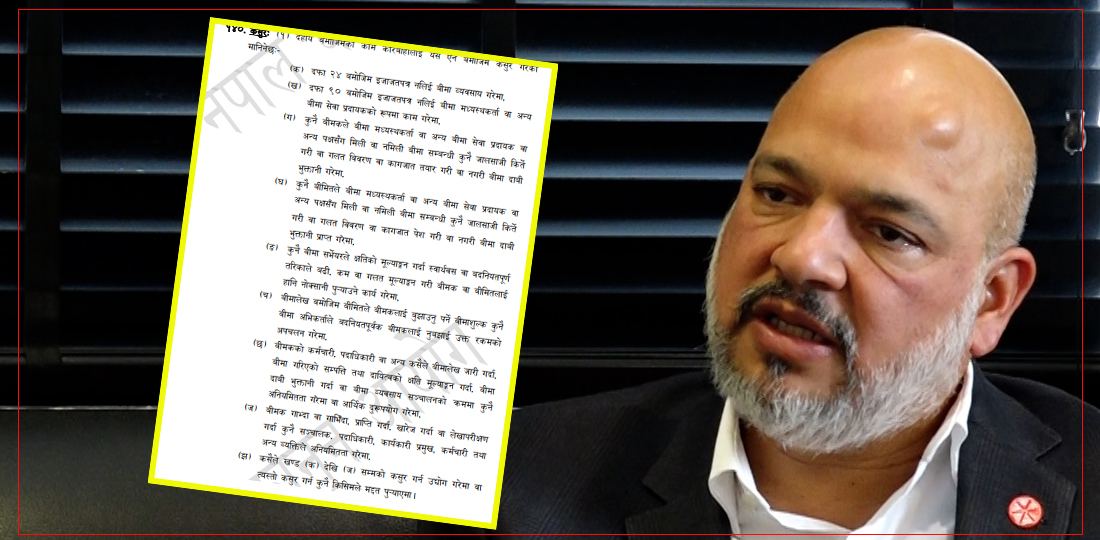
The Insurance Act of 2079 (2022 AD) does not have a provision for demanding bail before arrest, unlike the Securities Act of 2063 (2006 AD). The offenses mentioned in that Act can be investigated and inquired into in accordance with the Criminal Code of 2074 (2017 AD).
The Act also includes a provision for the Insurance Authority to assist investigative bodies in such investigations.
This specific news has been automatically translated by AI. As a result, there may be some inaccuracies or language errors.