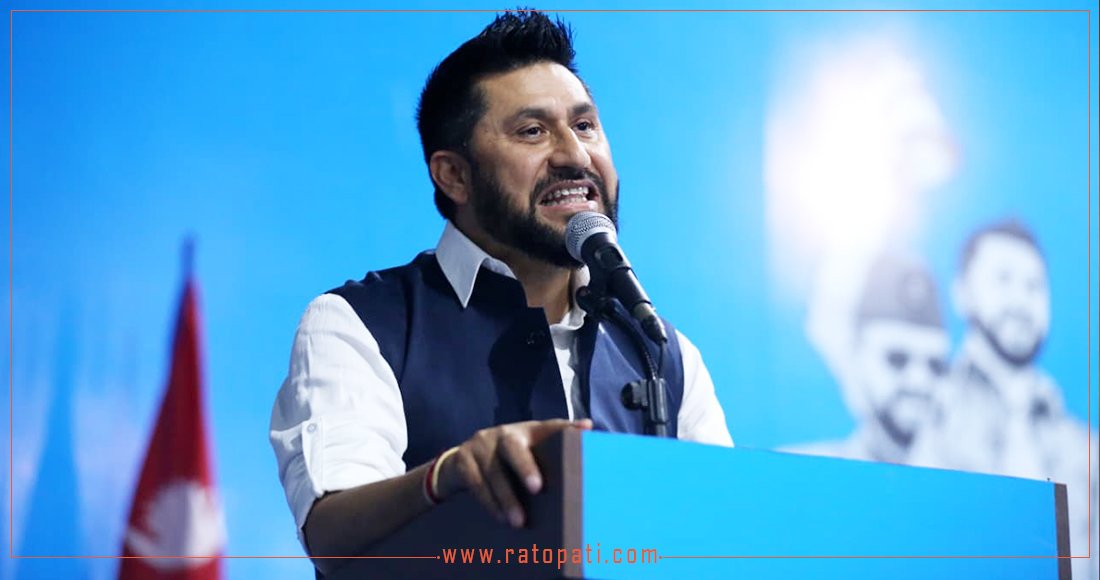
Ravi Lamichhane's Cooperative Fraud Case Hearing Delayed in Supreme Court

Kathmandu. The Supreme Court's 'full bench' has not yet heard the case related to cooperative fraud, organized crime, and money laundering involving former Home Minister and Rastriya Swatantra Party President Ravi Lamichhane. The joint bench of Supreme Court Justices Binod Sharma and Abdul Aziz Musalman had issued an order on Chaitra 15, 2082, sending the case to a full bench for hearing, deeming it necessary to interpret serious constitutional and legal matters. However, the case, which was first scheduled for hearing on Baisakh 10 in the full bench of Justices Nripadhwaj Niroula, Nityananda Pandey, and Shrikant Poudel, was postponed by the Attorney General's Office. On that day, the Attorney General's Office cited a lack of time as the reason for the postponement.
Senior Advocate Surendra Bhandari questioned why the case, placed at number 'Ka' in the full bench's schedule, was prioritized on Baisakh 10. Although the case was postponed that day, he questioned why it was placed in the 'Ka' list when no order for priority had been given. Bhandari raised concerns that prioritizing a case from a few months ago over other cases pending for three years makes the judicial process itself questionable. Generally, cases with priority, habeas corpus, and those related to senior citizens are placed in the 'Ka' or 'Kha' list.
The case was scheduled for hearing for the second time on Thursday (Baisakh 17) in the full bench of Justices Abdul Aziz Musalman, Shrikant Poudel, and Shanti Singh Thapa. In this bench, Justice Abdul Aziz Musalman, who was part of the joint bench earlier, could have recused himself from the case, stating that it involved serious constitutional and legal complexities that necessitated sending it to a full bench. However, the hearing could not take place as lawyers representing Lamichhane requested a postponement.
If the series of postponements continues, the amendment of Lamichhane's case may be prolonged. A legal practitioner mentioned that generally, a case can be postponed up to two times due to illness or other reasons. However, if the hearing is postponed for an extended period, it should be viewed with suspicion, the legal practitioner told RatoPati.
The Supreme Court has taken the decision by the Attorney General's Office to remove serious charges against Lamichhane (especially money laundering and organized crime) from the indictment as a case that needs to establish a 'precedent'.
In the charge sheets filed in various district courts, Lamichhane was accused of cooperative fraud, as well as organized crime and money laundering. However, the Attorney General's Office later amended the charge sheet and decided to remove the claims related to these offenses for Lamichhane. Yuvraj Poudel 'Sufal', Senior Advocate Dinesh Tripathi, and Advocate Abhas Regmi filed a writ petition in the Supreme Court, claiming that the decision was malicious and aimed at weakening the case.
The court has explained why this case needs to be heard by a full bench with three or more judges. Article 158 of the Constitution gives the Attorney General the final authority to prosecute or not prosecute. However, the court seeks to interpret whether the authority to amend the charge sheet after a case has been filed in court is absolute and discretionary or based on objective grounds.
The joint bench, suspecting a misinterpretation of 'additional evidence', indicated that this dispute should be heard by a full bench. According to Section 36 of the Muluki Criminal Procedure Code, the indictment can only be amended if additional evidence is found, but the court has raised the question of whether a request made by Lamichhane himself or any self-declaration can be considered additional evidence in this case.
The court has sent the case to a full bench after seeing the need to interpret whether the case can be withdrawn indirectly. Legally, cases like money laundering and organized crime cannot be settled through compromise or withdrawal. The court needs to interpret whether the removal of serious charges, as claimed by the petitioners, and retaining only 'cooperative fraud' is intended to allow for a future settlement of the case (indirect withdrawal).
See also

This specific news has been automatically translated by AI. As a result, there may be some inaccuracies or language errors.
_fkg5u05PqN.jpg)


_6BsDewPY2j.jpg)